Understand the significance of AI-driven formal proof search in improving precision within mathematical research and discovery.
Transforming Mathematics with AI-Driven Formal Proof Search
Estimated reading time: 6 minutes
Until now, mathematics relied entirely on human intuition and creativity. Mathematicians spent years working through complex problems. As a result, progress moved slowly. But this landscape shifted dramatically in May 2026. We see the rise of AI-driven formal proof search. Researchers at Google DeepMind introduced AlphaProof Nexus. This innovation changes how we approach complex problems and mathematical discovery.
ENTECH STEM Magazine has included this research in its list of Top 10 STEM Discoveries and Innovations of May 2026.
Understanding the Breakthrough in Formal Proof Search
To explain this innovation clearly, we must first understand what formal proofs actually are.
In short, a formal proof is a step-by-step logical argument written in a language that computers can verify automatically.
For the most part, mathematicians traditionally write proofs in natural language. In contrast, formal proofs require absolute precision. Every single step must be correct. In light of this distinction, computers excel at checking these proofs because they never miss errors or typos.
The Core of AI-Driven Formal Proof Search
We have seen computers struggle with complex logic until very recently. They often produced errors or guesses. As a result, mathematicians could not fully trust automated results. At the present time, new AI models change this dynamic.
In effect, AI-driven formal proof search bridges the gap. It combines large language models (LLMs) with formal verification tools. The researchers developed a system using Lean, a specialized programming language for mathematics. What’s more, the system combines large language models with an automated theorem prover called AlphaProof. Take the case of the Lean proof assistant. It ensures every step is logically sound. By all means, the system refuses to accept false logic.
As an illustration, the AI proposes a proof. The system checks it against mathematical axioms. Provided that the logic holds, the proof is accepted. In reality, this eliminates the risk of hallucinations. To put it another way, it brings precision to machine reasoning.
The System’s Remarkable Track Record
As noted, the full-featured agent solved 9 open Erdős problems out of 353 attempted. These are famous mathematical challenges posed by legendary mathematician Paul Erdős. In fact, some of these problems had remained unsolved for 56 years. To put it another way, the system succeeded where human mathematicians struggled for generations.
Beyond Erdős problems, the AI system proved 44 previously unknown theorems from the Online Encyclopedia of Integer Sequences (OEIS). In addition, it resolved open questions in optimization theory and algebraic geometry. At this point, the evidence clearly shows AI’s potential in pure mathematics research.
How AI-Driven Formal Proof Search Improves Efficiency
Another key point is speed. Proving theorems takes months of human labor. At this point, AI automates the grunt work. It scans vast mathematical databases quickly.
In similar fashion, it identifies potential steps. With this purpose in mind, researchers save immense time. They focus on high-level strategy instead. As a result, the pace of discovery increases.
“Formal verification provides the bedrock for trustworthy AI in scientific inquiry.”
To sum up, the synergy between AI and formal logic is powerful. It allows for a higher volume of verified work. To this end, we see more complex theorems solved.
Cost-Effective Problem Solving
What’s more, the system operated at surprisingly reasonable costs. Each Erdős problem solution cost between $200 and $600 in computational resources. By comparison, hiring expert mathematicians for equivalent work would cost vastly more. In consequence, this technology makes research more accessible to institutions worldwide.
Why AI-Driven Formal Proof Search is Essential?
While it may be true that AI is smart, it needs constraints. In contrast to standard chatbots, this system requires formal proof. In other words, it must follow strict rules.
With attention to detail, the AI builds a verifiable chain. Every link must be perfect. As has been noted, this creates a robust mathematical repository.
- Accuracy is guaranteed by the code.
- Verification occurs at every single step.
- Speed allows for rapid testing of new ideas.
By comparison, human proofs remain slow. Together with AI, we achieve a new standard. So long as the code remains valid, the proof is absolute.
How the AI Agents Actually Work
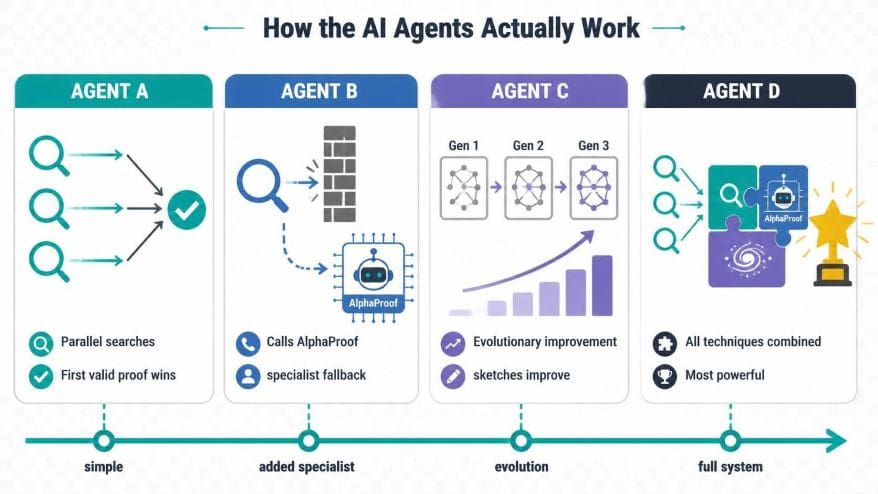
The researchers built four different agent configurations, each with increasing sophistication. The basic agent (Agent A) operated with straightforward simplicity. It created multiple independent search processes simultaneously. After that, the first one to find a valid proof wins. As a result, parallel searching dramatically improved success rates.
Agent B added AlphaProof integration. In this case, when standard proof methods stalled, the system called on AlphaProof for specialized assistance. Agent C introduced evolutionary algorithms. At length, this approach allowed sketches to improve across generations. Finally, Agent D combined everything – evolution, AlphaProof integration, and also sophisticated search strategies. In summary, this “full-featured” version proved most powerful for difficult problems.
The Role of Compiler Feedback
One critical insight: compiler feedback proved invaluable.
After each proof step, the Lean compiler provides immediate results. In like manner, the AI learns from these responses. Together with human intuition, this creates rapid iteration. As a matter of fact, this feedback loop accelerated discovery substantially.
Future Possibilities with AI-Driven Formal Proof Search
At this time, researchers use this for standard tasks. In due time, they will target the toughest open problems. To be sure, this changes the future of STEM education.
In light of this, students might use these tools soon. They will learn to write formal code. To that end, they gain deeper insight into logic.
Summing up, the potential is vast. We are witnessing a shift in scientific methodology. As a matter of fact, the machine becomes a collaborator. To repeat, it is a tool for human progress.
Addressing Limitations and Future Directions
To be sure, the system has clear boundaries. In essence, it performs best in combinatorics, optimization, and number theory. In contrast, fields requiring extensive new theory still challenge the system. As mentioned, Lean’s mathematical library remains incomplete for some domains. Sooner or later, this limitation will diminish as libraries grow.
Another key point concerns hallucinations. At times, the AI proposes false lemmas as established facts. In due time, better verification systems will catch these errors automatically. As has been noted, formal verification already catches many mistakes. With this purpose in mind, researchers continue refining validation processes.
“AI-driven formal proof search can serve not only to solve problems but to deepen human understanding.” — Research Team at Google DeepMind
The Path Forward for Mathematics
To this end, the discovery opens new possibilities for mathematical research. The integration of AI-driven formal proof search is here. In sum, it makes math more accessible. Provided that funding increases, more problems could be tackled. In light of recent successes, universities now invest in AI-mathematics collaborations.
In short, this technology won’t replace human mathematicians. Rather, it amplifies their abilities. As an illustration, the system handles tedious verification steps. Together with this assistance, researchers focus on creative insight and strategic planning.
Additionally, to stay updated with the latest developments in STEM research, visit ENTECH Online. Basically, this is our digital magazine for science, technology, engineering, and mathematics. Further, at ENTECH Online, you’ll find a wealth of information.
References:
- Tsoukalas, G., Kovsharov, A., Shirobokov, S., Surina, A., Firsching, M., Bérczi, G., Ruiz, F. J. R., Suggala, A., Wagner, A. Z., Wieser, E., Yu, L., Huang, A., Horváth, M. Z., Ferraiuolo, A., Michalewski, H., Lockhart, E., Grosu, C., Hubert, T., Balog, M., . . . Chaudhuri, S. (2026). Advancing Mathematics Research with AI-Driven Formal Proof Search. arXiv (Cornell University). https://doi.org/10.48550/arxiv.2605.22763
- Alexeev, B., Putterman, M., Sawhney, M., Sellke, M., & Valiant, G. (2026). Short proofs in combinatorics, probability and number theory II. arXiv (Cornell University). https://doi.org/10.48550/arxiv.2604.06609
- Author
- Latest Posts

Deven Nandapurkar is a Software Engineer, Project Lead; working at the strategic intersection of software engineering, productivity science, and emerging technologies. Driven by a core philosophy of “building things worth building,” he leads cross-functional teams and drives end-to-end technical strategy—from early-stage conceptualization through production-grade deployment.
A Computer Engineering graduate from Pune University, Deven brings a sharp systems-thinking approach to technical leadership, honed by years of managing high-stakes engineering projects and leading teams to top placements in national and international hackathons, including the NASA Space Apps Challenge and the Peerlist GenAI Hackathon.
Deven explores how human cognition and emerging technology converge. He regularly writes about cognitive performance optimization, attention management, AI integration, and the evolving dynamics of the modern workforce – offering actionable frameworks for professionals seeking to maximize their productivity and thrive alongside intelligent systems.