These findings shed new light on wound healing mechanisms and the crucial early steps that help tissues recover
Wound Healing Mechanisms Driven by Rapid-Onset Senescence Signals
Estimated reading time: 5 minutes
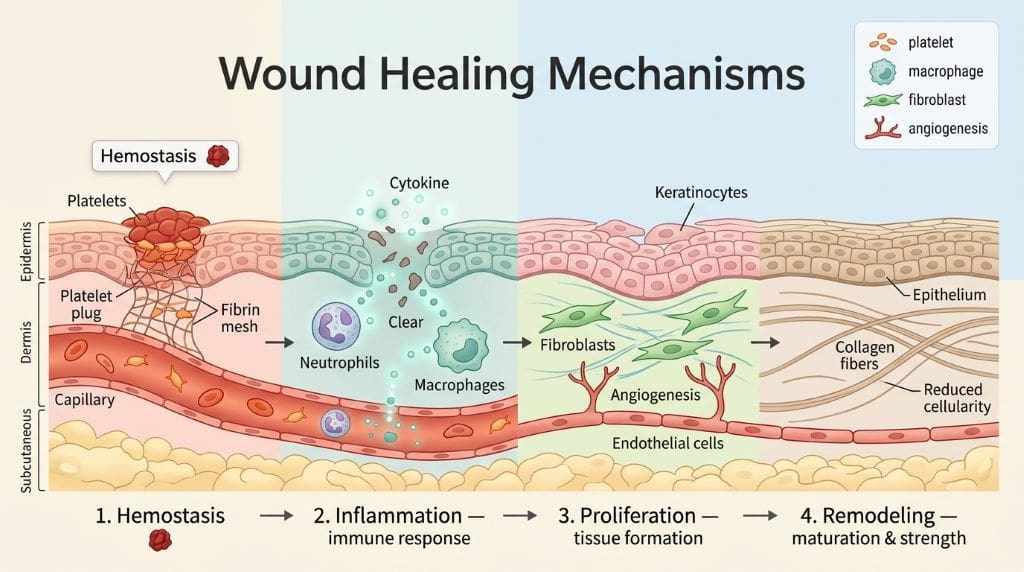
The body begins healing within moments of an injury, yet scientists have uncovered a surprising process that drives this rapid response. Instead of waiting for new gene activity, damaged tissues trigger a fast form of cellular senescence that starts almost immediately. In other words, cells enter a protective state within minutes and help coordinate repair. These findings shed new light on wound healing mechanisms and the crucial early steps that help tissues recover. Meanwhile, this early response limits damage and supports tissue recovery. In addition, researchers found that rapid-onset senescence plays a direct role in wound closure and regeneration. Because of these findings, scientists now view senescence as more than a sign of aging. Rather, it serves as a vital mechanism that helps tissues heal efficiently. Consequently, this discovery offers fresh insights into wound repair and may guide the development of new regenerative therapies.
ENTECH STEM Magazine has included this research in its list of Top 10 STEM Discoveries and Innovations of May 2026.
Key Takeaways: Wound Healing Mechanisms
- What cellular senescence means and why it matters
- How your skin uses old mRNA to heal faster
- Why blocking this process slows down healing
- How this discovery connects to your biology class
What Is Cellular Senescence?
For many years, researchers mainly connected cellular senescence with aging and Wound Healing Mechanisms, tissue decline, and cancer prevention. Because senescent cells no longer divide, many scientists viewed them as harmful cells that accumulated over time. In recent years, however, research has revealed a more complex picture. Studies have shown that senescent cells can also perform useful functions, especially during tissue repair.
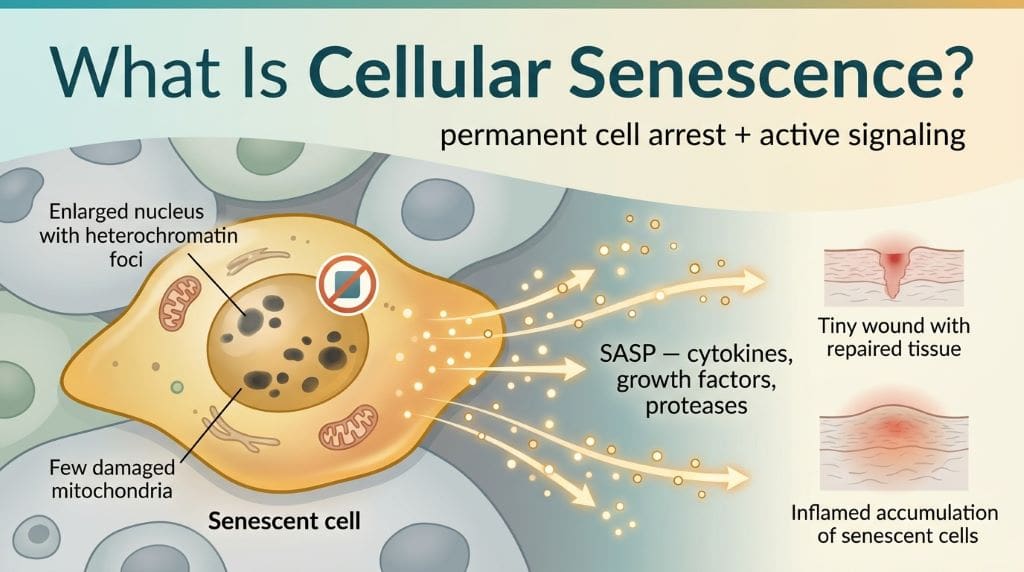
For example, senescent cells found near wounds help coordinate the healing process. Rather than dividing, these cells release signaling molecules that communicate with nearby cells. In turn, these signals attract repair cells, regulate inflammation, and support tissue regeneration. As a consequence, wounds can heal more efficiently.
What Does a Senescent Cell Actually Do?
During wound healing mechanisms, a senescent cell performs several important functions that help damaged tissue recover. First, the cell permanently stops dividing. By doing so, it prevents the uncontrolled spread of stress signals and reduces the risk of abnormal cell growth.
In addition, the senescent cell releases a variety of signaling molecules known as senescence-associated secretory phenotype (SASP) factors. These molecules send clear instructions to nearby cells and help coordinate the repair process. For instance, they can attract immune cells, regulate inflammation, and stimulate tissue remodeling.
Meanwhile, senescent cells also support cell migration. As healthy cells move toward the injured area, they replace damaged tissue and help close the wound. Consequently, the wound heals more efficiently and tissue structure is restored. Taken together, these activities show that senescent cells play an active role in guiding and supporting tissue repair rather than simply remaining inactive.
How Cells Heal Without Writing New Instructions: The mRNA Shortcut
This discovery connects key concepts from both biology and chemistry. Under normal conditions, a cell produces a protein through a two-step process. First, it transcribes DNA into messenger RNA (mRNA). Next, the cell translates that mRNA into a protein. Because these steps require time and resources, the process does not provide an immediate response to sudden injury.
However, the 2026 study by Valdivieso and colleagues revealed a much faster wound healing mechanism. Instead of creating new mRNA molecules after tissue damage, skin cells use mRNA that already exists inside the cell. In other words, the cells rely on stored genetic instructions rather than producing new ones.
The researchers identified p21, a protein encoded by the Cdkn1a gene, as a critical component of this response. Before injury occurs, Cdkn1a mRNA remains stored within the cell nucleus. During this period, nuclear export inhibitors prevent the mRNA from entering the cytoplasm, where protein production takes place.
Once an injury occurs, these inhibitory controls are rapidly removed. Consequently, the stored Cdkn1a mRNA exits the nucleus and moves into the cytoplasm. There, cellular machinery immediately translates the mRNA into p21 protein. Within minutes, p21 levels rise and trigger rapid-onset senescence. As a result, cells quickly enter a repair-supporting state that helps coordinate wound healing mechanisms. This mechanism allows tissues to respond to damage with remarkable speed because the necessary instructions are already prepared before the injury takes place.
Cell Types Involved in Rapid-Onset Senescence During Tissue Repair
- Epithelial Cells
Epithelial cells located near the wound healing mechanisms respond almost immediately to tissue damage.
Following injury, these cells enter a senescent-like state within minutes.
In turn, they release signaling molecules that help coordinate the healing response and guide nearby cells.
- Fibroblasts
Fibroblasts play a central role in rebuilding damaged tissue.
In addition, they produce extracellular matrix proteins, including collagen, which provide structural support for wound repair.
Through these activities, fibroblasts help restore tissue strength and integrity.
- Immune Cells
Immune cells rapidly migrate to the injured area once tissue damage occurs.
During this process, they remove dead cells, pathogens, and cellular debris from the wound site.
Consequently, the wound environment becomes more suitable for tissue repair and regeneration.
- Neighboring Tissue Cells
Cells surrounding the wound actively communicate with epithelial cells, fibroblasts, and immune cells.
Meanwhile, these interactions help regulate cell movement, tissue remodeling, and repair activities.
As a result, damaged tissue regains its normal structure and function more efficiently.
- Coordinated Cellular Response
Together, epithelial cells, fibroblasts, immune cells, and neighboring tissue cells form a highly organized repair network.
Frequently Asked Question
What are wound healing mechanisms?
Wound healing mechanisms are the biological processes that repair damaged tissue after an injury. These processes involve cell signaling, inflammation control, tissue regeneration, and wound closure.
What is rapid-onset senescence?
Rapid-onset senescence is a fast cellular response that occurs within minutes of tissue injury. During this process, cells stop dividing and begin supporting tissue repair through signaling activities.
How does rapid-onset senescence help wound healing?
Rapid-onset senescence helps coordinate tissue repair by releasing signals that guide neighboring cells, regulate inflammation, and promote wound closure.
Reference:
- Valdivieso, K., Rozmaric, T., Victorelli, S. et al. Transcription-independent induction of rapid-onset senescence is integral to healing. Nat Cell Biol (2026). https://doi.org/10.1038/s41556-026-01948-2
- Author
- Latest Posts

I completed my Master of Science from the University of Allahabad in 2017 with a strong academic background in life sciences and chemistry. My specialization included Molecular Biology, Microbiology, Genetics, Plant Breeding, Phycology, Paleobotany, and Bioinformatics, along with Organic Chemistry, Inorganic Chemistry, and Physical Chemistry. This multidisciplinary training provided me with a comprehensive understanding of biological systems and analytical scientific approaches.
After completing my postgraduate studies, I gained valuable professional experience in both the education and social development sectors. I worked at A.M. Oxford Public School, where I was actively involved in guiding students toward academic excellence. In this role, I focused on creating an engaging learning environment, encouraging critical thinking, and nurturing students’ curiosity for scientific learning. My experience as an educator strengthened my communication, mentoring, and classroom management skills.
In addition to my teaching experience, I worked with Jeevan Jagriti Foundation, where I contributed to community-based initiatives aimed at improving educational access and awareness among underprivileged sections of society. Through this work, I participated in programs designed to support social development and promote the value of education in marginalized communities.
These professional experiences helped me develop strong interpersonal, leadership, and organizational skills while reinforcing my commitment to education and community service.