Prime editing offers a powerful way to correct genetic mutations with high precision. Even so, unstable prime-editing guide RNAs (pegRNAs) often limit its success. In response to this challenge, researchers used directed evolution to discover…
Prime Editing Gene Advances with RNA-Stabilizing Motifs
Estimated reading time: 6 minutes
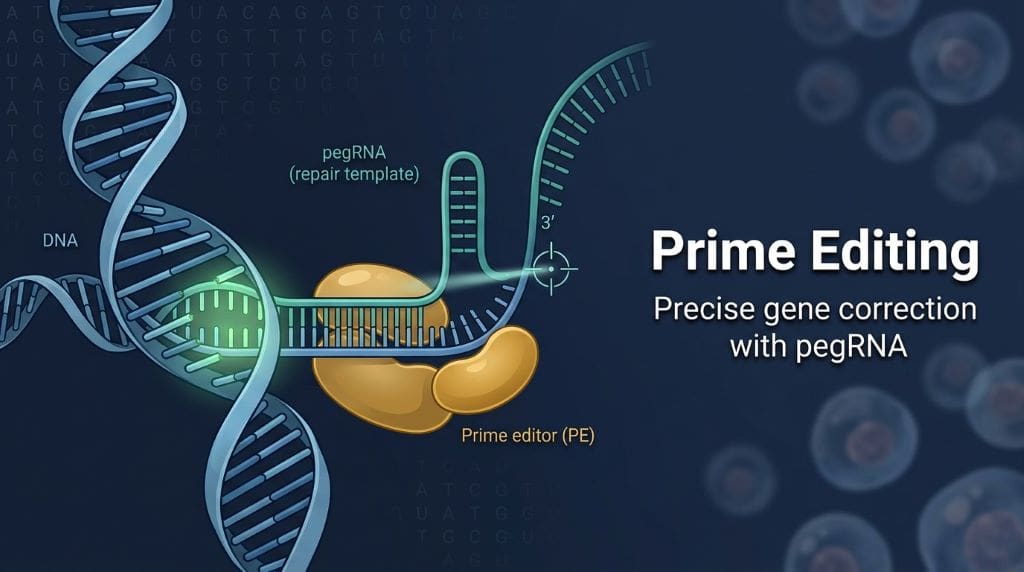
Prime editing offers a powerful way to correct genetic mutations with high precision. Even so, unstable prime-editing guide RNAs (pegRNAs) often limit its success. In response to this challenge, researchers used directed evolution to discover small RNA-stabilizing motifs that protect pegRNAs from degradation. Through a carefully designed screening strategy, they identified motifs that markedly increased RNA stability and boosted editing efficiency across multiple targets. In addition, these engineered motifs improved the accuracy of gene correction without adding extra complexity to the editing system. Consequently, this breakthrough brings prime editing closer to practical applications in biomedical research and future gene therapies.
ENTECH STEM Magazine has included this research in its list of Top 10 STEM Discoveries and Innovations of May 2026.
Key Takeaways: Prime Editing Gene
- Prime editing is a gene-editing method that can fix small DNA errors with high accuracy.
- The process relies on pegRNAs, which guide the editing machinery to the correct DNA site.
- However, pegRNAs often break down quickly, which can reduce editing success.
- To solve this problem, researchers used directed evolution to find stronger RNA-stabilizing motifs.
- These improved motifs helped pegRNAs last longer and work more effectively.
- The new design increased prime-editing efficiency across many genetic targets.
- Researchers tested the system on disease-related mutations and saw better correction rates.
- The enhanced motifs improved editing in more than 90% of the disease variants examined.
- The findings provide a simple way to make prime editing more reliable and powerful.
- This advance may support the development of treatments for thousands of inherited genetic disorders.
What Is Prime Editing Gene – And Why Does It Matter?
Imagine your DNA as a huge instruction book that tells your body how to grow and function. In some cases, a single wrong letter appears in that book. Even one small error can lead to serious genetic disorders such as sickle cell anemia or cystic fibrosis. For many years, scientists relied on CRISPR tools that cut DNA to repair these mistakes. Even though this method can work, DNA cuts may create unwanted changes.
In contrast, prime editing offers a more precise solution. Instead of cutting DNA, it works like the “find and replace” feature in a word processor. The system locates the incorrect DNA letter and replaces it with the correct one. Because of this approach, prime editing can make targeted changes with greater accuracy.
To perform this task, prime editing depends on a specialized molecule known as a prime-editing guide RNA, or pegRNA. This molecule directs the editor to the exact location in the DNA. In addition, it carries the genetic instructions needed for the correction. As the process unfolds, the pegRNA helps ensure that the desired change occurs at the right site. Despite these advantages, researchers faced a major obstacle. The pegRNA molecules often broke down before they could complete their job, which limited the overall efficiency of prime editing.
The Problem: pegRNA Breaks Down Too Fast
RNA is a delicate molecule that can break down quickly inside cells. Cells contain enzymes known as exonucleases, which continuously degrade RNA molecules. Because of this activity, the pegRNA used in prime editing faces a major challenge. The tail region of the pegRNA, which carries the genetic correction, is especially vulnerable to damage. When this section degrades too soon, the editing process cannot proceed efficiently.
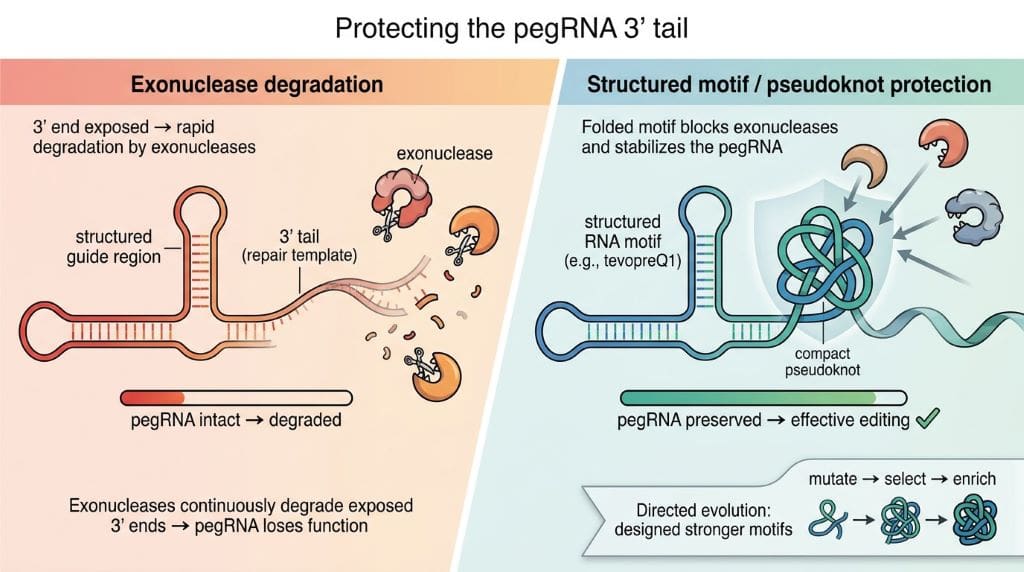
More specifically, the 3′ end of the pegRNA is the weakest part of the molecule. Since this region extends beyond the main RNA structure, exonucleases can easily access and digest it. Consequently, many pegRNAs lose their function before they deliver the intended genetic change. In turn, prime-editing efficiency drops considerably.
To address this problem, researchers searched for ways to protect the exposed RNA tail. One promising solution involved structured RNA motifs. In simple terms, an RNA motif is a short sequence that folds into a stable three-dimensional shape. When attached to the 3′ end of a pegRNA, the folded structure acts as a protective barrier that blocks exonuclease attack.
Earlier studies identified a useful motif called tevopreQ1. This motif forms a compact pseudoknot structure at the 3′ end of the pegRNA. Due to its stable shape, the pseudoknot helps shield the RNA from degradation and improves pegRNA survival inside cells. Even so, the level of protection remained limited. For this reason, researchers explored new strategies to create stronger and more effective RNA-stabilizing motifs. To achieve this goal, they turned to the powerful technique of directed evolution.
How Directed Evolution Found Better RNA Shields
Directed Evolution Helps Find Better RNA Motifs
Directed evolution uses the same basic idea as natural selection. Scientists create many versions of a molecule and then test them. Next, they keep the versions that work best. Then, they improve those top performers through additional testing.
In this study, researchers created a screening system called PE-PRISM. This tool helped them find RNA motifs that could protect the 3′ end of pegRNAs in human cells. Using PE-PRISM, the team tested 2,858 different RNA motifs. The collection included natural pseudoknots, engineered RNA structures, and G-quadruplex motifs.
Following this step, the scientists completed four rounds of screening. During each round, they measured how well every motif protected the pegRNA and improved prime editing. Only the strongest motifs moved forward. Meanwhile, weaker candidates were removed from the study.
The process worked much like a large tournament with nearly 3,000 competitors. Each motif competed to provide the best protection. With each round, the number of candidates became smaller, while the quality of the remaining motifs improved.
In addition, the team used structure-guided mutagenesis to make better motifs more quickly. They studied the three-dimensional shapes of the best performers. Next, they introduced small and precise changes to improve their function. This method helped the researchers focus on the most promising designs.
Through repeated testing and careful optimization, several motifs showed clear advantages. Ultimately, three evolved pseudoknot variants stood out from all others: tevo2.0, eHAV, and eSBRMV1-A. These motifs provided the strongest protection for pegRNAs and delivered the best prime-editing performance in the study.
Frequently Asked Questions
What is prime editing in simple words?
Prime editing is a gene-editing method that can fix a wrong DNA letter. It finds the error and replaces it with the correct letter. Much like the “find and replace” feature in a text document, it makes precise changes to the DNA sequence. Unlike many other gene-editing tools, prime editing does not cut the DNA strand.
What is a pegRNA?
A pegRNA is a special RNA molecule used in prime editing. It leads the prime editor to the exact place in the DNA that needs to be changed. In addition, it carries the correct genetic sequence that will replace the faulty DNA code. This guidance helps the prime editor make accurate changes at the target site.
What are tevo2.0, eHAV, and eSBRMV1-A?
These three RNA motifs were the top performers identified by the PE-PRISM screening platform. They protect the tail end of the pegRNA from degradation, helping the molecule remain stable for a longer time inside cells. As a result, they increased prime-editing efficiency in more than 90% of the disease-correction tests evaluated in the study.
Reference:
- Sakai, H.A., Pierce, S.E., Jiang, A.Y. et al. Directed evolution of small RNA-stabilizing motifs that improve prime-editing efficiency. Nat Biotechnol (2026). https://doi.org/10.1038/s41587-026-03123-2
Editorial Note: This article was written by Rakshanda Jabbar and reviewed for editorial accuracy by our editorial team. It has not yet undergone independent review by a professional.
- Author
- Latest Posts

I completed my Master of Science from the University of Allahabad in 2017 with a strong academic background in life sciences and chemistry. My specialization included Molecular Biology, Microbiology, Genetics, Plant Breeding, Phycology, Paleobotany, and Bioinformatics, along with Organic Chemistry, Inorganic Chemistry, and Physical Chemistry. This multidisciplinary training provided me with a comprehensive understanding of biological systems and analytical scientific approaches.
After completing my postgraduate studies, I gained valuable professional experience in both the education and social development sectors. I worked at A.M. Oxford Public School, where I was actively involved in guiding students toward academic excellence. In this role, I focused on creating an engaging learning environment, encouraging critical thinking, and nurturing students’ curiosity for scientific learning. My experience as an educator strengthened my communication, mentoring, and classroom management skills.
In addition to my teaching experience, I worked with Jeevan Jagriti Foundation, where I contributed to community-based initiatives aimed at improving educational access and awareness among underprivileged sections of society. Through this work, I participated in programs designed to support social development and promote the value of education in marginalized communities.
These professional experiences helped me develop strong interpersonal, leadership, and organizational skills while reinforcing my commitment to education and community service.