Explore how AI Search is transforming online information retrieval with direct answers instead of traditional links.
Structuring Websites for AI Search: How Retrieval and Entity Clarity Are Changing Web Development
Estimated reading time: 8 minutes
AI Search Engines are changing how people find the information they want on the Internet. ChatGPT, Gemini, Perplexity, and Claude are answering questions directly, instead of giving the user a series of blue links. You ask a question and are given a straight answer with an explanation, and potentially a source or two next to it, either in the explanation or with a link. That change has serious implications for any business that wants to build or maintain a website.
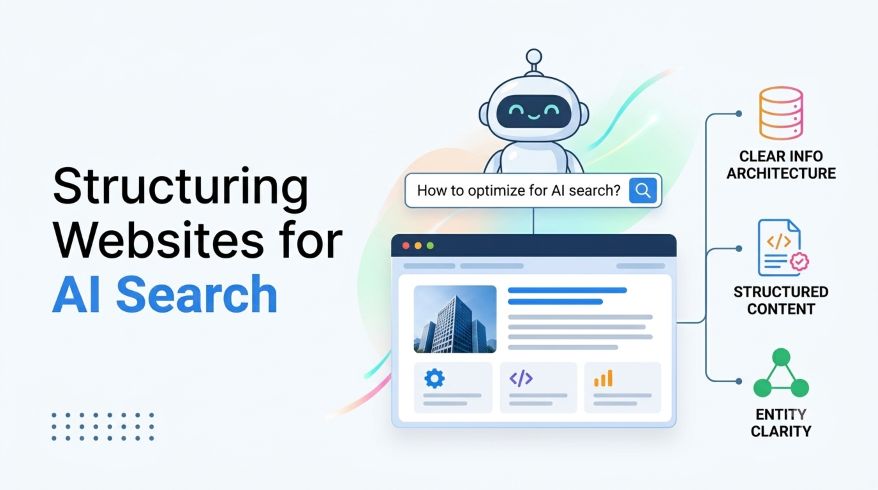
Traditional keyword optimization alone isn’t enough anymore, especially when you want to rank a page for a phrase. Websites too must be structured accordingly now so that artificial intelligence systems can retrieve, interpret, and trust the information. It’s less about chasing a new algorithm and more about rethinking how content should be well-organized from the ground level so search engines and AI models alike can make sense of it. In this guide, we’ll cover why structuring websites for AI search matters and how an AI development company can help.
How AI Search Is Disrupting Website Development
Traditional search is largely about keywords, ranking pages,s and waiting for a user to click through that link. AI search engines aren’t the same. It tries to understand the intent of the content, finds the most relevant passages from all over the web and produces an answer, often with the source of the answer given; where that answer came from.
This shifts the definition of visibility in business. It’s not just about getting a website to page one anymore; it’s whether an AI system understands your content well enough to use it in an answer. Gartner predicts that traditional search engine use will decrease by 25 percent by 2026 as more and more users turn to AI chatbots and virtual agents for answers.
That is, how much of the content is machine-readable, checkable and structured so as to make the sense clear? Website architecture now does two things: It serves human visitors and is compatible with artificial intelligence systems at the same time.
Also Read: How Smarter Technology Is Reshaping Website Content?
Understanding Retrieval in Modern AI Search Engines
Most AI search tools are built with a process called retrieval-augmented generation, or RAG. In simple terms, that means the AI doesn’t just come up with some random answer out of its existing memory, but rather it searches a large database of content and then pulls out the most relevant bits. This is all about information retrieval, semantic search and vector databases, which transform content into numerical patterns that encode meaning and not just the exact words.
The usual procedure is as follows. First, AI crawls web content and extracts important entities. It then converts that content into embeddings, matches it to a user’s intent and extracts the most relevant passages. Then it makes a reply of what it found.
Poor website structure may interfere with almost every stage of this process. Most crawlers can’t process important data embedded in images. AI has no idea what to do with generic headings. Similarly, pages that are not well-structured, lack page context, or use non-uniform terminology present significantly more challenges to the retrieval system when attempting to identify the passage of interest with confidence. The underlying architecture can become complicated, and excellent content can be wasted.
Also Read: Create Multi-Channel Content Variations Automatically with AI
AI-Search-Optimized Website: Key Elements
AI search is the future of web design. It’s moving the web away from a static repository of pages ranked by keywords to a space of synthesised, conversational answers. In general, AI agents will likely alter the manner in which interactions occur. All these issues impact the way developers design, optimise and build modern websites.
- AI agents are beginning to surf the web and interact directly with different websites. This means filling out forms, comparing options, and doing tasks. The bar for clean, predictable markup is even higher than if you were just catering for a human visitor.
- Generative search experiences will generate even more answers before the user even lands on a website.
- In fact, knowledge graphs are quickly becoming a standard layer of technical SEO, as businesses start to code in the entities and relationships already implied in their content.
- Headless architectures are the new normal for organisations looking to scale content without sacrificing consistency, shifting away from flat page-by-page publishing to structured content systems.
- Entity-first architecture, building a site around what it represents rather than a list of pages, will likely shift from being a differentiator to becoming the baseline expectation.
Creating Content for AI Retrieval Rather Than Traditional Ranking
AI retrieval systems will always favor information that uses clear definitions, conciseness, proper formatting of sections, questions and answers, and statements that are supported by facts. This shift also makes it important for businesses to understand the three visibility strategies shaping search in 2026, particularly as traditional SEO increasingly overlaps with AI-focused approaches.
Dedicated definition sections, process breakdowns, comparison tables, FAQs, how-tos and real-world industry examples are some of the content formats that work really well today. These formats are very easy for artificial intelligence systems to retrieve and trust, as they give them clean, self-contained information.
1. The Influence of Semantic Relationships on AI Visibility
Artificial intelligence systems don’t simply look at isolated keywords. They even map connections between different concepts. One straightforward chain of relations could be: The AI development company offers generative AI development. This is for the healthcare industry, using large language models, to automate the odds of clinical documentation
Content that demonstrates these links tends to have more topical authority, better contextual understanding, and more opportunities to be retrieved, as the artificial intelligence can see how one piece of content relates to the next rather than analysing each page in isolation.
2. Technical Website Considerations for AI Search
The technical base still counts for a website, though both structure and semantics matter. Crawlability, however, depends on clean XML sitemaps, well-managed robots.txt files and clean URLs.
Artificial intelligence systems can generally access and process a page of a website based on the page’s performance, like strong Core Web Vitals, fast load times and mobile responsiveness. In 2025, more than 60% of the world’s web traffic will be mobile. That makes mobile performance and accessibility a basic necessity, not an optional enhancement.
Contextual links and structured internal linking through topic clusters help to strengthen the relationship of entities across the site. Accessibility of content also means actually being able to read the content in the first place. HTML that can be read and information-based text is preferred to content heavy in images.
Also Read: How to Build the Right Infrastructure for AI, at Scale?
AI Search and the Future of Web Design
AI search is the future of web development, changing the web from a static place of keyword-ranked pages to a place of conversational, synthesised answers. Overall, AI agents are expected to change the way that interactions happen. All these issues affect how developers design, optimise and build modern websites.
- AI agents are beginning to surf the web and interact directly with websites. This means filling out forms, comparing options, and doing tasks. The bar for clean, predictable markup is even higher than if you were just catering for a human visitor.
- Generative search experiences will generate even more answers before the user even lands on a website.
- In fact, knowledge graphs are quickly becoming a standard layer of technical SEO, as businesses start to code in the entities and relationships already implied in their content.
- Headless architectures are becoming the norm as organisations look to scale content without losing consistency, replacing flat page-by-page publishing with structured content systems.
- Entity-first architecture, designing a site around what it represents rather than a list of pages, is likely to move from being a differentiator to becoming the baseline expectation.
How Can an AI Development Company Help Businesses Get Ready for AI Search
Many businesses are looking to an experienced and skilled AI development company to provide them with structured support in this transition. They assist with:
- Identifying current visibility gaps: what content is findable, what is not and why.
- Building content structures that mirror how AI models understand meaning in practice, down to the page hierarchy and individual headings.
- Mapping organisations, services, industries, and technologies, and the relationships between them to increase relevance to topics and context
- Schema markup is applied to organization, service, product, FAQ and article to make the information more readable to machines.
- RAG-friendly content patterns optimised for precise citation (e.g., definitions, comparisons, FAQs, and step-by-step guides).
In addition to core services, support may involve working with clients to develop more holistic AI discoverability tactics that incorporate both technical and content aspects, establishing authority signals by creating reliable, well-sourced content, improving retrieval accuracy to enable AI tools to more accurately identify businesses, and preparing a digital presence for the future as search continues to evolve.
Conclusion
It’s not just places for human visitors to go; AI is a great way to communicate knowledge for modern systems. Investing in clear entity structures, retrieval-friendly content architecture and machine-readable information successfully gives companies the chance to secure a better position and remain discoverable as AI-driven search continues to evolve in the coming years.
Ultimately, building for AI search is about making information more accessible and easier to verify and find at scale. That is where a good AI development company can make a difference. AI tools that understand the business can help it grow digitally in the long run, along with credibility and brand value.
Reviewed by Satish Kulkarni on October 18, 2026Edited by Mohini Modak
The article examines how website structure, semantic relationships, and technical SEO influence content retrieval in AI-powered search systems. It discusses concepts such as retrieval-augmented generation (RAG), entity-based architecture, structured data, and content accessibility, outlining their relevance to AI search visibility.
Note: The article includes external links to third-party services; readers should independently evaluate any referenced platforms before engaging.
- Author
- Latest Posts

I am Anvita Kashikar, a Computer Engineering graduate with Honors in Data Science, specializing in Artificial Intelligence and Machine Learning. My academic and research interests lie in Artificial Intelligence, Machine Learning, Deep Learning, Explainable AI, Optimization Techniques, and Data Science. I am particularly passionate about leveraging AI to address complex challenges in healthcare, finance, and drug discovery.
My work is grounded in a strong foundation of mathematics, optimization, and computational intelligence. I have contributed to the development of book chapters on topics including Dijkstra’s Algorithm, Necessary and Sufficient Conditions, Saddle Point Theory, Information Entropy, Taylor’s Series, Classification and Applications of Eigenvalues and Eigenvectors, MaxOne Problem, Topology Optimization, and Sensitivity Analysis. These contributions reflect my interest in the mathematical and optimization principles that underpin modern AI systems.
I have also been actively involved in research exploring emerging applications of Artificial Intelligence and Machine Learning. My research work includes studies on interpretable deep learning using Kolmogorov-Arnold Networks (KANs) for tabular data, AI-driven drug discovery and development, and generative optimization techniques for accelerating pharmaceutical research. Several of these research papers and book chapters have been published, while others are currently under review or in various stages of the publication process.
Through my academic and research endeavors, I strive to bridge theoretical concepts with practical applications, contributing to the development of transparent, efficient, and impactful AI solutions. As an early-career researcher, I am committed to continuous learning, interdisciplinary collaboration, and advancing the responsible use of Artificial Intelligence to address real-world challenges and create meaningful societal impact.