Munich researchers packed a camera, a light sensor, and thermometers into a temporary bone-cement knee implant, which kept working under load and sent data from a pig for about six days.
A sealed phone case protects a phone but reveals nothing about the screen. Doctors treating an infected knee implant face a similar blind spot. Now, a smart knee spacer from Munich offers a steady view from within the joint. Nguyen Bach Tran, Oliver Hayden, and colleagues built it at the Technical University of Munich. Their team joins the Heinz-Nixdorf-Chair of Biomedical Electronics with TUM University Hospital. Orthopedic surgeons from the hospital’s orthopedics department also took part. Together, they placed a camera, a light sensor, and thermometers inside medical bone cement. A motion sensor joined them in the same small block. As a result, the temporary implant carried load and sent readings wirelessly. The group described the device in Frontiers in Bioengineering and Biotechnology on November 5, 2026. Even so, the work remains an early engineering test in one pig. It reports no human results.
Millions of people receive artificial knees, and most work well for years. Sometimes, however, bacteria settle around the new joint and cause stubborn infection. Doctors call this a periprosthetic joint infection, meaning infection around an implant. The usual fix takes two operations instead of one. To begin with, surgeons remove the infected joint. They fit a temporary block made of antibiotic bone cement. Next, they wait, usually two to six weeks, while the antibiotics work. Only then do surgeons place a new permanent joint. On the one hand, this plan succeeds for many patients. Doctors, on the other hand, judge timing mainly from swelling, redness, and blood tests. Those clues lack precision. The TUM BoneSens project page states the central question plainly. In short, when can the spacer period end and the final joint go in?
A smart knee spacer has to survive heat and pressure
Putting electronics inside bone cement sounds simple, but the cement fights back. As liquid cement hardens, a chemical reaction releases a lot of heat. In fact, curing can push the temperature above 70 °C. That is roughly twice normal body temperature, and heat can damage delicate chips. At the same time, the spacer must hold a leg’s weight during walking. Space inside stays tight, because the block is only a little larger than a matchbox. On top of that, no wire or circuit may touch blood or tissue. A battery must last through weeks of treatment. Radio signals must also pass through cement and flesh. Finally, nobody yet knows which readings truly show that infection has gone. Because of these hurdles, the authors framed their study as a feasibility test. In other words, they asked whether the device could work at all.
How the smart knee spacer works: a plain-language explainer
Bone cement here means PMMA, a hard plastic that surgeons mix like dough. Shatterproof windows and display cases use the same plastic family. A spacer is a temporary block that fills the gap left by the removed joint. It keeps the leg at the right length, and its antibiotics fight nearby germs. For this smart knee spacer, the team kept the cement mold surgeons already use. However, they first sealed the circuit board inside medical-grade epoxy, a tough resin. This shell acts like a raincoat for the electronics. After that, they poured cement around the sealed board inside the mold. A clear dome over the camera stays open to the joint. That way, the lens can look at the tissue around the implant. The full open-access paper shows each molding step with diagrams.
Camera, light sensor, and thermometers sit inside the cement
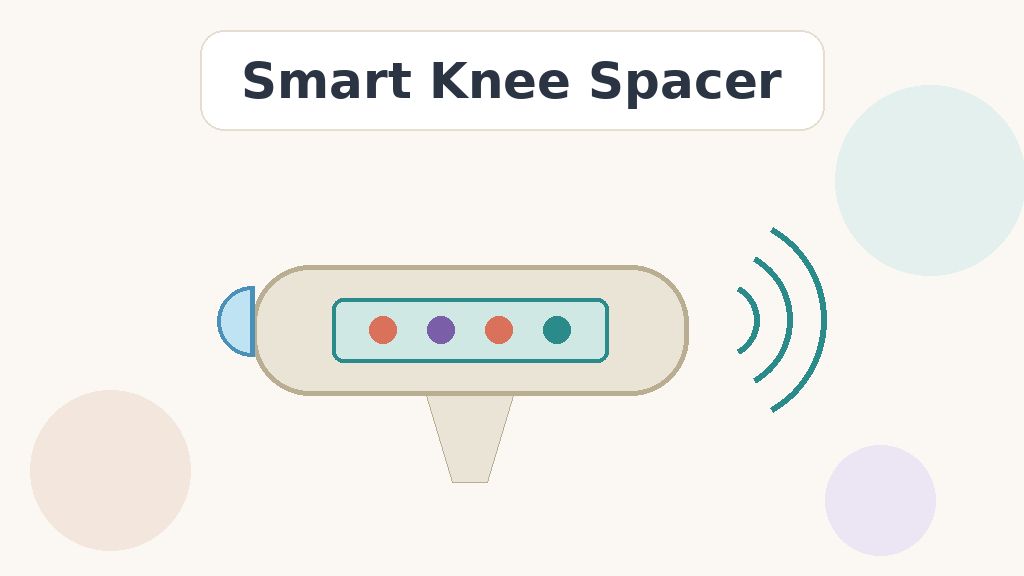
Each sensor inside the block answers a different question about the joint. A tiny camera photographs the soft lining of the knee, the synovial membrane. Meanwhile, a spectrometer measures how much light of each color bounces back. Think of it as a prism sorting reflected light into rainbow colors. To save energy, it borrows the camera’s small lamp rather than its own. Three digital thermometers track small temperature changes in the joint. Inflamed tissue often runs warmer, so these readings could matter later. In addition, a motion sensor notes how the knee bends and tilts. With its help, the device takes pictures at the same knee position each time. Not only does this keep images comparable, but it also eases trend reading. A magnetic switch lets staff turn the device off from outside. The same switch can also reset it after a fault.
Fig. 1: Heat, Pressure, And Pilot Test Results
Bluetooth Low Energy carries the readings out
Once sensors collect data, the readings still need a way out of the body. For this job, the team chose Bluetooth Low Energy radio. This radio is a power-saving cousin of the link in wireless earbuds. It sends small packets of data in short bursts, so the battery drains slowly. A mobile app displays images, color spectra, temperatures, and knee positions for doctors. ENTECH has covered a battery-free smart floor tile that uses a related radio idea. Inside a knee, though, the signal must pass through cement, skin, and muscle. Those layers weaken radio waves, much as thick walls weaken home Wi-Fi. For this reason, steady wireless contact counts as a real achievement here. Still, the paper did not measure signal strength or range. It also did not count how much data went missing.
What the tests on the sensorized knee spacer showed
The first test asked a basic question about heat. Would the electronics survive the cement’s curing reaction? To find out, the built-in thermometers logged conditions while the cement hardened. In this case, the peak reached about 75 °C. That is close to the heat of freshly poured tea. Even so, the camera, spectrometer, thermometers, and motion sensor all kept working. The smart knee spacer, therefore, handled this hot curing step. Its epoxy shell and careful choice of parts made the difference. The team also checked the casting for flaws. In particular, cement fully wrapped the board with no visible air pockets. A silicone cap shielded the camera dome during molding, so the lens stayed clear. Good printed circuit board design means little if casting cracks the part. Here, the casting held.
Repeated pressing without cracks
Next, the team tested whether the sensor-packed knee spacer could handle walking-like pressure. Engineers call this cyclic loading, which means pushing on a part over and over. A testing machine pressed the sensor side of the spacer 300,000 times. According to the authors, that many presses resembles about three months of walking. In other words, it covers more than twice the longest six-week spacer period. Each press reached 400 newtons, roughly the weight of a forty-kilogram sack. That force sits well below a standard value for permanent knee parts. Spacer patients use crutches, so their knees carry less weight. As a result of this test, the spacer showed no cracks. It never stopped sending data either. The sensor version, however, flexed slightly more than a plain cement spacer. Both changes stayed tiny, far thinner than a human hair.
Fig. 2: Layers That Protect The Sensor Board
Six days of data from a single pig
Finally, surgeons implanted the device in the right knee of one female pig. A pig’s knee closely resembles a human knee in size and shape. In fact, this 74-kilogram animal’s knee matched the smallest human spacer size. The team also placed bacteria in the joint to mimic an infected implant. For 148 hours, or about six days, the SmartSpacer implant streamed data without a break. It took pictures and color spectra every ten minutes. Temperatures arrived every minute, about ten times as often. At first, blood from surgery clouded the camera’s view. After about six hours, though, the images grew steadily clearer as bleeding eased. Meanwhile, the lining of the joint became easier to see. Even so, the authors compared no reading with an outside thermometer. Nor did they test whether any reading revealed the infection.
Limits and next steps for the SmartSpacer implant
Careful reading matters here, because the study answers engineering questions, not medical ones. It shows that sensors can survive inside a working cement spacer. Yet it does not show that they can diagnose infection or confirm a cure. The authors’ discussion section lists several open tasks. For example, the team must still link readings to lab tests for bacteria. They also need proof that the battery lasts six weeks, rather than six days. Sterilization, safe factory production, and approval by regulators remain future steps too. Blood or bacterial film could later coat the camera window and blur it. The sensors also leave less room for antibiotic cement. As a result, drug release from the spacer needs fresh checks. Finally, two authors appear as inventors on a related patent application.
Careers where electronics meet orthopedic surgery
Projects like this need people who speak several technical languages at once. Biomedical electronics engineers design tiny circuits that sip power inside the body. Similarly, materials scientists choose coatings such as epoxy and test cement behavior. Orthopedic surgeons judge whether a device fits real operations and patients. Test engineers run long loading trials, and regulatory specialists guide safety paperwork. ENTECH’s story on a scoliosis screening suit shows wearable sensors supporting spine care. In contrast to that wearable approach, this device works from inside the joint. Students who enjoy physics, biology, and coding together may find this field rewarding. At present, though, the study reports no new jobs or market figures. Any business value depends on future proof that the readings help patients. Until then, the career story stays one of skills, not sales.
Conclusion: a smart knee spacer built on careful steps
This smart knee spacer turns a plain block of bone cement into a data station. It survived curing heat, repeated loading, and six days inside a pig. Throughout, it sent pictures, color readings, and temperatures from inside the joint. In short, the study shows that engineers can build and run such a device. Doctors, however, cannot yet use it to decide when infection has cleared. That answer needs larger animal studies and, eventually, careful human trials. Battery life, clean camera windows, and safe production also need more testing. Even so, the work gives future research a solid technical base. For now, the SmartSpacer stands as a promising engineering prototype. Its medical value will depend on what the next studies show. Patients may one day benefit, but only after much more evidence arrives.
References and original research
Tran, N. B., Capogrosso, L., Dillitzer, C., Morandell, P., Lallinger, V., Micheler, C., Werner, J., Reiser, J., Baumgartner, C., Burgkart, R., Lazic, I., & Hayden, O. (2026). Sensor-integrated PMMA bone cement enables multimodal data acquisition in a load-bearing orthopedic knee spacer implants. Frontiers in Bioengineering and Biotechnology, 14, Article 1960069. Original journal article
Heinz-Nixdorf-Chair of Biomedical Electronics, Technical University of Munich. (n.d.). BoneSens. TUM project page
The layered explainer gives readers a clear picture of how the electronics stay sealed inside the cement. A future revision could add a short visual timeline of the two surgeries so the spacer period feels more concrete. The limits section might also separate engineering gaps from medical questions under their own subheadings. For the full methods and figures, readers are encouraged to refer to the original source paper on which this story is based.
Editorial note
Editorial note: ENTECH Magazine presents this early animal feasibility study in simplified form for students, and it does not describe a treatment available to patients. Please verify the details independently by consulting the original research paper.
Ishika Tawar is a biotechnology researcher and science enthusiast with a curiosity for understanding how life works at the molecular and cellular level. That curiosity started somewhere around school, wandered through a lot of unrelated corners of science and physics, and eventually settled on something she actually wants to spend her life on: aging and longevity. She supports transhumanism and believes that science and technology should be explored seriously as tools to overcome some of the biological limitations of the human body.
Ishika holds a Master's degree in Biotechnology and has experience in both wet-lab and computational research. At ACTREC, she worked on a project studying the interaction of the TG2 protein with the ribosome, where she gained experience in cloning, site-directed mutagenesis, transformation, and gene knockdown. She was also involved in studying ribosomal heterogeneity using R and publicly available single-cell RNA sequencing datasets from different cancers. As a Research Assistant at SafeWright, she worked on client-based projects involving microbial culturing, biochemical tests, and analysis, along with literature research, report writing, and preparation of laboratory protocols. She has also worked with Python-based analysis to study differential DNA methylation in breast cancer.
Her current areas of interest include epigenetics, genomics, gene therapy, stem cell biology, computational biology, and the use of AI in biological research. She is particularly interested in how these areas can contribute to understanding aging and developing ways to extend healthy human lifespan. She has explored this interest through research projects and hackathons focused on AI, aging, and longevity. She enjoys following ideas across biology, technology and physics, and she believes in evidence, questioning ideas and staying curious about things that are not yet understood.
Outside research, Ishika enjoys reading and talking about science and scientific ideas. She loves travelling and is especially fond of mountains. She also enjoys science communication and hopes to make scientific topics easier to understand without making them inaccurate or oversimplified.