Machines learn, yet nobody could say how. That mystery lasted for decades. July 2026 changed everything.
The AI Black Box Just Got a Glass Door — Scientists Can Now See Inside
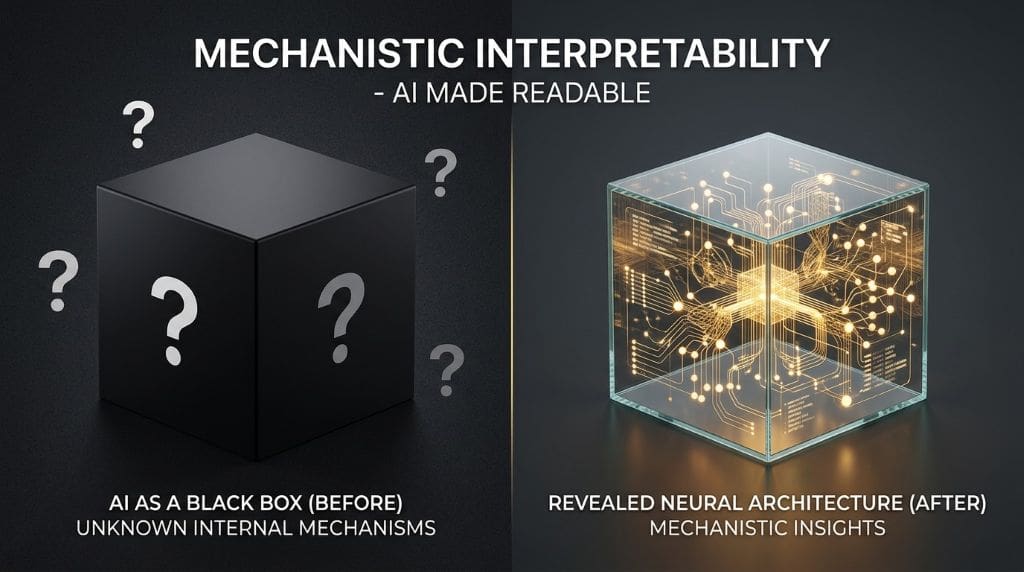
Machines learn, yet nobody could say how. That mystery lasted for decades. July 2026 changed everything. Two researchers published a landmark review. Their names are Pranav Sawant and Jakub Krejčí. The topic was mechanistic interpretability. This field reverse-engineers the internal logic of neural networks. For example, picture brain surgery for AI. Now, scientists can trace circuits inside models. Also, they can name hidden features. They can even steer model behavior. The paper explains why AI answers as it does. In short, opaque models became readable books. Certainly, this discovery makes AI safer and clearer. Here is what it means for you.
ENTECH Magazine — Top 10 Discoveries and Innovations of July 2026
Key Takeaways
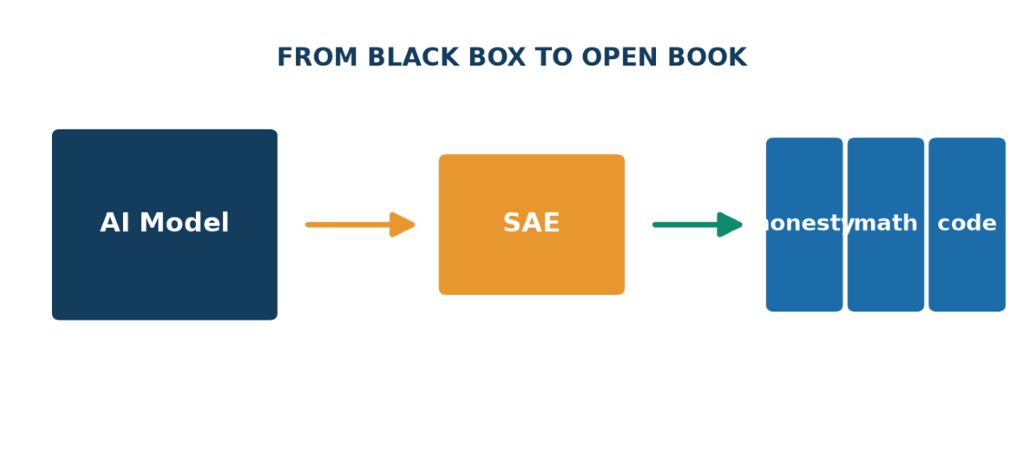
- Mechanistic interpretability reads a model’s internal logic.
- Sparse autoencoders split tangled signals into readable features.
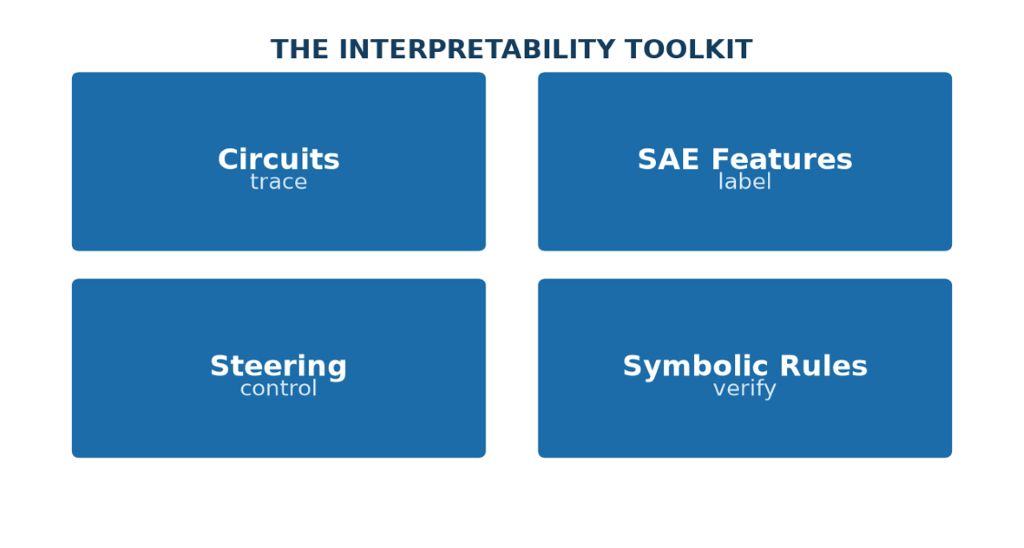
- Steering vectors give researchers a control dial for AI behavior.
- Causal interventions test which model parts matter most.
- July 2026 links these tools to explicit symbolic rules.
What Is Mechanistic Interpretability, and Why Does It Matter Now?
Old explainable AI watches inputs and outputs. It stops at surface-level correlations. Mechanistic interpretability goes far deeper. The July 2026 review explains the difference (Sawant & Krejčí, 2026). It asks how a network computes its answer. The authors analyze transformer circuits in detail. Specifically, they inspect the residual stream and attention heads. Indeed, these parts form the plumbing of a language model. As a result, readers gain a working map of model internals. This matters because AI now shapes daily life. Especially, banks, hospitals, and schools rely on these systems.
To explain why a loan was denied, we need real answers. That is exactly what this field promises. The review spans twenty pages of careful detail. Nothing here is marketing fluff. Every claim points to a testable method. Actually, it names open problems for the next wave of researchers. It also invites students to contribute early. The review draws on years of open research. It sets a clear agenda for the coming decade. Above all, it treats interpretability as an engineering goal. Not a distant dream. ENTECH’s guide to the future of technology covers these basics. Large models now fuel public debates about trust. A shared toolkit lets labs compare methods fairly.
The Old Way Stops at the Surface
Traditional XAI tools produce heatmaps and saliency maps. Surely, these visuals show where a model looks. However, they rarely show how it thinks. Sawant and Krejčí point out this limit. Surface explanations fail in high-stakes settings. A doctor needs reasons, not colorful pixels. To put it another way, correlation is not mechanism. Two models can match on outputs. Yet they may compute in totally different ways. That gap hides real risks. Take the case of a model that looks fair on paper. Its internal path might still favor one group. Specifically, mechanistic interpretability targets that exact path. It treats neurons like parts of a machine. Each part has a role in the computation.
This view makes errors findable and fixable. In fact, the new review builds on this core idea. Thus, this field grows with every open dataset. More eyes mean fewer blind spots. Obviously, independent labs now reproduce each other’s findings. As a result, that collaboration speeds up the whole field. It connects theory to practical tooling. So far, most wins come from smaller models. Scaling the method is the next big task.
Circuits, Induction Heads, and In-Context Learning
Transformers power most modern language models. Their inner loop repeats many times. Each repetition is called a layer. As a result, inside each layer, attention moves information around. For this purpose, the residual stream acts like a shared highway. Every layer reads from it and writes back. This design lets later layers reuse earlier work. For example, circuit analysis maps these repeated computations. Researchers label heads by the jobs they do. While some heads copy tokens, others find patterns. For this purpose, they form reusable circuits. Induction heads deserve special attention. They help models copy patterns from context.
This ability powers in-context learning. A model sees examples and infers the task. Induction heads spot repeated sequences. They then extend those sequences correctly. The July 2026 review explains their role plainly. So far, researchers map circuits at small scale. Larger models still resist full mapping. Yet the direction is clear. Every month brings a sharper map. Also, new tools cut the cost of analysis. Additionally, more labs publish their circuit catalogs. Open science is doing its job. In essence, the field rewards patient observation. Small models teach big lessons. Undoubtedly, skills are not magic; they are structure.
Sparse Autoencoders Turn Neural Noise into Readable Features
The second big idea is sparse autoencoders, or SAEs. Actually, these tools sort the noise inside models. Also, neural networks store many ideas in a few neurons. Indeed, that crowded storage is called superposition. Superposition causes polysemanticity. One neuron fires for many unrelated concepts. That behavior makes single neurons hard to read. In this case, SAEs solve this by learning new directions. Each direction stands for one clear feature. This decomposition is scalable and unsupervised. The original 2023 paper showed strong results (Cunningham et al., 2023). Features proved more interpretable than raw neurons. To enumerate, the authors pinpointed causal features. Those features drove one specific behavior. Undeniably, the result changed how researchers study models. Surveys now treat SAEs as a core method.
The July 2026 review places SAEs at center stage. It also pairs them with transcoders for harder cases. Transcoders untangle features that SAEs miss. Together, they turn messy activations into clear maps. In essence, SAEs give interpretability a standard unit. In fact, anyone can train one on an open model. Also, budget GPUs are enough for small studies. That low barrier fuels rapid progress. New feature dictionaries appear every month. Moreover, the community shares them without paywalls.
Superposition: Too Many Ideas, Too Few Neurons
Models want to represent more than they can store. Superposition lets them pack extra ideas. They share directions inside activation space. Each direction overlaps with its neighbors. This packing is efficient but confusing. Polysemanticity is the visible symptom. For example, a single neuron might fire for DNA and movies. In general, humans cannot guess its meaning. However, sparse autoencoders cut through this tangle. They find a new set of one-feature directions. As a matter of fact, training pushes each direction to activate rarely.
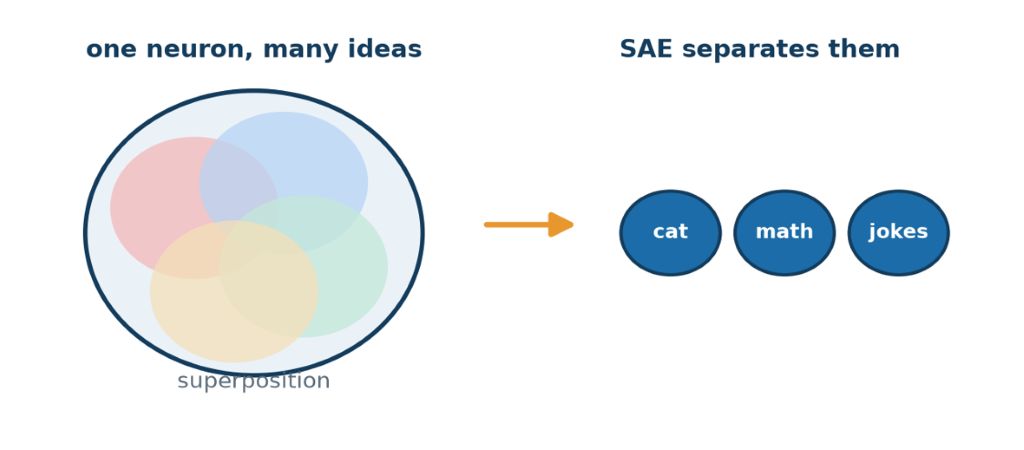
Rare activation makes features easy to isolate. Researchers can then label them by hand. The 2023 study measured this improvement directly. Its features beat alternative decomposition methods. Later work added better training recipes. The 2025 survey organized all these advances (Shu et al., 2025). Basically, it compared architectures and evaluation metrics. This growing toolbox keeps improving with open releases. In like fashion, newcomers can join the effort. Documentation keeps getting friendlier too. A curious student can start today. Notebooks walk beginners through each step. The tools run on a laptop. Every lab can contribute a piece.
Agents That Explain Their Own Moves
Interpretability is moving from chat models to agents. An agent takes actions, not just text. July 2026 brought a striking new study. Tan and colleagues trained a transformer agent (Tan et al., 2026). It played the Game of Hidden Rules. Two hidden rules mapped shapes to buckets. The agent never saw the rule labels. It had to infer rules from feedback. SAEs decoded its decision tokens. The recovered features matched real concepts. Some tracked the chosen shape or bucket. Others captured full strategies. One feature probed a rule hypothesis. Another switched after negative feedback. This is planning made visible. The agent’s strategy sat inside its activations.
Researchers could read it after the fact. That result extends interpretability to behavior. It shows SAEs work beyond language alone. To that end, agents become audit trails. What’s more, this method needs no labels from humans. The system finds its own concepts. Future agents will carry readable thought records. That makes delegation feel far safer. Humans keep the final say. Trust grows from visible reasoning.
From Reading the Model to Steering It: Safer AI Ahead
Reading a model is useful, but control is better. Steering vectors deliver that control. A steering vector is a direction in activation space. Add it, and the model shifts its behavior. Researchers used this trick to change tone and style. They can make a model more honest or cautious. The July 2026 review explains the math plainly. It connects steering to causal interventions. Causal tests edit one component at a time. Then they observe the resulting output change.
This is like testing a fuse in a circuit. Because the approach pinpoints which part does what. It also reveals hidden dependencies between parts. Prior to this work, most control was brute force. Another key point is that retraining whole models costs huge compute. Steering needs no retraining at all. That makes it fast and practical. Companies can update behavior in minutes. The review frames this as a safety tool. As can be seen, control and understanding now travel together. The two methods reinforce each other nicely. Reading informs where to push. Pushing reveals what still hides. That loop closes the gap between science and practice. That is the heart of the July 2026 story.
Control Without Retraining
Steering vectors work like volume knobs. You pick a feature direction to amplify. The model then behaves more like that feature. Want a calmer assistant? Amplify calm. Want less bias? Subtract the bias direction. Early demos impressed the research community. Later work refined the technique further. The 2025 survey catalogs these successes. It also notes where steering can fail. Oversteering produces unnatural outputs. Fine control requires careful calibration. The July review provides practical guidance.
It explains how to choose steering directions. It warns against mixing unrelated features. What’s more, steering is cheap to deploy. No expensive fine-tuning is needed. Models stay frozen while behavior shifts. This property suits fast-moving products. Teams can adjust AI on the fly. At this point, control feels almost like magic. Calibration remains the main challenge. Even so, the direction is promising. Safety teams now test these dials in pilots. Early results look encouraging. Expect product features in coming quarters. Research will keep tightening the knobs.
Neurosymbolic AI and the Safety Roadmap
The review ends with a bold vision. It links interpretability to neurosymbolic AI. Neurosymbolic systems blend neural and symbolic methods. Neural parts learn patterns from data. Symbolic parts reason with explicit rules. In essence, researchers want to convert learned features into rules. Certainly, those rules would be executable and checkable. This bridge makes models accountable by design. For example, a rule might state a clear policy. Auditors could read it like a spec sheet. AI safety depends on understanding, not faith. In either case, we cannot trust what we cannot inspect.

Regulators increasingly ask for explanations. In light of the European AI Act this is a common trend now. Moreover, companies need audit trails for models. Additionally, SAE feature maps can serve as evidence. Steering vectors can enforce limits. These tools work together in practice. ENTECH readers can start with open papers. In fact, ENTECH’s All About Artificial Intelligence series helps beginners. Particularly, the referenced studies are all free to read. Anyone can follow the code and data. At last, the black box is losing its mystery. As I have noted, the roadmap is public and collaborative. Anyone can track its milestones online. Progress reports arrive every month. The next breakthrough may come from a student.
Frequently Asked Questions about Mechanistic Interpretability
What is mechanistic interpretability in simple words?
It is the science of reading a model’s internal logic. Instead of watching inputs and outputs, we inspect the machinery. We find the circuits and features that drive answers. This turns a black box into an open book. It builds on years of open research.
What is a sparse autoencoder?
It is a small neural network that sorts model activations. It learns directions that each represent one feature. Rare use keeps the features separate and clear. Researchers label these features for humans. Feature dictionaries are now shared openly.
Why does the black box matter for AI safety?
Hidden logic can hide serious risks. A model might rely on unfair signals. If we cannot see them, we cannot fix them. Interpretability makes errors visible and correctable. Regulators and users both benefit. Transparency builds trust with the public.
Can scientists control AI behavior with steering vectors today?
Yes, in research settings. Researchers amplify or suppress selected features. They change tone, honesty, and bias. Production use is still maturing. Expect wider adoption soon. The July 2026 review lays out the path. Early pilots show steady gains.
References
Cunningham, H., Ewart, A., Riggs, L., Huben, R., & Sharkey, L. (2023). Sparse autoencoders find highly interpretable features in language models. arXiv. https://arxiv.org/abs/2309.08600
ENTECH Online. (2024). Artificial intelligence: Your guide to the future of technology. https://entechonline.com/ai
ENTECH Online. (2025). All about artificial intelligence: Part I — What it is, how it works, and its history. https://entechonline.com/all-about-artificial-intelligence-part-i-what-it-is-how-it-works-and-its-history
Sawant, P., & Krejčí, J. (2026). Mechanistic interpretability for neural networks: Circuits, sparse features and symbolic reasoning. arXiv. https://arxiv.org/abs/2607.07316
Shu, D., Wu, X., Zhao, H., Rai, D., Yao, Z., Liu, N., & Du, M. (2025). A survey on sparse autoencoders: Interpreting the internal mechanisms of large language models. arXiv. https://arxiv.org/abs/2503.05613
Tan, S., Zhao, Y., Qin, W., Wang, W., Feldman, J., Gallos, L. K., Kantor, P. B., Menkov, V., & Wang, H. (2026). Interpretable GOHR agents via sparse autoencoders. arXiv. https://arxiv.org/abs/2607.25132
- Author
- Latest Posts

I am Anvita Kashikar, a Computer Engineering graduate with Honors in Data Science, specializing in Artificial Intelligence and Machine Learning. My academic and research interests lie in Artificial Intelligence, Machine Learning, Deep Learning, Explainable AI, Optimization Techniques, and Data Science. I am particularly passionate about leveraging AI to address complex challenges in healthcare, finance, and drug discovery.
My work is grounded in a strong foundation of mathematics, optimization, and computational intelligence. I have contributed to the development of book chapters on topics including Dijkstra’s Algorithm, Necessary and Sufficient Conditions, Saddle Point Theory, Information Entropy, Taylor’s Series, Classification and Applications of Eigenvalues and Eigenvectors, MaxOne Problem, Topology Optimization, and Sensitivity Analysis. These contributions reflect my interest in the mathematical and optimization principles that underpin modern AI systems.
I have also been actively involved in research exploring emerging applications of Artificial Intelligence and Machine Learning. My research work includes studies on interpretable deep learning using Kolmogorov-Arnold Networks (KANs) for tabular data, AI-driven drug discovery and development, and generative optimization techniques for accelerating pharmaceutical research. Several of these research papers and book chapters have been published, while others are currently under review or in various stages of the publication process.
Through my academic and research endeavors, I strive to bridge theoretical concepts with practical applications, contributing to the development of transparent, efficient, and impactful AI solutions. As an early-career researcher, I am committed to continuous learning, interdisciplinary collaboration, and advancing the responsible use of Artificial Intelligence to address real-world challenges and create meaningful societal impact.