Vehicle structures depend on welds, adhesives, rivets, bolts, and hybrid joints. A material with excellent base properties may still fail at joints.
New Cobalt-Aluminum Material Could Change Strong, Bendable Metal Design

Estimated reading time: 11 minutes
Materials engineers chase a difficult goal every year. They want metals that stay strong under load. They also want metals that bend before breaking. That balance matters in cars, aircraft, robots, and energy systems. A recent study in Science Advances reports a notable innovation in cobalt-aluminum materials. The work focuses on a normally brittle class of compounds. These compounds can carry heavy loads. Yet, they often crack with little warning. As a result, engineers avoid them in safety-critical parts. This new research points toward a better route. It shows that brittle intermetallic materials may become more damage-tolerant. That change could affect structural design in future vehicles. Above all, it gives engineers another path toward lighter, safer components. Read the original study through this Science Advances DOI.
Key Takeaways: Cobalt-Aluminum Material Innovation
- Cobalt-aluminum material innovation targets a hard problem in metals.
- The study focuses on strength, bending ability, and damage tolerance.
- Brittle intermetallic compounds may become more useful.
- Automobile engineers could gain new lightweight design options.
- The finding supports future work in structural vehicle materials.
- More testing is needed before real automotive production use.
Why Cobalt-Aluminum Material Innovation Matters in Engineering
Cobalt-aluminum compounds belong to a wider family called intermetallics. These materials often show high strength and useful thermal stability. However, many intermetallics also break suddenly. That weakness limits their use in parts that face impact, vibration, or repeated loading. In contrast, common automotive steels bend before fracture. Aluminum alloys also deform under stress. That ductility gives engineers warning before failure. The cobalt-aluminum material innovation described in the Science Advances study matters because it challenges that old trade-off. At first, strength and ductility seemed hard to combine in this material class. With this in mind, the research offers a possible route toward stronger, safer structural metals.

This subject also matters for automobile engineering. Cars need materials that resist cracks during crashes. They also need materials that reduce vehicle weight. Lighter vehicles need less energy to move. Electric vehicles benefit from every kilogram saved. At the same time, safety standards remain strict. As a result, engineers cannot choose light materials blindly. They need reliable strength, ductility, and fatigue resistance. A cobalt-aluminum material innovation could help future design teams think differently. It may support smaller parts that carry higher loads. It may also inspire new alloy systems. For related materials coverage, readers can follow ENTECH Online’s materials science updates.
Cobalt-Aluminum Material Innovation and the Strength-Ductility Problem
The strength-ductility problem is central in mechanical engineering. Strong materials resist permanent deformation. Ductile materials stretch or bend before breaking. Unfortunately, increasing strength often lowers ductility. That creates a design conflict. For example, very hard materials can resist wear. Yet, they may crack under shock loading. Softer metals deform more easily. However, they can absorb more energy. The cobalt-aluminum material innovation is important because it deals with this conflict directly. To explain, the study points toward improved bending behavior in a strong material. That improvement matters because structural parts must survive real loading. Roads, crashes, heat, and vibration all stress vehicle components.

In general, intermetallic compounds have ordered atomic structures. That order gives them useful stiffness and strength. It can also make dislocation motion difficult. Dislocations help metals deform plastically. When dislocations cannot move well, cracks grow quickly. This is why many intermetallics fracture without much bending. The Science Advances DOI paper is interesting because it suggests a path beyond that limitation. To put it differently, the material does not need to remain trapped in a brittle behavior window. At the same time, engineers must study processing, scale-up, cost, and environmental stability before industrial adoption.
How Bendable Intermetallics Could Support Automotive Design
Automobile engineering depends on materials with predictable failure behavior. A car body must absorb crash energy. Suspension parts must survive cyclic loading. Battery enclosures must resist puncture. Motor parts must handle heat and vibration. Therefore, future vehicles need smarter structural metals. The cobalt-aluminum material innovation may not enter cars immediately. However, it can guide alloy design choices. As an illustration, engineers could use the same principles to improve other intermetallic systems. They could also combine high-strength phases with ductile microstructures. In this case, the research becomes more than one material. It becomes a design lesson for advanced mechanical systems.
Automakers already use many material families. These include steels, aluminum alloys, magnesium alloys, polymers, and composites. Each material solves a different problem. Steel gives strength and cost advantages. Aluminum reduces weight. Magnesium helps where mass savings matter. Composites provide stiffness at low density. Yet, every option has limits. A cobalt-aluminum material innovation could add new ideas to that toolbox. It may support high-temperature parts, wear-resistant areas, or compact load-bearing components. What’s more, the research can inspire computational alloy design. Engineers could search for similar structures with cheaper elements. For broader vehicle technology context, readers can visit ENTECH Online’s automobile technology section.
Possible Vehicle Applications for Cobalt-Aluminum Material Innovation
Possible applications must be treated with care. The Science Advances study does not automatically prove car readiness. Laboratory success differs from factory production. Still, automobile engineers can learn from it. To list, they may study this material concept for brackets, protective structures, drivetrain components, or thermal areas. Each application would need testing. Engineers must check fatigue, corrosion, weldability, machinability, and crash response. They must also compare costs against existing alloys. All things considered, the research may matter most as a direction-setting result. It shows that brittle ordered materials may gain useful bending behavior under suitable design conditions.
- Lightweight structural parts
A stronger material may allow thinner sections. That can reduce mass. However, engineers must confirm impact safety first. - Heat-exposed components
Intermetallic compounds often perform well at higher temperatures. This could help motors, power electronics, or exhaust-adjacent parts.
These ideas remain research-facing. They should not be marketed as production-ready. In fact, responsible engineering communication needs caution. A material can look excellent in one test. It may fail under another condition. For that reason, fatigue testing matters greatly. Corrosion testing also matters. Joining studies matter as well. Above all, automakers need repeatable production quality. The cobalt-aluminum material innovation should move through staged evaluation. That includes coupons, small parts, prototype assemblies, and long-term durability trials. This path protects users. It also builds trust in the science.
What Materials Scientists Should Watch Next
Materials scientists should watch the microstructure closely. Microstructure controls how metals deform and crack. Grain size, phase distribution, defects, and boundaries all matter. A small change can alter performance greatly. With attention to the cobalt-aluminum material innovation, the key question is simple. Why does the material bend better than expected? The answer likely sits in deformation mechanisms. Researchers may examine dislocations, cracks, phase boundaries, and local stress fields. Advanced microscopy can help. Synchrotron experiments can also track changes during loading. In similar fashion, computer simulations can test atomic-scale behavior. Together, these tools can explain why strength and ductility improved.
Processing will be another key issue. Laboratory samples are often small. Industrial parts are larger and more complex. Casting, forging, rolling, heat treatment, and additive manufacturing can all change properties. Therefore, the cobalt-aluminum material innovation must prove process tolerance. A promising material should perform reliably across batches. It should also avoid expensive or fragile processing routes. By comparison, automotive steels succeed partly because factories understand them well. Aluminum alloys succeed for similar reasons. New materials need both performance and manufacturability. At any rate, this research gives scientists a valuable target. It encourages them to design intermetallics with toughness in mind.
Testing Needs Before Automotive Use
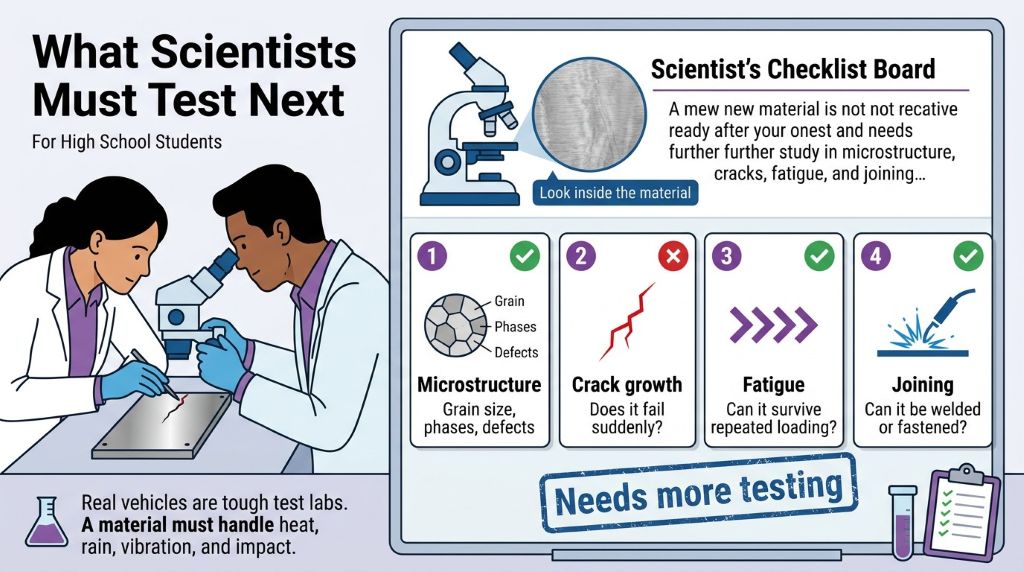
Automotive approval demands evidence. Tensile strength alone is never enough. Engineers need fracture toughness values. They need fatigue curves and crash strain-rate data. They also need corrosion behavior in salt, water, and heat. To enumerate, tests should include room-temperature loading, high-temperature exposure, cyclic bending, impact testing, and surface damage studies. The cobalt-aluminum material innovation may pass some early hurdles. Yet, real vehicles add complex conditions. Parts face potholes, moisture, vibration, and manufacturing stresses. In essence, a good material must survive a messy service life. That standard protects drivers and reduces warranty risk.
Another key point is joining. Vehicle structures depend on welds, adhesives, rivets, bolts, and hybrid joints. A material with excellent base properties may still fail at joints. Heat from welding can change microstructure. Mechanical fastening can cause local cracks. Adhesive bonding needs surface compatibility. Therefore, engineers must test how cobalt-aluminum materials join with steel, aluminum, and composites. At the same time, recycling matters. Automakers increasingly design for circular material flows. A new alloy should not create recovery problems. With this purpose in mind, future studies should include life-cycle analysis. Strong materials need responsible end-of-life planning.
Cobalt-Aluminum Material Innovation and Sustainable Mobility
Sustainable mobility needs better materials choices. Vehicle weight affects energy use. Stronger materials can reduce mass. However, sustainability is not only about weight. Mining impact, processing energy, recyclability, and service life also matter. Cobalt raises supply-chain questions. Engineers must consider cost and ethical sourcing. Aluminum production also requires significant energy. As a result, any cobalt-aluminum material innovation needs a balanced sustainability review. The best outcome may not be mass adoption of one exact alloy. Instead, the research may teach broader design principles. Those principles could apply to other element systems. That approach may reduce cost and supply risks.

Electric vehicles add new demands. Battery packs need protection from impact and fire. Motors need heat-resistant materials. Lightweight structures help range. Yet, safety remains the top priority. A cobalt-aluminum material innovation could support future EV concepts if testing confirms durability. To be clear, early-stage research often shapes theindustry indirectly. It changes design rules and inspires new alloy families. It helps simulation teams build better models. In due time, those insights can reach production materials. Science advances this way often. One study creates the first step. Later work improves chemistry, processing, cost, and reliability. That long path defines responsible engineering progress.
Future Research Directions for Cobalt-Aluminum Material Innovation
Future work should focus on repeatability. One strong sample is exciting. Ten reliable batches matter more. Researchers should test different sample sizes, shapes, and processing paths. They should also compare results with commercial steels and aluminum alloys. That comparison will show real engineering value. To illustrate, a material may look strong in isolation. Yet, it must beat existing options on cost, weight, safety, or durability. The cobalt-aluminum material innovation should be benchmarked against common automotive grades. It should also be tested under realistic strain rates. Crash behavior depends strongly on loading speed. Slow tests cannot answer every safety question.

Digital materials engineering may speed progress. Machine learning can screen related chemistries. Thermodynamic tools can predict phase stability. Crystal plasticity models can study deformation. At the same time, experiments remain essential. Models need validation. Microscopy needs careful interpretation. As has been noted, microstructure decides performance. Therefore, researchers should combine modeling with real mechanical tests. This balanced method can shorten development time. It can also avoid expensive trial-and-error programs. All in all, the cobalt-aluminum material innovation gives engineers a strong research signal. Brittle intermetallics may not be as limited as once believed.
Closing Remarks
This article follows, by explaining the cobalt-aluminum material innovation in plain language. The study is promising. It is not yet a guaranteed automotive material. That distinction matters. Readers deserve accurate context. Engineers deserve careful language. Companies deserve realistic timelines. Above all, science communication should connect discovery with practical limits.
FAQs: Cobalt-Aluminum Material Innovation
What is the cobalt-aluminum material innovation?
The cobalt-aluminum material innovation refers to research on a strong intermetallic material with improved bending behavior. The study appears in Science Advances. You can read it through this DOI link.
Is this material ready for cars?
No, not yet. The material needs more testing before automotive use. Engineers must check fatigue, corrosion, impact behavior, joining, and production quality.
Why are intermetallic compounds usually brittle?
Intermetallic compounds often have ordered atomic structures. That order can block easy plastic deformation. As a result, cracks may grow quickly under stress.
How could this help electric vehicles?
It could inspire lighter and stronger structural materials. Electric vehicles benefit from lower mass. However, safety and cost must come first.
- Author
- Latest Posts

Charudatta Pathak was a student at St. Aloysius High School in Bhusawal, established in 1874, making it one of India’s oldest convent institutions. He earned his bachelor’s degree in mechanical engineering from SSVPS College of Engineering, Dhule in 1995, demonstrating exceptional academic achievement. Thereafter, he launched his career as a CNC programmer in a toolroom. He has utilized FANUC, Deckel, Maho, and Mikron controllers to operate 2-axis and 3-axis machines for the fabrication of jigs, fixtures, dies, and molds. He commenced his career as an academic in 1996, when he assumed the role of lecturer at SSVPS College of Engineering, Dhule. Additionally, he earned his post-graduate degree in CAD/CAM from L. D. College of Engineering, Ahmedabad, in 2000, and then acquired a Ph.D. from COEP in 2011 while concurrently engaged in teaching. Until 2023, he occupied many academic roles, including lecturer, assistant professor, professor, dean, principal, director, and vice chancellor at both public and private universities throughout India. From 2008 to 2010, he served as the project lead in the CAE department of a European multinational firm. During his 28-year professional tenure, he identified a need for dependable books targeted at students in grades 8 to 12, particularly for nascent career planning. He founded ENTECH Digital Magazine, a free monthly publication available on entechonline.com and magzter.com. Teens with a strong interest in Science, Technology, Engineering, and Mathematics (STEM) who aspire to pursue careers in these fields may find ENTECH Digital Magazine beneficial.