Deciding between Travel eSIM vs Local SIM for your next trip? Discover which option keeps you connected while traveling.
Travel eSIM vs Local SIM: Which Option Fits Your Trip?
Estimated reading time: 6 minutes
Mobile data is easy to forget when planning an international trip. Flights, hotels, transport, and sightseeing usually come first. Then, shortly before departure, another practical question appears: how will you get online after landing?
For many travelers, the choice comes down to buying a local SIM after arrival or using a Travel eSIM that can be installed digitally on a compatible phone. Both options can work well, but they solve slightly different problems. The better choice depends on where you are going, how long you are staying, whether you are crossing borders, and whether you need a local phone number.
Travel eSIM vs Local SIM: What Is the Real Difference?
A local SIM is a physical card issued by a mobile operator in the country you are visiting. Travelers usually buy one after arrival from an airport kiosk, mobile store, convenience store, or other retailer. Once installed, it connects the phone to the local network according to the selected plan.
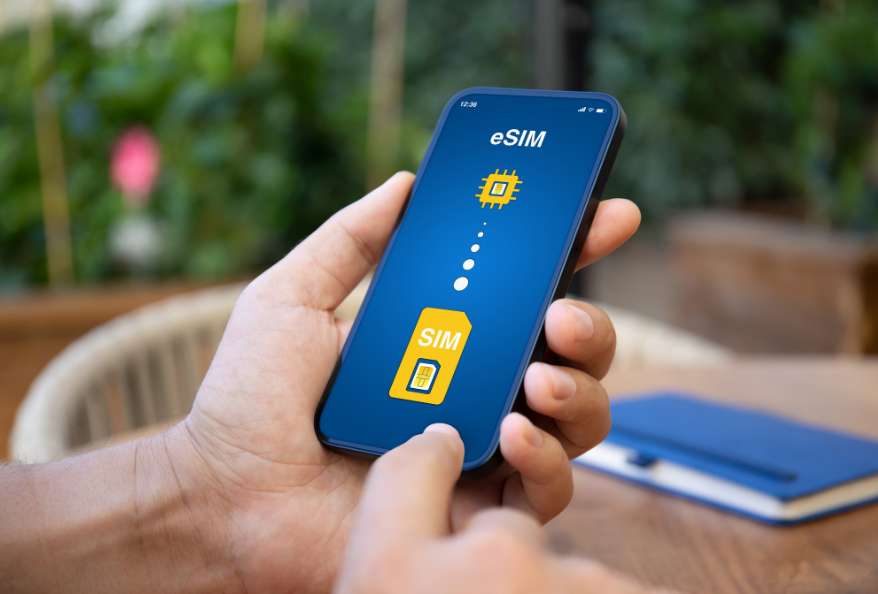
A travel eSIM works digitally. Instead of removing your existing SIM and inserting another card, you install an eSIM profile on a compatible phone, usually by scanning a QR code.
The practical difference is mainly about when and how you arrange your connection. A local SIM often requires some effort after arrival, while a travel eSIM can usually be purchased and installed before the trip. That can be useful when you want mobile data available soon after landing rather than searching for a SIM shop first.
When a Local SIM Makes More Sense
A local SIM can be a good fit if you are spending several weeks or months in one country. Local operators may provide plans with large data allowances, domestic calls, SMS, or a local number, which can be useful for longer stays.
A local number can also matter in situations where you need traditional calling rather than app-based communication. Some accommodation providers, local services, workplaces, or reservation systems may be easier to use with a local number.
Device compatibility is another factor. If your phone does not support eSIM, or if it is carrier-locked in a way that prevents another eSIM from being added, a physical SIM may be the more practical option.
For a traveler staying entirely within one country, buying one local SIM after arrival may therefore be perfectly reasonable.
Also Read: How AI And Location Intelligence Are Reshaping Tourism
Why a Travel eSIM Can Be Easier
Travel eSIMs are particularly useful when convenience matters. There is no physical card to collect, no SIM tray to open, and no need to store your original SIM somewhere safe during the trip.
They can also be useful for short holidays. If you are only visiting a city for four or five days, spending part of your first afternoon finding a phone shop and comparing local plans may not be worth the trouble.
The advantage becomes even clearer on a multi-country trip. Someone traveling through France, Italy, Germany, and the Netherlands may prefer a regional eSIM rather than repeatedly thinking about connectivity at each border. The exact coverage still needs to be checked before buying, but one regional plan can be more convenient than arranging several separate SIM cards.
How Travelers Can Arrange an eSIM Before Departure
Travelers who decide that an eSIM fits their itinerary can organize their mobile data before leaving home.
On esim.now, users can browse country-specific, regional, and global eSIM plans depending on where they are traveling. After a plan is purchased, the eSIM QR code is shown on the order page and also sent by email.
The service does not require travelers to download an app or create an account to purchase and receive the eSIM. It can be installed over Wi-Fi before departure, although travelers should check the activation conditions of the specific plan before turning it on.
The plans are focused on mobile data. On compatible dual-SIM phones, travelers can keep their usual SIM in the device for their normal calls and SMS while using the eSIM for data.
Travel eSIM vs Local SIM: Which Option Fits Different Types of Trips?
There is no single answer that works for every traveler. Looking at the structure of the trip usually makes the choice much easier.
A Short Trip to One Country
For a short city break or one-week holiday, a travel eSIM can be convenient because it can be prepared before arrival. This may be especially useful if you land late, have limited time, or simply do not want to visit a mobile store during the trip.
A local SIM can still work, particularly if it is easy to purchase at the destination and offers a suitable plan.
A Longer Stay in One Destination
If you are staying for several weeks or months, a local SIM becomes more attractive. You may get a local number, larger domestic packages, or options designed for longer-term use.
In this situation, the inconvenience of visiting a local carrier once may matter less because you will use the plan for a much longer period.
A Multi-Country Itinerary
Travel eSIMs can be particularly useful when several countries are involved. Instead of buying a new SIM every time you cross a border, travelers can look for a regional or global plan covering the destinations on their itinerary.
The key is to confirm the country list rather than assuming every regional plan covers every destination.
Data Needs Matter Too
Whichever option you choose, it is worth thinking about how much data you actually use. Someone who mainly checks messages, maps, transport times, and restaurant information may need far less data than someone who frequently uploads videos or works remotely.
Travelers should also check whether hotspot or tethering is supported if they plan to connect a laptop or share data with another device.
Before paying, it is useful to confirm:
- device compatibility and carrier-unlock status;
- destination coverage;
- data allowance and validity period;
- whether the plan is data-only or includes calls and SMS;
- hotspot or other usage restrictions.
These details are often more important than choosing the plan with the lowest price per gigabyte.
Choosing Based on the Trip, Not the Technology
The decision between a travel eSIM and a local SIM does not need to become a debate over which technology is universally better.
A local SIM may fit a long stay in one country, especially when a local number is important. A travel eSIM may fit a short holiday, a multi-country itinerary, or a traveler who wants to prepare mobile data before departure and keep the existing SIM in the phone.
The easiest way to decide is to look at the trip itself: how many countries you are visiting, how long you will stay, how much data you expect to use, and what your phone supports. Once those questions are clear, the right option usually becomes much easier to identify.
Reviewed by Kedareshwar Goranale on September 28, 2026Edited by Juveriya Khan
Note: The article includes external links to third-party services; readers should independently evaluate any referenced platforms before engaging.
- Author
- Latest Posts

Deven Nandapurkar is a Software Engineer, Project Lead; working at the strategic intersection of software engineering, productivity science, and emerging technologies. Driven by a core philosophy of “building things worth building,” he leads cross-functional teams and drives end-to-end technical strategy—from early-stage conceptualization through production-grade deployment.
A Computer Engineering graduate from Pune University, Deven brings a sharp systems-thinking approach to technical leadership, honed by years of managing high-stakes engineering projects and leading teams to top placements in national and international hackathons, including the NASA Space Apps Challenge and the Peerlist GenAI Hackathon.
Deven explores how human cognition and emerging technology converge. He regularly writes about cognitive performance optimization, attention management, AI integration, and the evolving dynamics of the modern workforce – offering actionable frameworks for professionals seeking to maximize their productivity and thrive alongside intelligent systems.