Clotting Disorders: Early Warning Signs You Should Know
Clotting Disorders: Discovery, Advances, Diagnosis, and Treatment
Estimated reading time: 6 minutes
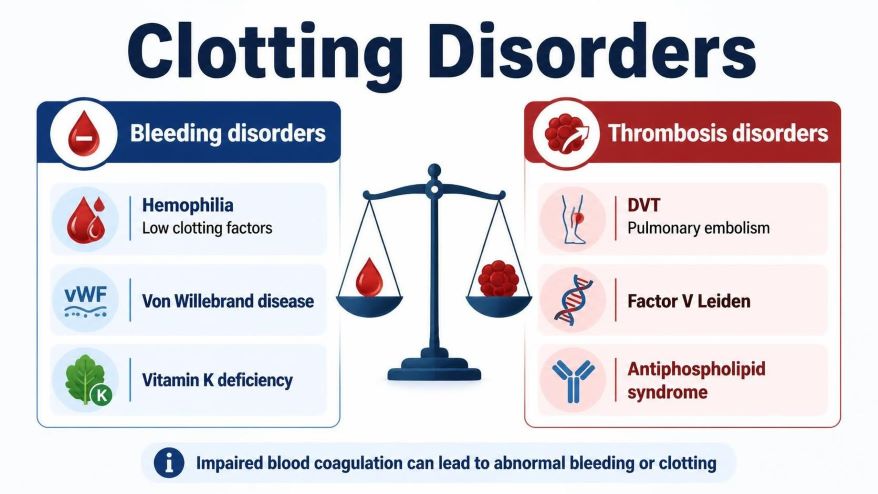
Blood coagulation is the process by which your body stops bleeding. When you get a cut, your blood forms a clot to seal the wound. This process uses a series of steps called the coagulation cascade. Proteins in your blood turn on one after another, like dominoes falling. Each step makes the next one happen faster. At the end, a protein called fibrin builds a strong mesh over the wound. This mesh traps blood cells and forms a solid clot. Sometimes blood coagulation does not work right. Some people have disorders where their blood does not clot well. Such disorders can cause excessive bleeding after a minor injury. Other people have blood that clots too easily inside their veins. These conditions can block blood flow and cause serious health problems. Understanding blood coagulation helps doctors treat both types of disorders.
Key Takeaways: Clotting Disorders
Blood coagulation is essential for your health. It is the process that stops bleeding when you get hurt. The coagulation cascade is the series of steps your body uses to form a clot. First, a protein called tissue factor starts the process. Then, other proteins activate one by one in a chain reaction. This leads to the creation of thrombin. Thrombin then turns fibrinogen into fibrin. Fibrin forms a strong net that holds the clot together.
Primary Hemostasis: Platelet Adhesion and Aggregation
First, let us talk about primary hemostasis. This is the earliest step in blood coagulation. When a blood vessel gets hurt, the inner lining is exposed. Then, platelets in your blood stick to the damaged area. This is called platelet adhesion. A protein called von Willebrand factor helps the platelets stick. Next, more platelets rush to the site. They also stick to each other. This process is called platelet aggregation. As a result, a temporary platelet plug forms. This plug is soft and weak. However, it is crucial. It acts as a quick first cover for the wound. Therefore, it buys time for the next steps of blood coagulation. Without this first step, the rest of the coagulation cascade cannot work properly. In short, platelet adhesion and aggregation are the foundation of blood coagulation.
Common Pathway and Fibrin Formation in Clotting Disorders
The common pathway creates the final clot. It starts when factor X is activated. This activated factor then turns prothrombin into thrombin. Thrombin acts quickly. It cuts fibrinogen into fibrin strands. These strands then weave together into a strong mesh. This mesh traps blood cells and platelets. It forms a solid, stable clot. Clotting disorders disrupt this process. For example, a lack of factor X prevents fibrin formation. This causes heavy bleeding. Other disorders produce too much thrombin. The condition leads to dangerous clots inside veins. Doctors test the common pathway to identify clotting disorders. They use the PT and aPTT blood tests. These tests show which step fails. Understanding the common pathway helps doctors treat clotting disorders effectively.
Role of Thrombin in Blood Coagulation Related to Clotting Disorders
Thrombin plays a central role in blood coagulation. It activates quickly after a vessel injury. First, thrombin cuts fibrinogen to form fibrin strands. These strands weave into a strong mesh that holds the clot together. Thrombin also activates factor XIII. This factor cross-links the fibrin strands, making the clot even stronger. In addition, thrombin activates platelets. They clump together and release more clotting factors. This accelerates the entire process. Thrombin even activates factors V and VIII, creating a positive feedback loop. However, too much thrombin activity causes clotting disorders. For example, it leads to deep vein thrombosis or pulmonary embolism. Too little thrombin activity can cause bleeding disorders such as hemophilia. Doctors target thrombin with drugs to treat these clotting disorders. Anticoagulants like heparin and warfarin reduce thrombin activity. This prevents dangerous clots. Understanding thrombin helps doctors control blood coagulation and manage clotting disorders.
Vitamin K and Blood Coagulation
Vitamin K plays a vital role in blood coagulation. It helps your liver make clotting factors II, VII, IX, and X. Without enough Vitamin K, your body cannot activate these factors. This slows down the clotting process. You get Vitamin K from green leafy vegetables and some bacteria in your gut. When you take blood thinners like warfarin, they block Vitamin K’s action. This reduces clotting factor production. Doctors use this effect to treat clotting disorders like deep vein thrombosis and pulmonary embolism. However, too little Vitamin K causes its own problems. It leads to bleeding disorders. Newborn babies often receive a Vitamin K shot to prevent dangerous bleeding. People with liver disease or poor diet also lack enough Vitamin K.
Fibrinolysis: Clot Dissolution and Tissue Repair
First, fibrinolysis breaks down blood clots. This process allows tissue repair to begin. After a clot stops bleeding, the body does not need it forever. So, a protein called plasminogen sits inside the clot. Then, activators such as tPA convert plasminogen into active plasmin. Plasmin then breaks down the fibrin mesh into small fragments. As a result, the clot dissolves. This clears the way for new cells to heal the injured tissue. However, fibrinolysis can cause problems. For example, excessive activity dissolves clots too quickly. This leads to rebleeding and worsens clotting disorders.
In contrast, too little activity allows clots to remain. Such activity raises the risk for dangerous blockages. Therefore, doctors balance fibrinolysis when treating clotting disorders. They use drugs like tPA to break up harmful clots. They also use antifibrinolytics to prevent excessive bleeding.
Frequently Asked Questions: Clotting Disorders
What is blood coagulation?
Blood coagulation is how your body stops bleeding after an injury. It forms a clot to seal the damaged blood vessel. Platelets, clotting factors, and fibrin all work together to make this process happen. First, platelets stick to the wound site. Next, clotting factors begin to activate in a chain reaction. Finally, fibrin forms a strong mesh that holds the clot together. This process usually works fast and well. However, clotting disorders can break this system. For example, hemophilia stops clotting factors from working. This condition leads to prolonged bleeding. Other clotting disorders cause blood to clot too easily in veins.
What is the coagulation cascade?
The coagulation cascade is a chain of enzyme reactions. It activates clotting factors one after another. The cascade has three main parts: the intrinsic pathway, the extrinsic pathway, and the common pathway. First, the extrinsic pathway starts fast after a blood vessel injury. Then the intrinsic pathway operates more slowly within the vessel. Both pathways lead to the common pathway. Ultimately, the common pathway forms a stable fibrin clot. This clot seals the wound and stops bleeding. However, clotting disorders can disrupt any step in this cascade. For example, a missing clotting factor in the intrinsic pathway causes hemophilia.
How are coagulation disorders diagnosed?
Doctors use simple blood tests to check blood clotting. They look for clotting disorders with these tests. One test is prothrombin time, or PT. Another is the international normalized ratio, or INR. They also use activated partial thromboplastin time (aPTT). Doctors check platelet counts too. Occasionally, they use genetic testing. These tests show how well each part of the clotting process works—for example, a high PT or INR points to a problem with the extrinsic pathway.
Reference
Reardon, B., Pasalic, L., & Favaloro, E. J. (2026). Biomarkers of Coagulation Disorders—Where to from Here? Biomolecules, 16(2), 235. https://doi.org/10.3390/biom16020235
This article was written by Rakshanda Jabbar and reviewed for editorial accuracy by our editorial team. It has not yet undergone independent review by a professional.
- Author
- Latest Posts

I completed my Master of Science from the University of Allahabad in 2017 with a strong academic background in life sciences and chemistry. My specialization included Molecular Biology, Microbiology, Genetics, Plant Breeding, Phycology, Paleobotany, and Bioinformatics, along with Organic Chemistry, Inorganic Chemistry, and Physical Chemistry. This multidisciplinary training provided me with a comprehensive understanding of biological systems and analytical scientific approaches.
After completing my postgraduate studies, I gained valuable professional experience in both the education and social development sectors. I worked at A.M. Oxford Public School, where I was actively involved in guiding students toward academic excellence. In this role, I focused on creating an engaging learning environment, encouraging critical thinking, and nurturing students’ curiosity for scientific learning. My experience as an educator strengthened my communication, mentoring, and classroom management skills.
In addition to my teaching experience, I worked with Jeevan Jagriti Foundation, where I contributed to community-based initiatives aimed at improving educational access and awareness among underprivileged sections of society. Through this work, I participated in programs designed to support social development and promote the value of education in marginalized communities.
These professional experiences helped me develop strong interpersonal, leadership, and organizational skills while reinforcing my commitment to education and community service.