Avocado Flowering Genetics Discovery Advances Modern Crop Breeding
Avocado Flowering Genetics Discovery Reveals Ancient Pollination Rhythm
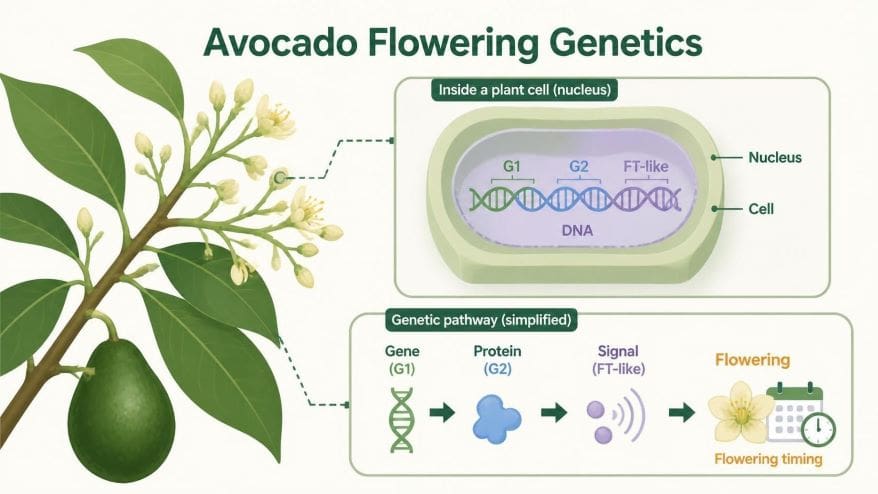
A new study in the journal Current Biology looks at Avocado Flowering Genetics. These trees have a strange daily habit. Each day, they change their sex. First, a flower acts like a female. Later, it acts as a male. This helps the tree avoid self-mating. Scientists found a key gene behind this rhythm. This gene is a floral transcription factor. It controls the daily sex switch. This gene has two forms. Both forms stay in the population over time. This phenomenon is called balanced polymorphism. As a result, the tree keeps its ancient daily rhythm. Thus, this study shows how a simple gene keeps a natural sex clock running.
ENTECH STEM Magazine has included this research in its list of Top 10 STEM Discoveries and Innovations of July 2026.
Key Takeaways: Avocado Flowering Genetics
In the study Avocado Flowering Genetics, it is revealed that Avocado trees have a unique daily sex rhythm. Each flower changes from female to male in one day. This stops the tree from mating with itself. Scientists found a key gene that controls this switch. It is called a floral transcription factor. This gene has two forms, both of which persist over time. This phenomenon is known as balanced polymorphism. One form helps flowers act female in the morning. The other form helps them act male in the afternoon. As a result, the tree keeps a stable sex rhythm. This rhythm is ancient, according to a study in Avocado Flowering Genetics. It has been around for millions of years. So, the gene’s two forms work together to keep nature in balance.
Heterodichogamy in Avocado
A study on Avocado Flowering Genetics found that Avocado trees have a special way to avoid self-mating. This is called heterodichogamy. It means each flower changes sex during the day. First, the flower acts like a female. Later, it acts as a male. This mechanism stops the tree from pollinating itself. Scientists found the gene behind this trick. It is a floral transcription factor. This gene has two forms that stay in the population. One form makes flowers female in the morning and male in the afternoon. The other form does the opposite. As a result, trees with different forms can mate with each other. This keeps the avocado species healthy and diverse. Thus, heterodichogamy is a simple but smart system. It uses one gene to control a daily sex rhythm.
A-Type and B-Type Flowering Patterns

Research on Avocado Flowering Genetics shows that Avocado trees have two types of flowering patterns. They are called A-Type and B-Type. First, an A-Type tree opens its flowers as females in the morning. Then, those same flowers close at noon. Later, they open again as males in the afternoon. A B-Type tree does the opposite. It opens as a female in the afternoon. Then, it opens as a male the next morning. This daily sex switch is called heterodichogamy. It helps the tree avoid self-mating. Scientists found that one gene controls both patterns. This gene has two forms. One form gives the A-Type pattern. The other form gives the B-Type pattern. As a result, trees with different patterns can mate with each other. This process keeps avocado populations strong and diverse. So, this simple gene creates a natural rhythm that helps the species survive.
Discovery of the SDMYB Transcription Factor
Scientists found a key gene in avocado trees while studying avocado flowering genetics. This gene is called SDMYB. It is a type of floral transcription factor. First, researchers noticed that avocado flowers follow a daily sex rhythm. They wanted to identify the gene behind this rhythm. Next, they looked at the tree’s DNA. They found SDMYB. This gene has two forms. Each form controls a different flowering pattern. One form makes a tree act like an A-type. The other form makes a tree act like B-Type. As a result, trees with different forms can mate with each other. This discovery is important. It shows how one simple gene can control a complex daily rhythm. So, SDMYB is the master switch for sex timing in avocado flowers.
Genetic Basis of Avocado Flowering Types
Research while studying avocado flowering genetics shows that Avocado trees have two flowering types. They are called A-Type and B-Type. Scientists found the gene that controls both types. This gene is a floral transcription factor named SDMYB. It has two different forms. One form gives the A-Type pattern. The other form gives the B-Type pattern. Both forms stay in the tree population over time. This phenomenon is called balanced polymorphism. As a result, trees with different types can mate with each other. This prevents self-mating and helps keep the species healthy. Thus, the genetic basis is simple. One gene with two forms controls the daily sex rhythm. This rhythm has been around for millions of years. It helps avocado trees survive and produce fruit.
Ancient Trans-Species Genetic Variation
In a study on Avocado Flowering Genetics, Scientists found something surprising in avocado trees. The gene that controls flower sex is ancient. It has two forms that both survive today. This phenomenon is called balanced polymorphism. But the gene is not just in avocados. It is also in other plants. This means the gene is ancient. It has been passed down for millions of years. Before avocado existed, this gene was already in a common ancestor. As a result, different plant species share the same genetic variation. This is called trans-species genetic variation. So, the daily sex rhythm in avocados is not new. It is an ancient trick from nature. The same gene helps many plants avoid self-mating. This evidence shows how deep and old some genetic patterns really are.
Circadian Regulation of Floral Development
Avocado Flowering Genetics follow a daily clock. This clock is called the circadian rhythm. It tells each flower when to be female and when to be male. First, a flower opens as a female in the morning or afternoon. Then, it closes. Later, it opens again as a male flower. This cycle repeats each day. Scientists found that a gene called SDMYB controls this rhythm. The gene works with the plant’s internal clock. It turns on at certain times of day. As a result, the flower changes sex at the right time. This timing is crucial. It helps the tree avoid self-mating. It also helps different trees mate with each other. Thus, the circadian rhythm and the SDMYB gene work together. They create a daily sex rhythm that has worked for millions of years.
Biphasic Floral Anthesis in Avocado
A study on Avocado Flowering Genetics reveals that avocado flowers open in two phases. This is called biphasic floral anthesis. In the first phase, the flower acts like a female. It opens to receive pollen. Then, it closes. Next, in the second phase, the same flower opens again. This time, it acts as a male. It releases pollen. So, each flower changes sex in one day. As a result, a single flower cannot mate with itself. First, this process helps the tree avoid self-mating. Then, it also helps different trees trade pollen. Finally, this two-phase rhythm is ancient. It is controlled by one gene with two forms.
Molecular Control of Reproductive Timing
Scientists wanted to understand how avocado trees regulate their reproductive timing while studying the genetics of avocado flowering. They looked at the molecular level. Specifically, they found a key gene called SDMYB. This gene is a floral transcription factor. Consequently, it acts like a master switch. First, it turns on at certain times of day. Then, it turns off at other times. As a result, the flower knows when to be female. Similarly, it knows when to be male.
Implications for Avocado Breeding Programs
This study has big implications for avocado breeding programs. Previously, breeders had to wait and watch trees flower to know their type. Now, scientists can look directly at the SDMYB gene. Consequently, they can tell if a tree is A-Type or B-Type from a small DNA sample. First, this method saves a lot of time. Then, it also saves money. As a result, breeders can plan crosses more easily. Similarly, they can ensure they plant the right mix of types in an orchard. Moreover, this process helps increase fruit yield.
Future Research on Floral Rhythm Genetics
This study opens many doors for future research on floral rhythm genetics. Scientists now know that one gene controls the daily sex rhythm in avocados. However, many questions remain. First, researchers want to know how the SDMYB gene interacts with the plant’s internal clock. They also want to see if the same gene works in other fruit trees. Similarly, scientists can study how the two gene forms stay balanced over time.
Frequently Asked Questions: Avocado Flowering Genetics
What is daily sex alternation in avocados?
Avocado flowering genetics is simple but smart. First, avocado flowers open twice over two days. This two-step process helps the tree avoid self-mating. On the first day, A-type trees act like females in the morning. Later, they switch to males. Meanwhile, B-type trees do the opposite. They act like females in the afternoon. Then, they switch to males the next morning. As a result, A-type and B-type trees can mate with each other.
What is balanced polymorphism?
Balanced polymorphism is a simple idea. It means that multiple genetic variants stay in a population for a long time. In avocado flowering genetics, this is exactly what happens. There are two forms of the SDMYB gene. One form gives the A-type pattern. The other form gives the B-type pattern. As a result, both forms stay in the population.
Why is the SDMYB gene important?
SDMYB regulates the timing of floral maturation and influences the rhythmic opening and closing of flowers, thereby determining whether a tree exhibits A-type or B-type flowering behavior.
Reference
J.S. Groh, M.F. Soares dos Santos, E. Avila de Dios, G. Ackerman, E. Solares, R.A. Iturrieta, E. Focht, D. Seymour (2026). Balanced polymorphism in a floral transcription factor underlies the ancient rhythm of daily sex alternation in avocado. c. Natl. Acad. Sci. U.S.A. 123 (31) e2606876123, https://doi.org/10.1073/pnas.2606876123
- Author
- Latest Posts

I completed my Master of Science from the University of Allahabad in 2017 with a strong academic background in life sciences and chemistry. My specialization included Molecular Biology, Microbiology, Genetics, Plant Breeding, Phycology, Paleobotany, and Bioinformatics, along with Organic Chemistry, Inorganic Chemistry, and Physical Chemistry. This multidisciplinary training provided me with a comprehensive understanding of biological systems and analytical scientific approaches.
After completing my postgraduate studies, I gained valuable professional experience in both the education and social development sectors. I worked at A.M. Oxford Public School, where I was actively involved in guiding students toward academic excellence. In this role, I focused on creating an engaging learning environment, encouraging critical thinking, and nurturing students’ curiosity for scientific learning. My experience as an educator strengthened my communication, mentoring, and classroom management skills.
In addition to my teaching experience, I worked with Jeevan Jagriti Foundation, where I contributed to community-based initiatives aimed at improving educational access and awareness among underprivileged sections of society. Through this work, I participated in programs designed to support social development and promote the value of education in marginalized communities.
These professional experiences helped me develop strong interpersonal, leadership, and organizational skills while reinforcing my commitment to education and community service.