Bayesian EHR Analysis Identifies Novel Genetic Disease Associations
Bayesian EHR Analysis Reveals Hidden Disease Signatures Longitudinally
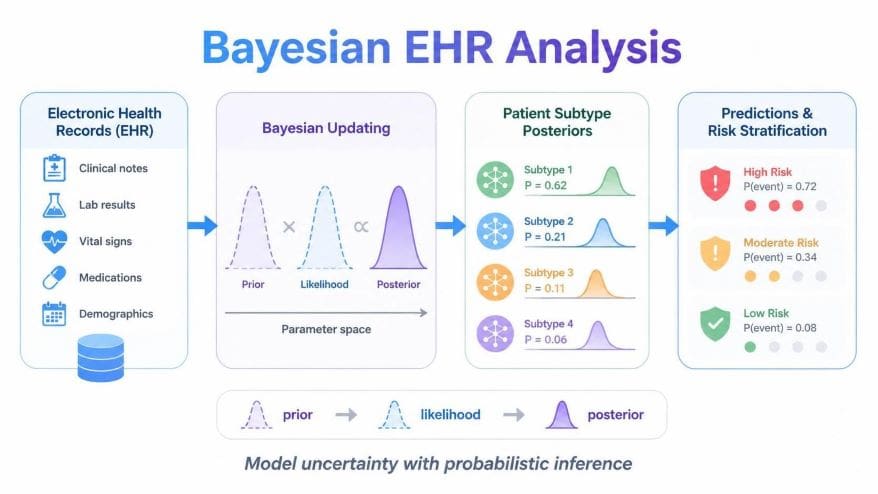
Researchers developed ALADYNOULLI, a Bayesian EHR analysis framework that combines electronic health records (EHRs) with genetic data. This helps to better understand how diseases develop over time. Instead of studying one disease at a time, the model looks at many health conditions together. It also identifies hidden disease patterns that change throughout a person’s life. By analyzing data from more than 683,000 people across multiple biobanks, the framework uncovered important genetic links and disease subtypes. Traditional methods often miss these findings. In addition, it also improved disease risk prediction by using both a person’s medical history and genetic risk factors. As a result, this approach can support earlier disease detection, more personalized healthcare, and new discoveries in human genetics.
Key Takeaways: Bayesian EHR analysis
- Researchers developed ALADYNOULLI, a Bayesian EHR analysis model that combines electronic health records (EHRs), age, and genetic risk into one system.
- The model tracks how diseases begin and change over time. It studies many diseases together instead of examining each one alone.
- Researchers tested the model using data from more than 683,000 people in three large biobanks.
- The study included health records collected over as many as 52 years, giving the model a long-term view of disease patterns.
- ALADYNOULLI found 21 stable disease signatures that appeared in all three populations.
- The model uncovered hidden biological subtypes within common diseases.
- Bayesian EHR analysis, findings help explain why people with the same diagnosis can have different symptoms, disease progression, and health outcomes.
- The framework gives researchers a clearer picture of disease development and supports more personalized healthcare in the future.
Combining Genetic Data with EHR Information
In Bayesian EHR analysis, the ALADYNOULLI framework combines genetic data with electronic health records (EHRs) to give a clearer view of human health. Genetic data shows a person’s inherited risk of disease. Bayesian EHR analysis record illnesses, treatments, and other health events throughout life. The model studies both types of data at the same time. This helps it find disease patterns that may stay hidden when each source is examined on its own.
ALADYNOULLI uses polygenic risk scores to measure a person’s genetic risk. It then matches these scores with long-term health records. This process helps researchers see how genes affect disease over many years. The model also improves disease prediction. It finds hidden disease subtypes and identifies genetic factors that influence several health conditions.
Discovering Biological Subtypes Within Diseases

While studying Bayesian EHR analysis, the ALADYNOULLI framework helps researchers find hidden biological subtypes within the same disease. People with the same diagnosis do not always have the same symptoms, risk factors, or health outcomes. Traditional methods often place all of these patients into one group. ALADYNOULLI takes a different approach. It studies long-term health records, age, and Bayesian EHR analysis and genetic information together.
The model finds groups of patients who follow different disease paths. It also shows that these groups have different genetic profiles. For example, people with the same disease can have different disease signatures. This suggests that the disease may develop through different biological processes. These findings help explain why the same disease affects people in different ways.
Advantages of Multi-Disease Modeling in Bayesian EHR analysis
In study Bayesian EHR analysis, Multi-disease modeling gives researchers a better way to study human health because many diseases happen together. Instead of studying one disease at a time, the ALADYNOULLI framework examines hundreds of diseases at once. It also tracks how they develop and change throughout life. This approach helps the model find shared biological processes that connect different diseases. As a result, ALADYNOULLI can detect disease patterns that single-disease studies may miss.
The model also improves risk prediction. It uses information from common diseases to better understand rare diseases. In addition, the framework shows how several diseases develop together. It finds hidden patient groups and links disease patterns with genetic factors. Because the model uses each person’s complete health history, it provides more accurate and personalized predictions.
Frequently Asked Questions: Bayesian EHR analysis
What is ALADYNOULLI?
ALADYNOULLI is a Bayesian framework that combines electronic health records (EHRs), age, and genetic data into one system. It studies how diseases begin, change, and interact throughout a person’s life instead of looking at each disease on its own.
Why is this framework different from traditional disease studies?
In Bayesian EHR analysis, Old methods look at one disease at a time. ALADYNOULLI is different. It looks at many diseases at once. This helps it find shared body processes. It can spot links that other studies miss.
How does the framework use genetic information?
The model uses genetic data. This includes polygenic risk scores. It links genes with years of health records. This helps find genes tied to disease risk. It also finds genes tied to how disease grows. And genes tied to diseases that happen together
Reference
Urbut, S.M., Ding, Y., Nakao, T. et al. A Bayesian framework for longitudinal EHR and genetic discovery. Nature (2026). https://doi.org/10.1038/s41586-026-10780-5
- Author
- Latest Posts
I completed my Master of Science from the University of Allahabad in 2017 with a strong academic background in life sciences and chemistry. My specialization included Molecular Biology, Microbiology, Genetics, Plant Breeding, Phycology, Paleobotany, and Bioinformatics, along with Organic Chemistry, Inorganic Chemistry, and Physical Chemistry. This multidisciplinary training provided me with a comprehensive understanding of biological systems and analytical scientific approaches.
After completing my postgraduate studies, I gained valuable professional experience in both the education and social development sectors. I worked at A.M. Oxford Public School, where I was actively involved in guiding students toward academic excellence. In this role, I focused on creating an engaging learning environment, encouraging critical thinking, and nurturing students’ curiosity for scientific learning. My experience as an educator strengthened my communication, mentoring, and classroom management skills.
In addition to my teaching experience, I worked with Jeevan Jagriti Foundation, where I contributed to community-based initiatives aimed at improving educational access and awareness among underprivileged sections of society. Through this work, I participated in programs designed to support social development and promote the value of education in marginalized communities.
These professional experiences helped me develop strong interpersonal, leadership, and organizational skills while reinforcing my commitment to education and community service.