BCS II/IV Antibiotics in SPEEK Nanofibers for Wounds refers to the development and application of electrospinning technology..
BCS II/IV Antibiotics in SPEEK Nanofibers for Wounds
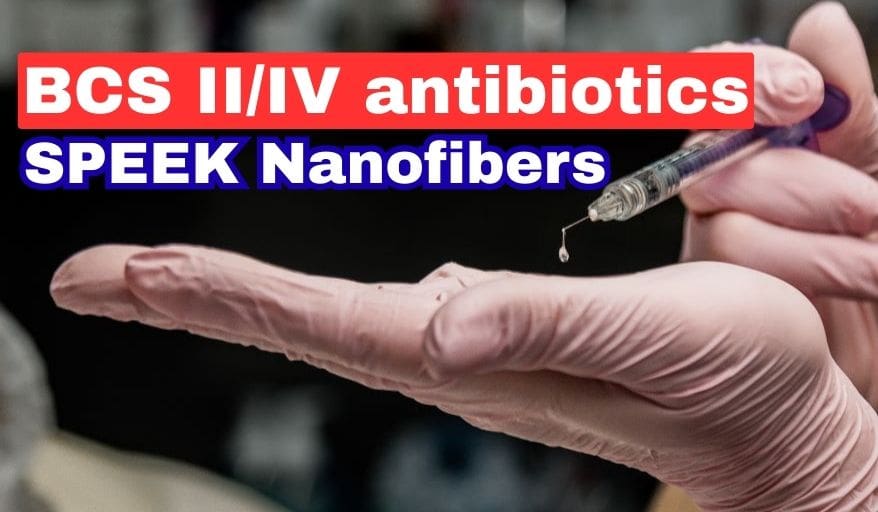
The innovation of BCS II/IV Antibiotics in SPEEK Nanofibers for Wounds refers to the development and application of electrospinning technology to create nanofibers for advanced medical treatments. This process uses high-voltage electricity to turn liquid polymers into tiny fibers, thousands of times thinner than a human hair, which can be loaded with medicines. This is innovative because these nanofibers mimic the body’s natural extracellular matrix (ECM), providing a “scaffold” that helps cells grow and wounds heal much faster than traditional bandages.
Himabindu Padinjarathil, Carmelo Drago, Sandro Dattilo, Libera Vitiello, Kaarthick Raaja Venkatachalam, Thirugnasambandam G. Manivasagam, Prasanna Ramani have conducted study and Published it under the Title “BCS II/IV antibiotics blended with SPEEK nanofibrous mat as an alternative for recurrent wound care: An in vitro and in vivo assessment” in October 2025.
ENTECH STEM Magazine has included this research in its list of the Top 10 Pharmacy Discoveries of 2025.
Practical Usage Areas of BCS II/IV Antibiotics in SPEEK Nanofibers for Wounds

These innovations have several practical applications that could soon change daily healthcare:
Advanced Wound Care
“Smart” bandages can be use for cuts, burns, or chronic sores (like those caused by diabetes). These dressings act as a barrier to germs. While slowly releasing medicine, meaning patients do not have to change their bandages as often.
Better Bone Implants
Traditional metal implants are very stiff and can damage real bone. Using PEEK (a high-performance plastic) for dental or orthopedic implants is better because it feels more like real bone and allows for clearer X-rays.
Preventing Infection
Nanofibers can be uses in specialized fabrics or masks to block bacteria and viruses.
Personalized Medicine
Future medical devices can be 3D-printed to fit a specific patient’s body perfectly, such as for skull reconstructions or dental bridges.
Commercialization Prospectus of BCS II/IV Antibiotics in SPEEK Nanofibers
The source indicate that while some “passive” nanofiber dressings are already available, bioactive and interactive meshes—those that actively fight bacteria or stimulate cell growth—are still primarily in the research and clinical trial phases. Some of the research provided is extremely recent, with publication dates as far as 2025, showing that the field is moving quickly toward real-world use. However, a major hurdle for widespread commercial use is scaling up production from small laboratory batches to large-scale industrial manufacturing.
Also Read: Denosumab vs Zoledronic Acid in Aged Men with Osteoporosis
Educational Research and Career Opportunities
Students interested in this field (BCS II/IV Antibiotics ) can pursue several exciting career paths:
Nanotechnology and Nanomedicine
Designing tiny drug-delivery systems that can target specific areas of the body with extreme precision.
Tissue Engineering
Additionally, Working on “bio-scaffolds” that help the body regrow lost skin, bone, or even organs.
Biopolymer Science
However, Developing new, eco-friendly, and biodegradable materials. Where the body can safely absorb after they have done their job.
Osteoimmunology
A new field that studies how the immune system and bones interact. Which is crucial for making better implants.
Regulatory Affairs
Helping companies navigate the complex rules of organizations like the FDA to ensure new medical innovations are safe for public use.
In summary, this innovation represents a move away from simple “passive” medical tools toward intelligent materials. That work with the body’s own biology to heal and protect. With more clinical research and improved manufacturing, these nanomaterials could soon become a standard part of modern medicine.
Reference
Padinjarathil, H., Drago, C., Dattilo, S., Vitiello, L., Venkatachalam, K. R., Manivasagam, T. G., & Ramani, P. (2025). BCS II/IV antibiotics blended with SPEEK nanofibrous mat as an alternative for recurrent wound care: An in vitro and in vivo assessment. Current Research in Pharmacology and Drug Discovery, 9, 100235. https://doi.org/10.1016/j.crphar.2025.100235
Additionally, to stay updated with the latest developments in STEM research, visit ENTECH Online. Basically, this is our digital magazine for science, technology, engineering, and mathematics. Also, at ENTECH Online, you’ll find a wealth of information.
Disclaimer: We do not intend this article/blog post to provide professional, technical, or medical advice. Therefore, please consult a healthcare professional before making any changes to your diet or lifestyle. In fact, we use AI-generated images for illustration and decoration. Their accuracy, quality, and appropriateness can differ. So, users should avoid making decisions or assumptions based only on the text and images.
- Author
- Latest Posts

I am an inspirational writer and emerging science blogger with a deep-rooted passion for understanding and sharing the wonders of the world around us. My journey began with a Bachelor of Science in Chemistry from AKI’s Poona College of Arts, Commerce and Science, where I developed not only a strong foundation in scientific principles but also a mindset that values curiosity, observation, and critical thinking. Studying chemistry has taught me to approach problems with logic, to look beyond the obvious, and to see patterns where others might only see complexity. These experiences have shaped the way I perceive life and influence the way I express my thoughts, both scientifically and creatively.
I have always believed that knowledge is only as powerful as the way it is shared. This belief has guided me to create content that bridges the gap between science and everyday life. I aim to simplify complex scientific ideas so they become approachable, relatable, and engaging for everyone—whether someone has a formal background in science or is simply curious about the world. Science, in my view, is not confined to textbooks and laboratories; it is a way of thinking, understanding, and connecting with the world around us. By making science accessible, I hope to inspire curiosity, ignite learning, and encourage people to see the beauty and relevance of scientific discovery in their daily lives.
Alongside my love for science, I am deeply passionate about motivational writing. I believe words carry the power to transform perspectives, encourage self-reflection, and inspire action. By combining analytical thinking with creativity, I create content that is intellectually stimulating yet emotionally resonant. Whether I am breaking down a chemical concept, exploring a scientific phenomenon, or crafting motivational narratives, my goal is to communicate ideas in a way that is clear, meaningful, and impactful.
Through my work, I strive to empower my readers – not just by helping them understand the science around them, but by inspiring them to grow, learn, and realize their full potential. Every article, post, or story I write reflects my commitment to turning knowledge into inspiration. I want to spark curiosity, encourage self-improvement, and show that learning and personal growth are deeply connected. For me, writing is not just a craft; it is a way to touch minds, connect hearts, and make ideas come alive in a way that truly resonates.