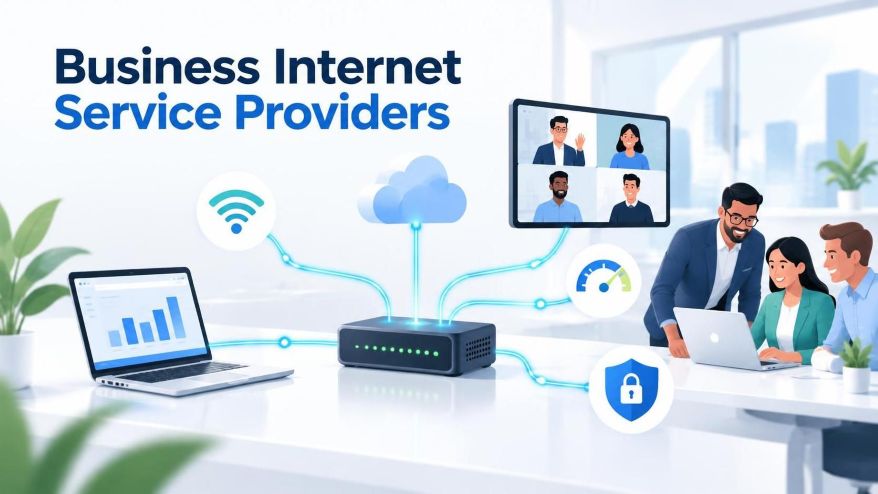
Compare business internet service providers by speed, connection type, reliability, support, and total cost to find a plan that fits your company's needs.
Business Internet Service Providers: Key Takeaways
The right business internet plan depends on actual work demands, not download speed alone.
Small teams often need a plan in the 100 to 500Mbps range, while growing teams may need 500Mbps to 1Gbps or more.
Upload speed, latency, customer support, security options, and backup connectivity can be as important as the monthly price.
Fiber, cable, fixed wireless, 5G, and satellite service each solve different availability and performance needs.
Businesses should compare the full cost of service, including equipment, installation, promotions, contracts, and add-ons.
Choosing business internet is not just a matter of selecting the largest speed number or the lowest introductory price. A practical comparison starts with the company’s location, daily workloads, number of users, upload needs, reliability requirements, and growth plans. The business internet service providers guide from HighSpeedInternet.com gives businesses a structured way to compare plans and narrow a broad provider request into options that fit their operations.
Internet availability, connection types, speeds, and pricing can vary by address. Before enrolling, businesses should verify the final plan details, installation requirements, contract terms, and equipment costs for their specific location.
How to Compare Business Internet Providers
HighSpeedInternet.com compares providers based on more than just headline speed. Its 2026 business guide identifies provider strengths in overall performance, customer satisfaction, small-business value, availability, flexible contracts, and rural service. That approach is useful because a provider that works well for a downtown office may not be the best option for a retail storefront, a remote facility, or a rural operation.
Start every comparison with six questions:
What is the total monthly cost? Ask about the regular price after any promotion, equipment rental, installation, activation fees, taxes, and early termination charges.
What are the typical download and upload speeds? Upload performance matters for cloud backups, file sharing, video calls, remote access, and sending large media files.
Which connection type is offered? Fiber, cable, fixed wireless, 5G, and satellite perform differently and may not be available everywhere.
How many people and devices will use the network at once? Include employees, point-of-sale terminals, phones, cameras, smart devices, and guest Wi-Fi.
What support is available? Confirm business support hours, outage reporting procedures, and escalation options.
Is a backup connection available? LTE or 5G failover can help essential systems stay connected during a wired-service outage.
HighSpeedInternet.com recommends approximately 100 to 500 Mbps for small businesses with 1 to 20 employees, 500 Mbps to 1 Gbps for growing businesses with 20 to 200 employees, and 1 to 10 Gbps for larger enterprise environments. These are starting ranges, not fixed rules. A small design studio that handles large files may need more capacity than a larger office that focuses mainly on email and web-based documents.
Look Beyond Download Speed
A realistic speed estimate accounts for simultaneous demand. Review the busiest part of the day, then list every activity competing for bandwidth. Common drivers include cloud software, VoIP calling, video meetings, payment systems, security cameras, VPN access, shared storage, and customer Wi-Fi. Plan for expected hiring or new locations over the next 12 to 24 months so an upgrade does not become an urgent operational problem.
Which Connection Type Fits Best?
Fig. 1: Internet Connectivity Options
Fiber: Often a strong choice for businesses that need fast upload speeds, cloud-heavy workflows, video conferencing, and room to scale.
Cable: Can provide high download speeds and broad availability, making it a practical option for many offices and storefronts.
Fixed wireless and 5G: Can work well where wired choices are limited or where a company needs fast deployment and backup connectivity.
Satellite: Can provide an option for remote locations with few terrestrial internet options, although latency and bandwidth limits may affect certain applications.
Address-level research should come before provider selection. The FCC’s National Broadband Map lets users search an address and review reported providers, technologies, and available speeds, which can help establish a realistic shortlist.
Why Reliability and Support Matter in Business Internet Service Providers
An outage can interrupt card payments, customer communications, cloud access, scheduling systems, and remote work. Businesses should ask whether a provider offers an uptime commitment or service-level agreement, whether static IP addresses are available when needed, and what happens when the primary connection fails.
Backup service deserves special attention for organizations that cannot afford to go offline. A retail store may need a backup path for transactions, while a professional office may need it for calls and cloud applications. Also, separate provider issues from internal Wi-Fi problems. Weak router placement, overloaded access points, and unsecured guest networks can make a sound internet connection appear unreliable.
How to Control Total Internet Costs
The cheapest advertised plan is not necessarily the best value. Underbuying can slow essential work, while overbuying can leave a business paying for unused capacity. Compare the total cost over the full contract period, including installation, activation, managed Wi-Fi, equipment, static IP addresses, security features, backup service, and the price after promotional discounts end.
Broadband access also has wider economic relevance. The Census Bureau’s broadband availability and adoption data can be viewed alongside measures such as employment, self-employment, and business establishment changes, reinforcing why connectivity planning matters for local businesses and communities.
A Better Decision-Making Process in Choosing right Business Internet Plan
List the applications, devices, and critical workflows that depend on internet access.
Estimate peak simultaneous usage, not just the total number of employees.
Confirm which technologies and providers serve the exact address.
Set a speed range that includes upload requirements and foreseeable growth.
Compare total pricing, support, security features, contract terms, and backup options.
Review the final order carefully before signing, including speed, equipment, data policies, and installation timing.
Frequently Asked Questions: Business Internet Service Providers
What is the best business internet provider?
There is no single best provider for every business. The strongest option depends on address-level availability, connection type, required speeds, budget, support expectations, and the importance of backup connectivity.
Is fiber always the best business internet option?
Fiber is often a strong fit for businesses that need high upload capacity and scalable performance. However, cable, fixed wireless, 5G, or satellite may be a better practical choice when fiber is unavailable or when deployment flexibility is the priority.
Should a small business pay for backup internet?
Backup internet can be worthwhile when downtime would stop payments, communications, customer service, security monitoring, or cloud-based work. Businesses should weigh the cost of failover service against the operational cost of an outage.
Aditya Joshi is an SDE Intern at Coneixement India, the company behind ENTECH STEM Magazine and STEMQuiz. He is a Computer Engineering graduate from Savitribai Phule Pune University (SPPU), with honours in Machine Learning and Data Science. His academic background and hands-on project experience have developed his interest in artificial intelligence, emerging technologies, software development, and the practical applications of computing.
His areas of technical interest include Artificial Intelligence (AI), Generative AI, Machine Learning, Data Science, Large Language Models (LLMs), Natural Language Processing (NLP), Retrieval-Augmented Generation (RAG), GraphRAG, and knowledge graphs. Through projects involving locally hosted language models, Neo4j knowledge graphs, multilingual chatbots, and AI-powered analytics, he has explored how emerging technologies can be used to solve practical problems.
Aditya's professional experience includes work in frontend development, AI/ML application development, and full-stack software projects. During his internships at Maharashtra Knowledge Corporation Limited (MKCL) and Hilwitz Solutions, he worked on applications involving web technologies, Python, Flask, and AI-driven functionality. He has also developed projects such as SalesCope, an AI-assisted sales analytics platform, and a multilingual chatbot designed to help users explore Indian government schemes.
At ENTECH STEM Magazine and STEMQuiz, Aditya brings a technology-focused perspective shaped by his engineering education and practical experience with AI and software systems. He is interested in making complex science and technology concepts easier to understand through clear explanations, relatable everyday examples, and an emphasis on how emerging innovations work and affect real-world applications.
His broader goal is to help bridge the gap between technical concepts and public understanding, encouraging curiosity about artificial intelligence, computing, and the technologies shaping the future.