Coastal mangrove ecosystems play a crucial role in carbon storage, with both above-ground biomass and soil acting as major carbon reservoirs.
Coastal Ecosystem Management: Effects of Mangrove Land Use Change on Carbon Storage
Estimated reading time: 6 minutes
Coastal mangrove forests play a vital role in fighting climate change. In the context of Coastal Ecosystem Management, they serve as essential natural systems for carbon storage and environmental protection. Above all, they act as powerful natural carbon storage systems, trapping carbon in biomass as well as deep soils. To enumerate, these ecosystems store carbon both above and below ground.
At the present time, Coastal Ecosystem Management involves human activities such as aquaculture and urban growth threaten these systems. To illustrate, land conversion reduces their ability to hold carbon. All in all, protecting mangroves is essential for effective Coastal Ecosystem Management.
Above all, researcher I. M. Radjawane and their team developed a study along Java’s northern coast. Prior to this, limited data existed on such changes. To enumerate, the study examined coastal dynamics, land use patterns, as well as carbon variations. At the present time, this research remains highly relevant for understanding coastal ecosystems. Through Coastal Ecosystem Management approach, they showed how different land uses influence carbon stocks in mangroves. In this context, the findings improve our understanding of coastal ecosystems. On the whole, the research offers valuable guidance for protecting these important blue carbon sinks.
Key Takeaways from the Mangrove Carbon Study
- Mangrove soils store most carbon: Up to 93.5% of carbon is in deep soil layers, not just trees.
- Land-use affects carbon distribution: Different uses like aquaculture or natural growth change where carbon is stored.
- Semi-natural areas have the highest total carbon: These zones blend natural conditions with human use.
- Long-term soil stability is crucial: Carbon stored deep underground remains stable despite surface changes.
- Protecting soil and water flow matters more than just managing plants: Hydrological connectivity supports carbon preservation.
Coastal Ecosystem Management study shows that simple labels like aquaculture or forest cannot explain mangrove health alone. Site conditions, sediment types, and management histories impact carbon storage more strongly than land-use category itself.
The Science of Mud
To list clearly, testing uses large metal soil augers. At first, scientists dry mud samples in hot ovens. After that, they measure density using simple math. To enumerate, coastal ecosystem management work requires strong high school math skills as well as basic chemistry knowledge. To explain, these skills help ensure accurate analysis. Above all, carbon analysis supports the protection of endangered coastlines. At the present time, such methods remain essential for environmental studies.
To illustrate, scientists measured carbon stocks in deep muddy layers. They tested soil up to 150 cm using special metal tubes. In summary, thick sediments store large amounts of trapped energy. Beyond that, old ponds hold carbon in waterlogged mud.
The Science Behind Mangrove Carbon Storage
Mangrove Land Uses in Northern Java
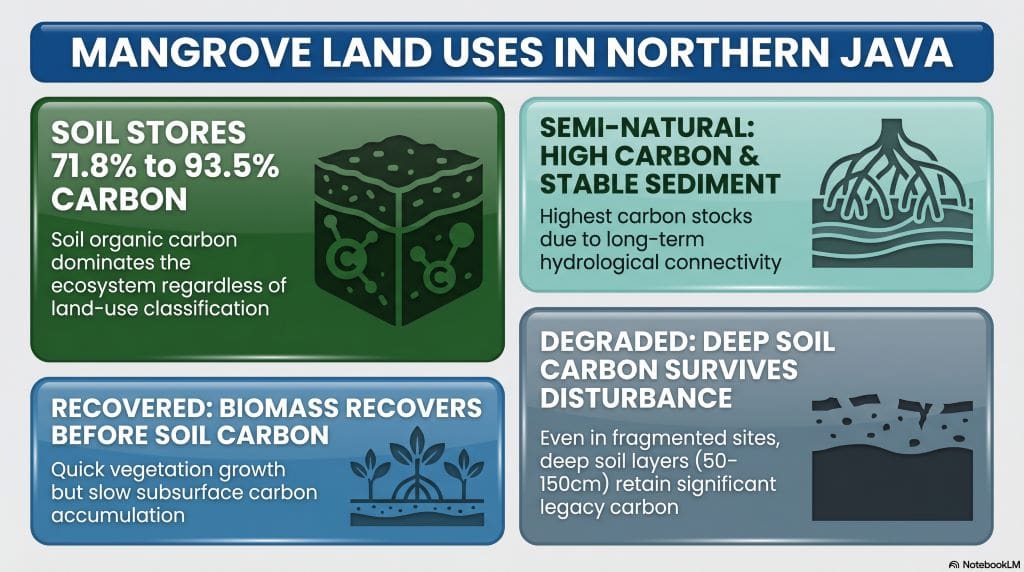
To enumerate, recovered sites are areas restored after degradation with growing vegetation. Over time, they show gradual ecological recovery. At the same time, semi-natural systems remain mostly intact forests with limited human impact. To put it another way, they maintain stable structure and function as well as ecological balance. Above all, Coastal Ecosystem Management systems are important for long-term sustainability. At the present time, they offer valuable insight for ecosystem management. Degraded sites are heavily disturbed zones with sparse vegetation due to ponds or urbanization. As a result of such pressures, ecosystem quality declines.
Mangroves store carbon in above-ground biomass like trunks and branches, and in roots below ground. Under low-oxygen conditions, soil organic carbon builds up over centuries. Across different land uses, biomass may vary, but soil remains the main carbon pool despite disturbance or management.
| Site | Biodiversity Status | Main Species | Sediment Type |
|---|---|---|---|
| Tenjo Ayu (Degraded) | Pond Fragmented | Avicennia sp. | Muddy sand |
| Tanjung Pasir (Semi-Natural) | Pond Urbanized | Rhizophora & Avicennia sp. | Silty mud, sand |
| Tanjung Tiga (Semi-Natural) | Pond Natural | Avicennia sp. | Muddy sediments |
| Patimban (Recovered) | Pond Restored | Avicennia sp. | Muddy to sandy sediments |
This table summarizes key site details. It highlights different ecological conditions along Java’s coast linked to carbon storage potential. At a glance, variations across locations become clear. With this insight, conservation efforts can be better targeted.
Mangroves and Your STEM Career Pathways: Real-Life Science Applications
If you’re excited about science subjects right now, consider how studying mangroves can connect your learning to real-world environmental solutions. To list a few career options inspired by this research:
- Aquatic ecologist – Study how marine life interacts with habitats like mangroves. In this role, you help protect biodiversity and ecosystem balance.
- Civil engineer – Design water systems that support natural flow. At the same time, you maintain hydrological links needed for healthy blue carbon ecosystems.
- Meteorologist or climate scientist – Model how coastal vegetation changes affect greenhouse gases. Through this work, you track emissions like methane and nitrous oxide near aquaculture sites.
- Sustainability policy advisor – Use scientific data to guide environmental rules. With this knowledge, you balance development and conservation in tidal forests.
- Agricultural technologist – Create sustainable aquaculture methods. Along this line, you combine food production with ecosystem restoration near mangroves.
Your curiosity in biology, chemistry, physics, or math can lead to exciting paths in blue economy science. In this field, many opportunities connect science with real-world impact.
With growing awareness, understanding local and global environmental issues gives you a strong advantage. It supports access to scholarships and meaningful internships.
At an early stage, building your STEM skills opens future possibilities. For more guidance, explore STEM education resources today.
This cutting-edge research highlights the complex dynamics of coastal environments. At a deeper level, it shows how these systems control natural climate solutions. In practical terms, true understanding comes from combining science with management policies.
For students seeking meaningful careers, this field offers strong opportunities. Looking ahead, studying mangrove ecosystems connects nature with technology. On this path, it supports solutions aligned with global needs.
Frequently Asked Questions
How does aquaculture affect mangrove forests?
Aquaculture sometimes reduces vegetation but may keep some greenery if managed properly.
Why does deep soil hold so much carbon?
Because the wet soils preserve organic matter from decaying quickly due to lack of oxygen.
Why is the deep mud important?
In fact, it stores massive energy underground
Can fish ponds be completely safe?
To be sure, careful management helps ponds survive
Reference:
- D.G.K. Ketaren, I.M. Radjawane, H. Latief1 , F. Sidik , S.W. Trenggono, S.D. Diantara, N.A.R. Setyawidati, M.I. Akbar , J.A.L. Raja, M.A. Farkhan, K. Kasim, S. Maharani,(2026) Impacts of mangrove land use change on carbon stocks in coastal ecosystems, Global Journal of Environmental Science and Management. https://doi.org/10.22034/gjesm.2026.03.10
- Author
- Latest Posts

I completed my Master of Science from the University of Allahabad in 2017 with a strong academic background in life sciences and chemistry. My specialization included Molecular Biology, Microbiology, Genetics, Plant Breeding, Phycology, Paleobotany, and Bioinformatics, along with Organic Chemistry, Inorganic Chemistry, and Physical Chemistry. This multidisciplinary training provided me with a comprehensive understanding of biological systems and analytical scientific approaches.
After completing my postgraduate studies, I gained valuable professional experience in both the education and social development sectors. I worked at A.M. Oxford Public School, where I was actively involved in guiding students toward academic excellence. In this role, I focused on creating an engaging learning environment, encouraging critical thinking, and nurturing students’ curiosity for scientific learning. My experience as an educator strengthened my communication, mentoring, and classroom management skills.
In addition to my teaching experience, I worked with Jeevan Jagriti Foundation, where I contributed to community-based initiatives aimed at improving educational access and awareness among underprivileged sections of society. Through this work, I participated in programs designed to support social development and promote the value of education in marginalized communities.
These professional experiences helped me develop strong interpersonal, leadership, and organizational skills while reinforcing my commitment to education and community service.