A brief overview of ducted rockets and the potential use of boron particles as fuel is also mentioned, which will offer future opportunities to overcome existing challenges.
Evolution of Ramjet Engines: Past and Present

Estimated reading time: 12 minutes
The article gives an overview of the evolution of subsonic combustion and ramjet engines. A review of worldwide development is provided from the initial testing phase to the current applications. The explanation briefly covers how a ramjet engine works. The article further discusses the major programs undertaken and the countries that made significant contribution in the evolution and success of the ramjet designs. The summary covers how different military programs use variants of ramjets. It also provides a brief overview of ducted rockets and explores the potential of boron particles as fuel, offering future opportunities to overcome existing challenges.
Introduction
The study starts by looking at past tech advances to better understand current issues and avoid repeating mistakes. The history of aeronautics started with kites and gliders and had evolved over more than two thousand years through various brilliant minds and ideas, when the Wright Brothers tested their first successful flying machine in 1903. With modern air-breathing engines, we are hitting speeds that were once thought impossible, along with much better efficiency and reusable designs. This study will cover some remarkable advancements in this field from the last century.
The aim is to present an overview of the working principles of ramjet engines and to trace the technological advancements made over the years.
These changes have gradually solved the main problems linked to ramjets.

Operation of ramjets
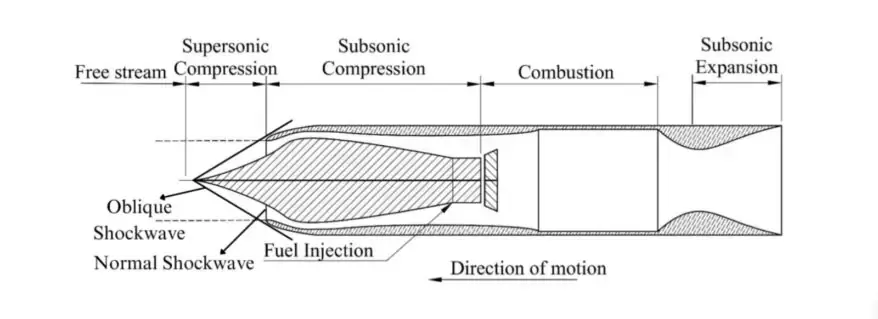
A ramjet engine is a type of air-breathing engine that is commonly used in aircraft. It operates by taking in incoming air and subsequently releasing hot gases, which in turn produce forward propulsion or thrust. As shown in Figure 1 below, the power cycle of a ramjet engine is illustrated. Notably, it functions most efficiently at supersonic speeds, as it has no moving parts, such as a compressor or turbine. Instead, it generates thrust solely through the ram effect. As air enters through the inlet, the velocity of the air gradually decreases, while the static pressure steadily increases. A mix of fast and slow inlet designs, including angled and straight shock waves, compresses the air.
This process slows the air to subsonic speeds while significantly increasing its pressure and temperature.
The energized and highly compressed air then enters the combustion chamber, where it is thoroughly mixed with fuel and subsequently ignited. As a result, the combustion gases are rapidly expanded through the nozzle, effectively converting heat into kinetic energy to produce movement and thrust. This change in momentum generates thrust (F), which is calculated as: F = (mass flow rate of exhaust gas × jet velocity) – (mass flow rate of inlet air × inlet velocity). Even though the ramjet is a very fast air-breathing engine, it burns fuel at speeds slower than sound. For this reason, people sometimes refer to it as a subsonic combustion ramjet engine.
The primary drawback of the ramjet engine is its inability to produce static thrust, meaning it cannot start from a stationary position on the ground.
An auxiliary system must accelerate it to supersonic speeds before activating the engine.
Progress in ramjet technology has reached important goals. Today, ramjets combined with rocket engines create a single system that can launch from a stopped position, making them ideal for missile use.
Types of Ramjet Engine
Experts categorize the ramjet engine into three major variants:
- liquid fuel ramjet (LFRJ)
- solid fuel ramjet (SFRJ)
- ducted rocket (DR)
A liquid fuel ramjet engine burns liquid fuel like hydrocarbons ahead of the flame holder to produce thrust. Supersonic target missiles and long-range supersonic cruise missiles use LFRJ engines.
In a solid fuel ramjet engine, the fuel is a composite material often consists of hydrocarbons, oxidizers, and binder. SFRJ do not require built-in oxidizer as they depend on atmospheric air for combustion.
The ducted rocket engine is an advance propulsion system that features two combustion chambers. The main combustor is a rocket motor that creates fuel-rich hot gases. The secondary combustor uses energized air from the atmosphere to reignite and burn the gases from the main combustor [3]. Hence, ducted rockets do not require any auxiliary system to start the system and widely used in missile applications.
To produce static thrust, other kind of engines are also in practice. They are air-turboramjet (ATRJ) which contains turbojet within the ramjet engine, and air turbo rocket (ATR), in which a rocket engine is inside the main engine. The ejector ramjet (ERJ) is the final variant of this kind.
Rocket-based combined cycle with small rocket motors in flow path of the ramjet engines can also provide the initial thrust.
In the same way, a turbine-based combined cycle system first uses a turbojet engine from take-off until reaching the speed needed for a ramjet. In all these kinds of engines, once it reaches supersonic speed, the system transitions and uses the ramjet engine.
Also read: Non Polluting Combustion Engine
History of Ramjet Engine Development
Early Concepts and Development of Ramjet Engines
Researchers introduced ramjet concepts in the early 1900s and began manufacturing and testing viable designs in the mid-1930s. Lorin was the first person to examine the propulsion devices that did not have any obstruction in the flow of free stream, called ejector ramjets. In 1926, Carter from Great Britain designed the first ramjet-like devices, featuring one with an annular duct and a conical nose, and the other with a cylindrical duct and a normal intake. Fono from Hungary got a patent in 1928 for the first known ramjet with a cone-shaped nose. It included a special inlet diffuser that narrows and widens, fuel injectors, flame holders, a combustor, and a nozzle that also narrows and widens.
Leduc ground-tested a conical ramjet in the mid-1930s and conducted component tests by 1939. By this time, engineers had also started working on ramjet-powered aircraft. In 1935 development in the artillery shells powered by multiple-shock and conical-inlet LFRJ was going on.
Germans improved ramjet technology, the V-1 Buzzbomb which was the first operational ramjet missile. The Soviet Union tested a tandem-boosted ADR flight in 1939, under Merkulov.
Post-War Expansion and Global Ramjet Development
After war, nations like the US (Bomarc, Talos), Great Britain (Bloodhound), and others expanded ramjet systems. By the 1980s, countries like China (C-301), South Africa (LRAAM), India (BrahMos), and Israel joined the development race, with France, the US, Russia, and Germany continuing progress on advanced missiles and targets.
The Atlantic Research Corporation worked on combustion of boron. In 1988, a research group at Pennsylvania State University investigated the ignition of solid fuels using HTPB, with boron to enhance the volumetric impulse in ramjets.
In the 2000s, research grew even more. Israel tested fuels with additives like boron and boron carbide. Around 2016-17, researchers at Purdue University, USA, set up a high-pressure combustion facility. They used it to investigate performance with HTPB-based fuels.
These programs provide an advanced understanding of ramjet technology evolution, and the discussion will cover them in detail later.
Advancements in Ramjet Engine Development Programs
Albert Fono’s First Concept (1915)
The very first propulsion system like a ramjet was developed in 1915 by Albert Fono, a Hungarian inventor.
His idea revolved around the concept of using high-speed airflow to compress air, then mixing it with fuel to ignite and create thrust.
In 1920, Rene Lorin, a French engineer, put forward the idea of a ramjet which relied on the aircraft reaching high speed for compressing air. Additionally, the system ignited it after mixing it with fuel.
In the late 1930s, Sanger and Bredt began developing a suborbital rocket bomber called the Sanger-1 or RaBo (Antipodal Bomber) [6]. It was able to strike targets at intercontinental distances. Engineers integrated the RaBo with a long sled that propelled it to its take-off speed. Then, the onboard engine produced a thrust of around 900kN, launching the body into a ballistic trajectory reaching several hundred miles in altitude.
Advancements in the 1930s and 1940s
Soon after the second World War, the U.S. developed drones propelled by airbreathing engines. McDonald developed the Katydid KDH-1, a pulsejet-powered target drone, in 1942. After 1944, Marquardt Company started making ramjet engines with the primary target of cost-effectiveness.
Ramjet Engine – Testing and Military Applications (1946-1960s)
The first demonstration (1946) involved a North. The first test used the American P-51 Mustang as the carrier aircraft, while the second, flown in 1948, utilized a turbojet-powered, high-speed Lockheed F-80 Shooting Star fighter [7]. In both cases, engineers initially loaded the ramjets with excessive fuel to achieve maximum thrust, which caused large exhaust flames that diminished as flight speed increased. One of the most famous ramjet projects was the United States Navy’s Bumblebee, which aimed to create a surface-to-air missile system using ramjet engines. It began in 1944 leading to the creation of the CIM-10 Bomarc missile, which became the first long-range surface-to-air missile to be deployed by the US. The missile’s development showed that ramjets can work well for military use.
In the 19th, engines used here, Pratt & Whitney J58 engines, were hybrid turbo-ramjets, meaning they operated as turbojets at low speeds but transitioned to ramjet-like operation at high speeds. In 60s, the United States developed the hyper jet concept to connect the ramjet engine with a liquid propellant booster, such as kerosene and hydroen peroxide. Engineers successfully tested it at velocities exceeding Mach 5.
One of the most notable and impactful applications of ramjet technology in the 1960s was the SR-71 Blackbird, a strategic reconnaissance aircraft that was developed and built by the Skunk Works unit at Lockheed Martin.
he engines used here, Pratt & Whitney J58 engines, were hybrid turbo-ramjets, meaning they operated as turbojets at low speeds but transitioned to ramjet-like operation at high speeds.
International Ramjet Engine Development (1980s-1990s)
During the next 20 years, the pace of development increased internationally. In 1980, France initiated the development of ASMP to address the need for an air-launched nuclear stand-off weapon. Meanwhile, during the 1980s, the United States launched the VFDR program, which achieved numerous successes, such as designing an all-in-one engine system, producing lightweight, flight-ready components, and developing a robust and efficient design. Additionally, the program led to the creation of a booster nozzle, which performed 103% as efficiently as expected during tests conducted in both cold and hot temperatures, ranging from -65°F to 145°F. Furthermore, engineers rigorously tested a flight-type gas generator and a throttle valve set under harsh conditions. Ultimately, the main engine’s performance either met or surpassed the initial expectations.

In the first half of the 1980s, India began the indigenous development of its own medium-range SAM, the AKASH missile. Meanwhile, during the 1990s, China developed the CSS-C-6 Sawhorse, a shore-based anti-ship missile. Later on, in the late 1990s, the BrahMos was jointly developed by Russia and India as a supersonic cruise missile. Notably, it utilized a ramjet engine, which enabled the missile to maintain supersonic speeds throughout its entire flight.
The BrahMos was one of the first to integrate not only a solid-propellant booster but also a liquid-fuel ramjet, which provided it with superior speed and range over traditional missile systems.
Germany started working on the ARMIGER missile which had a Mach 3 IRR design and used a boron-based solid fuel sustainer. The BVRAAM/Meteor was another milestone in the area of air-to-air weapons which employed a solid propellant booster. It was developed to deliver kinematic performance which significantly surpassed that of current MRAAMs.
Ramjet Engine Research and Fuel Innovations (1995-Present)
Between 1995 and 2000, TNO in the Netherlands and FOA in Sweden conducted a collaborative study on SFRJ propulsion for gun-launch projectiles. At the same time, researchers in South Korea also carried out experiments with the same objective. In particular, researchers closely examined how boron particles burn in air-breathing engines and the challenges associated with running these engines under varying conditions. Furthermore, similar experiments were conducted using HTPB-based fuel mixed with different metals to study various regression rates. Later on, in 2005, in Germany, Eisenreich and his team explored different methods to analyze how particle-filled solid fuel burns for SFRJ applications.
During 2010, study was performed on boron combustion modelling with the aim to get the model for single boron particle to use in computational analysis at Munich University. Israel kept studying the heat and pressure conditions in ramjet burners that use boron. This eventually led to forming the reaction barrier. They were also experimenting with different quantities of aluminium granules in HTPB-based fuel for mass flow rate.
Researchers at the Naval Surface Warfare Center carefully conducted a series of experiments in order to thoroughly study the combustion properties of a small percentage of HTPB, which was specifically combined with nitrous oxide, oxygen, and hot air for potential applications in hybrid rockets and SFRJ. Meanwhile, scientists at Stanford University recently studied various ways to improve the mechanical properties and burning performance of HTPB fuel mixed with boron.
Researchers in China and South Korea also conducted experiments with HTPB-based fuel and additives. In 2020, Muller and Gany experimented on expandable graphite to prove that it improves the rate of regression of hybrid rockets or SFRJ.
Researchers at the Indian Institute of Technology conducted a study to understand the burning rates of boron-loaded HTPB-based fuels for ducted rocket use.
Also read: A Single Atom Can Drive a Piston in a Quantum Engine
Conclusion
This article provides details on the growth and change of ramjet engines, highlighting key technology breakthroughs. It looks at why each step forward is important and how ramjet technology is used in different military missions by following what organizations worldwide have done.
Airbreathing engines offer many benefits over other rockets, including flexibility, reusability, and the potential for higher efficiency, speed, and missile range. Researchers briefly mention advancements in various fuels and combustion technologies that meet the requirements of many aerospace and defense applications.
It also discusses the countries and groups involved in developing ramjet engine technology, highlighting key achievements over the last hundred years. Advancement like SR-71 Blackbird that was developed by Skunk Works, a unit of Lockheed Martin. The BrahMos supersonic cruise missile was another remarkable feat, developed by Russia and India in the late 1990s.
Ramjet technology has gotten a lot better over the years and is important for propulsion, helping the military and space access. However, numerous challenges remain to be tackled by the next generation.
References
- Avery, W. H. (1955). Twenty-five years of ramjet development. Journal of Jet Propulsion, 25(11), 604-614.
- Thomas Jr, A. N. (1957). Some fundamental aspects of ramjet propulsion. Journal of Jet Propulsion, 27(4), 381-385.
- Waltrup, P. J. (1987). Hypersonic airbreathing propulsion: Evolution and opportunities. Applied Physics Laboratory, The Johns Hopkins University.
- Fry, R. S. (2004). A century of ramjet propulsion technology evolution. Journal of propulsion and power, 20(1), 27-58.
- Veraar, R. G., Oosthuisen, R., & Andersson, K. (2022). ramjet propulsion for projectiles − an overview of worldwide achievements and future opportunities. International Journal of Energetic Materials and Chemical Propulsion, 21(5).
- Sanger, E., & Bredt, I. (1947). A Ram-Jet Engine for Fighters (No. NACA-TM-1106).
- Escher, W. J. D., “Back to the Future, Our Ramjet/Rocket Propulsion Heritage–A Kaiser Marquardt Historical Review,” 1997.
- Hashim, S. A., Karmakar, S., & Roy, A. (2019). Effects of Ti and Mg particles on combustion characteristics of boron–HTPB-based solid fuels for hybrid gas generator in ducted rocket applications. Acta Astronautica, 160, 125-137.
- Gao, Y., et al. (2010). Principle of conforming water-fuel ratio for metal matrix fuel water-ramjet engine. Key Engineering Materials, 450, 474-477. https://doi.org/10.4028/www.scientific.net/kem.450.474
- Kamin, M., et al. (2024). The nexgen burner: Analysis of turbulent fuel-air mixing. Volume 3B: Combustion, Fuels, and Emissions. https://doi.org/10.1115/gt2024-129399
- Ramakrishnan, M., et al. (2020). Development of nano‐al based highly metalized fuel‐rich propellant for water ramjet propulsion applications. Propellants, Explosives, Pyrotechnics, 45(7), 1026-1040. https://doi.org/10.1002/prep.201900384
Additionally, to stay updated with the latest developments in STEM research, visit ENTECH Online. Basically, this is our digital magazine for science, technology, engineering, and mathematics. Further, at ENTECH Online, you’ll find a wealth of information.
- Author
- Latest Posts

Dr. S. A. Hashim holds a Ph.D. in Aerospace Engineering from IIT Kharagpur, with a specialization in rocket propulsion. He currently serves as a Director of COE-Propulsion Systems and Associate Professor at the Department of Aerospace Engineering, Alliance University, Bangalore, India. Reach out to him at [email protected].