Genetic Suppressor Genes Transform Mendelian Disease Treatment Strategies
Genetic Suppressor Genes Offer New Hope For Patients
Genetic diseases often arise from a single faulty gene. Yet, new research shows that other genes can sometimes reduce or even block the harmful effects of that mutation. These helpful genes, called genetic suppressors genes, may open a new path for treating rare inherited disorders. Instead of trying to repair the damaged gene itself, scientists can target suppressor genes to restore normal biological functions. As new genome-editing tools, large-scale genetic studies, and artificial intelligence methods improve, researchers are discovering more of these natural protective mechanisms. Consequently, this exciting approach could lead to safer, more affordable, and more effective treatments for many Mendelian diseases. Many of these diseases currently have few or no therapeutic options.
Key Takeaways
- First, most Mendelian diseases still have no effective treatment. As a result, current care often focuses on managing symptoms rather than fixing the root genetic problem.
- Next, genetic suppressors genes are special genes that can reduce or block the harmful effects of a disease-causing mutation. In other words, they act as natural protectors in the body.
- Moreover, targeting suppressor genes may offer a new treatment strategy when repairing the faulty gene is difficult or impossible. For this reason, they are a promising backup plan.
- Additionally, many suppressor genes can be turned into drug targets. That is because their effects may be copied by medicines, antibodies, or gene-based therapies.
- For example, successful therapies already exist. Specifically, drugs targeting BCL11A for sickle cell disease and PCSK9 for familial hypercholesterolemia have shown strong clinical benefits.
- Furthermore, research suggests that suppressors may be common across many inherited disorders. Consequently, they could become a valuable source of future treatments.
- Finally, scientists can discover suppressor genes through several methods. These include genome-wide association studies, family studies, animal models, and CRISPR-based genetic screens.
What Are Genetic Suppressors?
Genetic suppressors genes are like “genetic fixes.” They are specific gene changes that can hide or fix the bad effects of a harmful mutation. When one gene has a problem that causes a disease, a change in a second gene can sometimes turn things back to normal. Scientists are finding that these special gene pairs could be new targets for drugs. By using medicine to copy the helpful effect of the suppressor gene, they might treat Mendelian diseases without changing the main broken gene. This is a big step toward simple, smart treatments.
Types of Genetic Suppression: Intragenic and Extragenic
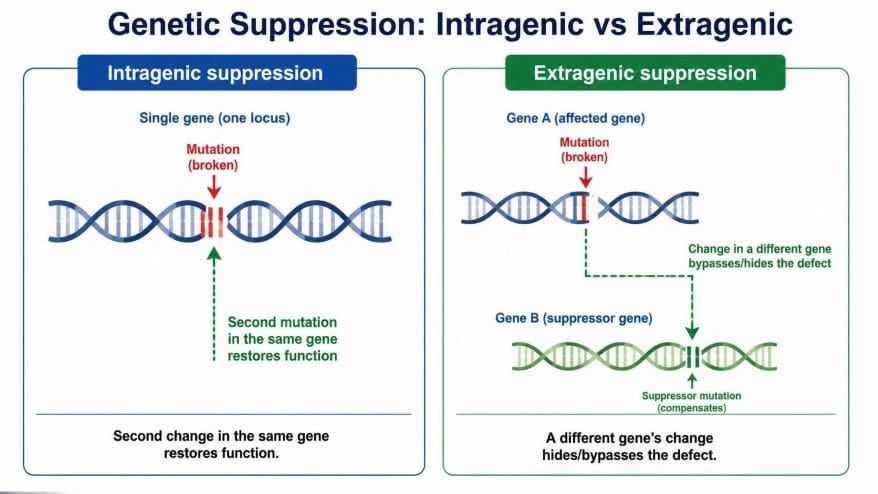
In genetic suppressors genes, There are two main types of genetic suppression: intragenic and extragenic. Intragenic suppression happens when a second change in the same broken gene fixes the first problem. Think of it as a “fix within the same part” – the gene gets a second edit that makes its protein work again. Extragenic suppression is different. Here, the fix comes from a second, totally separate gene. This second gene’s change can hide or bypass the harm from the first broken gene. So, for Mendelian diseases, finding these extragenic suppressors is exciting. They point to new paths for drugs that can copy the helpful effect without touching the main broken gene. This simple idea opens the door to smart, new treatments.
Examples of Suppressor-Based Therapies
On studying genetic suppressor genes we found real examples of genetic suppressor therapies which are already in use or in development. One well-known case is cystic fibrosis. Here, a broken gene stops a key protein from working. Some drugs act as a genetic suppressor – they fix the protein’s shape so it can work again. This is a good example of a genetic suppressor in action.
Another example is for certain blood disorders. A drug called luspatercept helps the body make more healthy red blood cells. It does this by blocking a signal that slows down blood cell growth. This is a form of extragenic genetic suppressor: the drug targets a second pathway to fix the main problem. So, this drug works like a genetic suppressor by using a different route.
For some types of muscular dystrophy, a drug named ataluren works like a “read-through” genetic suppressor. It helps cells skip a bad stop signal in the gene so the protein can be made. This is another way a genetic suppressor can help the body work better. These examples show that using a genetic suppressor as therapy is not just a theory. It is a working, clever way to treat diseases by helping the body fix itself. Finding and using the right genetic suppressor is a big step forward.
Frequently Asked Questions
What are genetic suppressors genes?
Genetic suppressors genes are genes or tiny changes in genes that can lower or stop the bad effects of a disease gene. They help the body work well, even when a broken gene is still there.
Why are genetic suppressors important for treating Mendelian diseases?
Most Mendelian diseases have no cure. Genetic suppressors give us a new way to treat them. Instead of trying to fix the broken gene, scientists can aim at these helpful, protective genes. This is a simpler and smarter path to a cure.
How do scientists find genetic suppressor genes?
To find genes that protect against disease, researchers use a few smart tools. They look at big groups of people, study families, and test many genes at once in the lab. They also use animal models and large genetic databases. These methods help spot the helpful genes that can block or hide the harm from a broken gene.
Reference
Paltenghi-Peceva, C., van Schie, S., Heidari, E., Friend, S., & van Leeuwen, J. (2026). Genetic suppressors as new therapeutic targets for Mendelian diseases. Trends in Genetics. Advance online publication. https://doi.org/10.1016/j.tig.2026.06.003
- Author
- Latest Posts

I completed my Master of Science from the University of Allahabad in 2017 with a strong academic background in life sciences and chemistry. My specialization included Molecular Biology, Microbiology, Genetics, Plant Breeding, Phycology, Paleobotany, and Bioinformatics, along with Organic Chemistry, Inorganic Chemistry, and Physical Chemistry. This multidisciplinary training provided me with a comprehensive understanding of biological systems and analytical scientific approaches.
After completing my postgraduate studies, I gained valuable professional experience in both the education and social development sectors. I worked at A.M. Oxford Public School, where I was actively involved in guiding students toward academic excellence. In this role, I focused on creating an engaging learning environment, encouraging critical thinking, and nurturing students’ curiosity for scientific learning. My experience as an educator strengthened my communication, mentoring, and classroom management skills.
In addition to my teaching experience, I worked with Jeevan Jagriti Foundation, where I contributed to community-based initiatives aimed at improving educational access and awareness among underprivileged sections of society. Through this work, I participated in programs designed to support social development and promote the value of education in marginalized communities.
These professional experiences helped me develop strong interpersonal, leadership, and organizational skills while reinforcing my commitment to education and community service.