Chemotactic Self-Organization Generates Diverse Mammalian Hair Follicle Arrangements
Chemotactic Self-Organization Shapes Mammalian Hair Follicle Pattern Formation
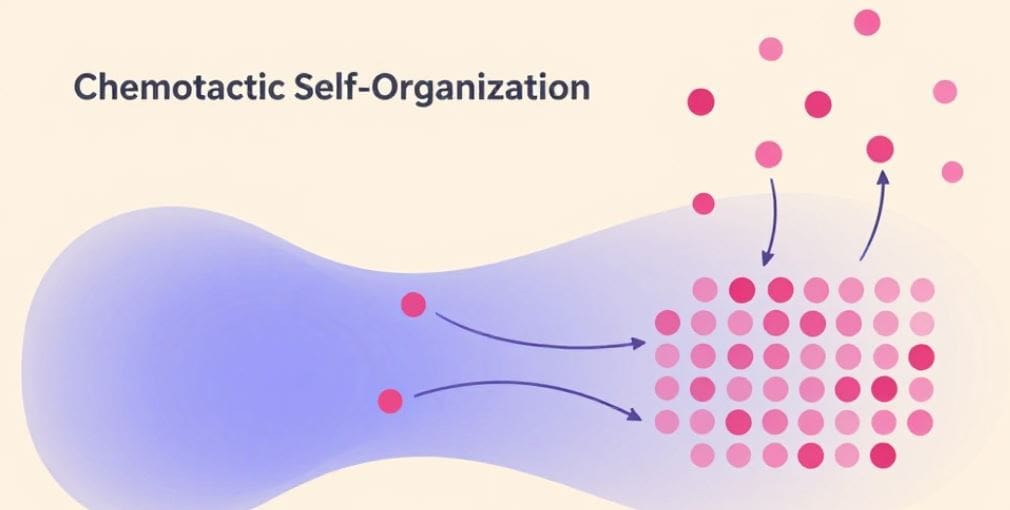
A new study, Chemotactic Self-Organization Captures the Dynamics of Mammalian Hair Follicle Patterning, reveals that hair follicles do not need a complex biological map to know where to grow. Instead, simple cell movements and chemical signals guide them into organized patterns. Researchers found that cells naturally move toward chemical attractants, creating evenly spaced follicle arrangements across developing skin. As a result, this self-organizing process explains hair pattern formation in both laboratory mice and spiny mice. Both types have very different coat designs. The findings show how simple cellular interactions can produce the remarkable diversity of fur patterns seen in mammals. Additionally, they provide fresh insights into the fundamental rules that shape tissues during development.
Key Takeaways
- Researchers found that hair follicles form through a simple process called self-organization. They do not need a complex genetic blueprint. Instead, cells follow nearby chemical signals and naturally create an orderly pattern.
- First, skin cells release chemical signals that attract other cells. Next, nearby cells move toward these signals. Then, groups of cells gather in the right places. As a result, new hair follicle precursors form in a regular pattern across the growing skin.
- The study showed that chemotaxis, or cell movement toward chemical signals, explains how hair follicle patterns develop in mammals.
- The researchers also tested this model in laboratory mice. The model accurately reproduced hair follicle formation. As a result, its predictions closely matched the patterns seen in developing mouse embryos.
The Concept of Chemotactic Self-Organization
Chemotactic self-organization is a simple way that cells form orderly patterns. Cells sense chemical signals around them and move toward stronger signals. As they move, they interact with nearby cells and change their positions. Over time, these small local movements create large, organized patterns. This process does not need a complex biological blueprint.
In this study, researchers found that developing skin cells use chemotaxis to form hair follicles. First, some skin cells release chemical signals that attract nearby cells. Next, neighboring cells move toward these signals. Then, the cells gather in specific spots. These groups become early hair follicle structures called placodes. As a result, hair follicles form in an even pattern across the skin.
Chemotaxis as a Driver of Hair Follicle Spacing
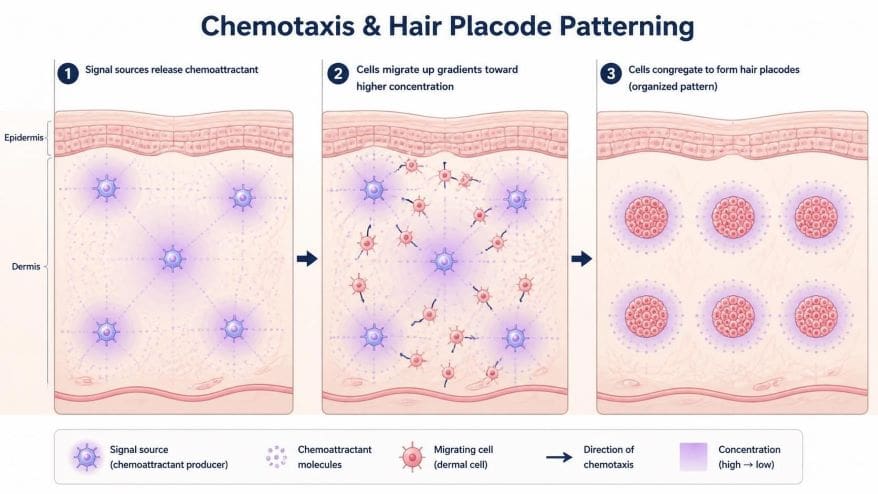
Chemotaxis helps explain how hair follicles form at the right distance from each other during development. In this process, cells move toward chemical signals in the skin. As the cells gather, they form the first structures that later become hair follicles. This process creates an even and organized pattern.
First, developing skin cells release chemical signals. Next, nearby dermal cells detect these signals and move toward them. Then, the cells gather in specific places. These cell groups form hair placodes, the first visible signs of hair follicle development. As a result, hair follicles appear in a regular and predictable pattern across the skin.
Conclusion
This study shows that chemotactic self-organization explains how mammals form neat and evenly spaced hair follicles. Cells do not need a complex system that tells each follicle where to grow. Instead, they respond to nearby chemical signals and arrange themselves into regular patterns. As a result, simple cell actions create complex hair patterns.
The researchers also found that the same process works in both laboratory mice and spiny mice. Even though these animals have very different fur patterns, they use the same basic way to form hair follicles. Small changes in how cells move and respond to chemical signals produce different hair patterns. Therefore, the same simple process can create many types of fur patterns in mammals.
Frequently Asked Questions
What is chemotactic self-organization?
Chemotactic self-organization is a simple process in which cells move toward chemical signals. As the cells move, they gather in specific places. In developing skin, these cell groups become the first hair follicle precursors. As a result, hair follicles form in an even and organized pattern without the need for a complex biological blueprint.
How do hair follicles form during development?
First, skin cells release chemical signals that attract nearby cells. Next, dermal cells move toward these signals. Then, the cells gather in small groups. These groups form placodes, the earliest stage of hair follicle development. As a result, hair follicles appear in a regular and even pattern across the skin.
How does chemotaxis help create evenly spaced follicles?
Chemotaxis guides cells toward chemical signals. As the cells move, they gather with nearby cells and form small clusters. These clusters appear in an organized way, not at random. As a result, hair follicles form at regular distances across the skin and create an even pattern.
Reference
Ibrahimi, M., Jahanbakhsh, E., Tzika, A. C., & Milinkovitch, M. C. (2026). Chemotactic self-organization captures the dynamics of mammalian hair follicle patterning. Proceedings of the National Academy of Sciences, 123(27), e2530407123. https://doi.org/10.1073/pnas.2530407123
- Author
- Latest Posts

I completed my Master of Science from the University of Allahabad in 2017 with a strong academic background in life sciences and chemistry. My specialization included Molecular Biology, Microbiology, Genetics, Plant Breeding, Phycology, Paleobotany, and Bioinformatics, along with Organic Chemistry, Inorganic Chemistry, and Physical Chemistry. This multidisciplinary training provided me with a comprehensive understanding of biological systems and analytical scientific approaches.
After completing my postgraduate studies, I gained valuable professional experience in both the education and social development sectors. I worked at A.M. Oxford Public School, where I was actively involved in guiding students toward academic excellence. In this role, I focused on creating an engaging learning environment, encouraging critical thinking, and nurturing students’ curiosity for scientific learning. My experience as an educator strengthened my communication, mentoring, and classroom management skills.
In addition to my teaching experience, I worked with Jeevan Jagriti Foundation, where I contributed to community-based initiatives aimed at improving educational access and awareness among underprivileged sections of society. Through this work, I participated in programs designed to support social development and promote the value of education in marginalized communities.
These professional experiences helped me develop strong interpersonal, leadership, and organizational skills while reinforcing my commitment to education and community service.