Spatial Transcriptomics Analysis Identifies Distinct Erythroid Microenvironments Precisely
Spatial Transcriptomics Analysis Reveals Distinct Erythroid Niches
Red blood cells carry oxygen to every part of the body. They develop inside the bone marrow in special areas called erythroid niches. For many years, scientists believed that these niches worked in the same way in both mice and humans. A new study using spatial transcriptomics analysis has revealed a different picture. Researchers mapped gene activity directly within bone marrow tissues and found clear differences between the two species. In mice, developing red blood cells depend heavily on nearby macrophages for support. In humans, many red blood cells can form clusters without these support cells and instead rely on a protein called ICAM4. These findings improve our understanding of how blood cells grow and mature. They also provide valuable clues for studying anemia, bone marrow disorders, and other diseases that affect red blood cell production.
Key Takeaways
- First, red blood cells develop in special bone marrow areas called erythroid niches.
- Traditionally, scientists believed these niches worked in a similar way in mice and humans.
- To investigate this idea, researchers used spatial transcriptomics.
- This advanced method shows where genes are active within tissues.
- As a result, scientists could study erythroid niches with greater accuracy.
- Importantly, the study revealed clear differences between mice and humans.
- In mice, developing red blood cells depend heavily on nearby macrophages.
- In addition, these macrophages provide support for cell growth and maturation.
- In contrast, many human erythroid cells form clusters without macrophages.
- Instead, human cells rely on the adhesion protein ICAM4 to remain connected.
- Therefore, human erythroid niches can function differently from mouse niches.
- Moreover, the findings challenge a long-standing model of red blood cell development.
- At the same time, the study highlights species-specific features of bone marrow biology.
- Consequently, researchers may need to reconsider how mouse models are used to study human blood diseases.
- Furthermore, the results provide new insights into anemia and other blood disorders.
- Ultimately, this research improves our understanding of how red blood cells form and mature.
- Looking ahead, these discoveries could support the development of better therapies for bone marrow diseases.
How Spatial Transcriptomics Maps Cell Activity
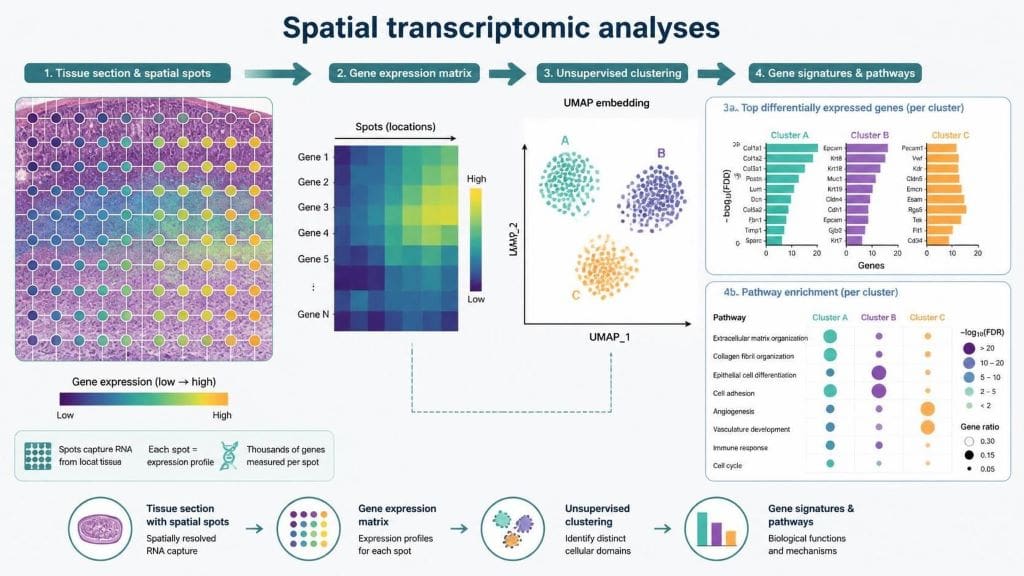
First, spatial transcriptomics analysis is a powerful tool that helps scientists see where genes are active inside tissues. Unlike traditional methods, it preserves the exact location of cells while measuring gene expression.
Next, researchers place thin tissue sections onto special slides that capture RNA molecules from individual cells. These RNA molecules reveal which genes are turned on or off in different parts of the tissue.
Then, advanced sequencing technologies read the captured RNA. As a result, scientists create detailed maps that show gene activity across the tissue landscape.
Future Directions for Blood Cell Research
The discovery of distinct erythroid niches in mice and humans opens new paths for blood cell research. First, scientists can explore how different cell types work together to support red blood cell production.
Next, researchers may study the role of proteins such as ICAM4 in human bone marrow. This could reveal new ways to improve red blood cell formation in patients with blood disorders.
The Importance of ICAM4 in Human Erythropoiesis
In Spatial transcriptomics analysis, ICAM4 plays an important role in the production of red blood cells in humans. It is a cell-surface protein found mainly on developing and mature red blood cells.
Traditionally, scientists believed that macrophages were essential for supporting red blood cell development. However, this study revealed a different pattern in humans. Many developing red blood cells formed clusters even when macrophages were not present nearby.
Frequently Asked questions
What are erythroid niches?
Erythroid niches are small areas inside the bone marrow where red blood cells grow and mature. These spaces give developing blood cells the support they need to become healthy, fully functioning red blood cells.
What is spatial transcriptomics?
Spatial transcriptomics analysis is a technique that shows where genes are active within a tissue. It allows scientists to study cells in their exact locations, helping them understand how different cells work and interact inside the tissue.
Why is ICAM4 important in humans?
ICAM4 is a protein found on red blood cells. It helps developing red blood cells stick together and stay organized. Because of this, ICAM4 supports the structure of human erythroid niches and helps red blood cells grow and mature properly.
Reference
Han, X., Ren, K., Wang, P., Bi, H., Li, E., Aydemir, I., Ji, A., Cai, W., Soleimanisardoo, L., Wai, C. M., Schipma, M. J., Liu, Y., Goldstein, J., Sukhanova, M., Yang, J., & Ji, P. (2026). Spatial transcriptomic analyses highlight distinct erythroid niches in mice and humans. Nature Genetics. Advance online publication. https://doi.org/10.1038/s41588-026-02671-2
- Author
- Latest Posts

I completed my Master of Science from the University of Allahabad in 2017 with a strong academic background in life sciences and chemistry. My specialization included Molecular Biology, Microbiology, Genetics, Plant Breeding, Phycology, Paleobotany, and Bioinformatics, along with Organic Chemistry, Inorganic Chemistry, and Physical Chemistry. This multidisciplinary training provided me with a comprehensive understanding of biological systems and analytical scientific approaches.
After completing my postgraduate studies, I gained valuable professional experience in both the education and social development sectors. I worked at A.M. Oxford Public School, where I was actively involved in guiding students toward academic excellence. In this role, I focused on creating an engaging learning environment, encouraging critical thinking, and nurturing students’ curiosity for scientific learning. My experience as an educator strengthened my communication, mentoring, and classroom management skills.
In addition to my teaching experience, I worked with Jeevan Jagriti Foundation, where I contributed to community-based initiatives aimed at improving educational access and awareness among underprivileged sections of society. Through this work, I participated in programs designed to support social development and promote the value of education in marginalized communities.
These professional experiences helped me develop strong interpersonal, leadership, and organizational skills while reinforcing my commitment to education and community service.