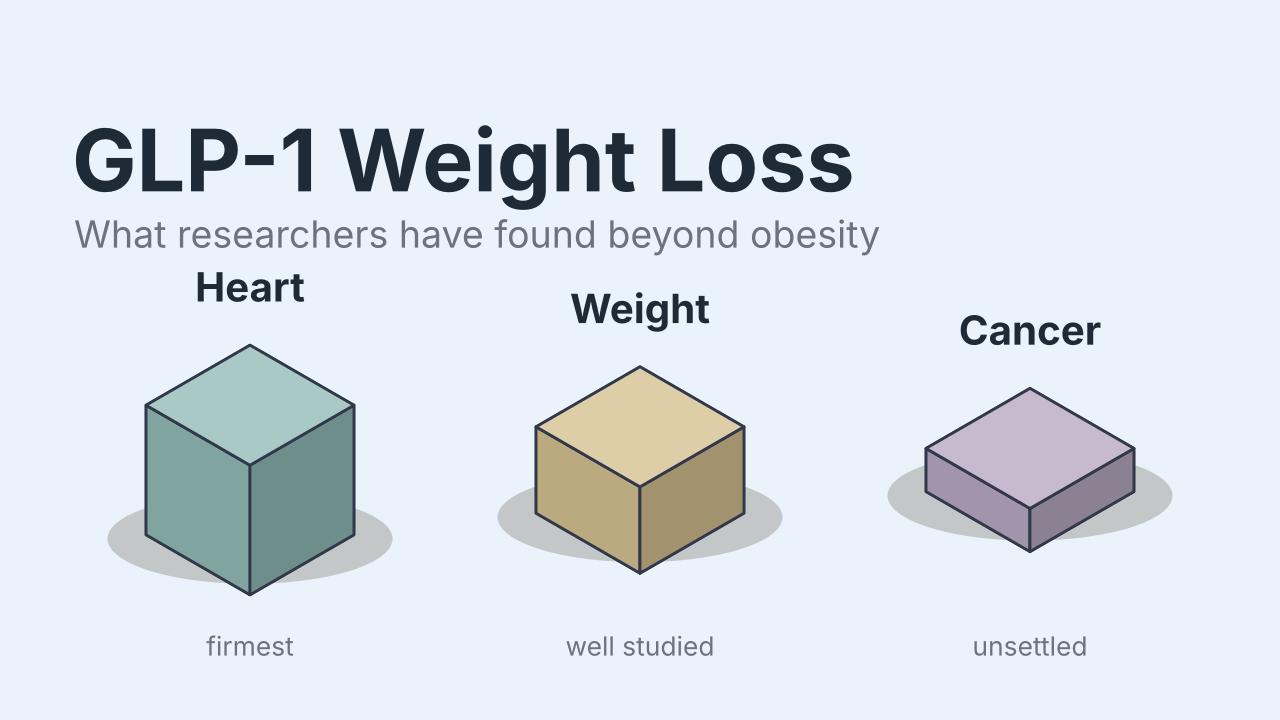
GLP-1 weight loss drugs have moved from diabetes clinics into everyday conversation. Semaglutide and its relatives began as treatments for type 2 diabetes. Researchers are therefore asking what else these drugs do. Four recent reviews and one large cohort study offer part of an answer. The cardiovascular findings are the most settled. The cancer findings are not settled at all. One pooled analysis reports a higher colorectal cancer risk. A far larger cohort study reports lower cancer risk than other diabetes drugs. This article sets out what each study reported, and how their designs differ. It does not tell anyone what to take.
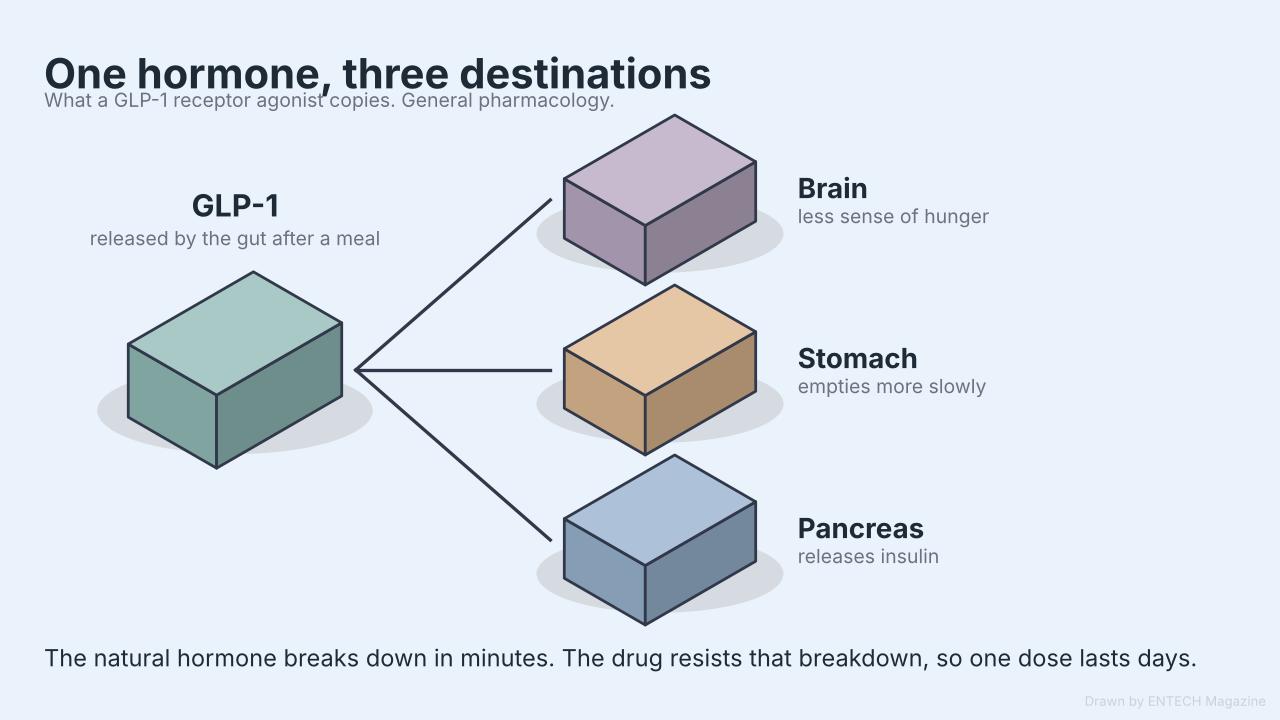
Your gut releases a hormone after you eat. It is called glucagon-like peptide-1, shortened to GLP-1. First, the hormone tells the pancreas to release insulin. It also slows how fast the stomach empties. In the brain, it reduces the sense of hunger. Natural GLP-1 breaks down within minutes, so its effect is brief. Drug designers built molecules that copy the hormone but resist that breakdown. These are the GLP-1 receptor agonists, and semaglutide is the best known. Because they last for days rather than minutes, one weekly injection can work. Notably, the weight loss follows mostly from eating less, not from burning more.
That single mechanism touches several organs at once, which is why the research spread so widely. Blood sugar falls, body weight falls, and blood pressure often falls with them. Each of those changes is itself a risk factor for other diseases. So a drug that shifts all three might shift the diseases downstream. Testing that idea is harder than it sounds. Weight loss alone lowers the risk of many cancers, as the Oklahoma review notes. Any cancer finding therefore has to separate the drug from the weight change. That problem shapes almost every disagreement described below.
* Drug action described by Valencia-Rincón and colleagues (2025).
Fig. 1: One hormone, three destinations
The Heart Evidence Is the Firmest
Fewer Major Events in Four Randomized Trials
Sadraei and five colleagues pooled four randomized controlled trials of semaglutide. Together those trials enrolled 27,617 people, split almost exactly between drug and placebo. Overall, the team reported a 19% lower risk of major adverse cardiovascular events. Cardiovascular death and nonfatal heart attack both fell as well. Meanwhile, serious adverse events of any kind were slightly less common. Yet the same analysis found no significant effect on nonfatal stroke. It found none on heart failure hospitalization or unstable angina either. The authors also flagged something the headlines tend to miss. People taking semaglutide stopped treatment more often than those on placebo.
A second review, by Yao and four colleagues, looked wider and reached a different conclusion on stroke. It drew on 17 studies covering 40,632 patients, and it included observational work alongside trials. By contrast, that review reported a 32% lower risk of nonfatal stroke. It also reported falls in cardiovascular death, major events and nonfatal heart attack. The benefits looked largest in patients who also had chronic kidney disease. On the kidney measures themselves, though, the review found no significant change. Neither filtration rate nor urinary albumin shifted meaningfully. So the two reviews agree on major events and disagree on stroke.
Why Two Reviews of the Same Drug Disagree
The disagreement is not a contradiction so much as a difference in what was counted. The first review admitted only randomized trials, where chance decides who gets the drug. That design keeps the two groups alike in ways researchers cannot otherwise control. The second review added observational studies, which follow people who were already prescribed something. Those studies gather far more patients, and more statistical power with them. They also inherit the reasons a doctor chose one drug over another. Readers can hold both results without picking a winner. A trials-only pool saw no stroke effect, and a wider pool saw one.
* Study designs compared as reported by Sadraei and colleagues (2025) and Yao and colleagues (2025).
Fig. 2: What goes into the pool
The Cancer Question Remains Open
Two Studies Pointing Opposite Ways
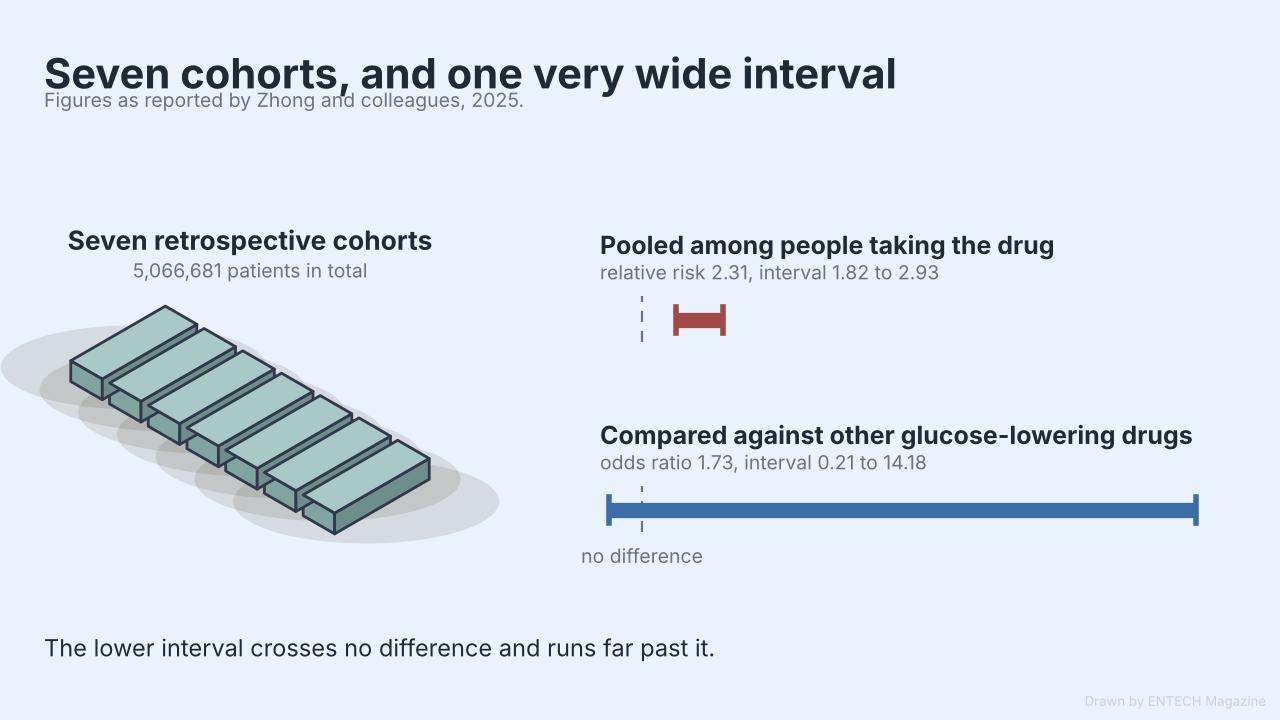
Zhong, Wu and Khan pooled seven retrospective cohort studies covering 5,066,681 patients. Among people taking GLP-1 receptor agonists, they reported colorectal cancer risk more than doubled. Specifically, the figure they published was a relative risk of 2.31. That number has been quoted widely, and it deserves a careful reading. The same paper ran a second analysis comparing GLP-1 drugs against other glucose-lowering drugs. That comparison found no significant difference at all. Its confidence interval ran from 0.21 to 14.18, which is extremely wide. The authors graded their own evidence as low to moderate quality. They named inconsistency, indirectness and imprecision as the reasons for that grade.
Mao and seven colleagues took a different approach, published in a National Cancer Institute journal. They followed 919,609 overweight or obese adults with type 2 diabetes in United States insurance records. Over 2,086,526 person-years, 16,653 of them developed an obesity-related cancer. People on GLP-1 drugs had a 13% lower risk than people on other glucose-lowering drugs. In other words, the incidence was 7.5 cases per thousand person-years against 8.1. That lower risk held up against metformin, insulin and five other drug classes separately. It grew stronger as body weight rose. This is the largest single study of the five, and it points the gentler way.
A Risk Needs Something to Be Compared Against
Here is the detail that reconciles most of the gap. After all, a relative risk describes one group measured against another group. The 2.31 figure describes colorectal cancer among patients receiving these drugs, pooled across seven cohorts. The paper does not set that pooled figure against a matched group of non-users. Where it does use a comparison group, namely other glucose-lowering drugs, the signal disappears. The nationwide cohort study was built around a comparison group from the start. Every one of its estimates is a drug measured against another drug. That is why its result carries further than a pooled count of users alone.
* Pooled colorectal figures and the evidence grade as reported by Zhong and colleagues (2025).
Fig. 3: Seven cohorts, one wide interval
What the Laboratory Work Suggests
Obesity Is Itself a Cancer Risk Factor
Valencia-Rincón and three colleagues at the University of Oklahoma reviewed this field for a clinical journal. They begin from a number worth sitting with. The World Health Organization estimated in 2022 that more than 890 million adults live with obesity. A further 1.6 billion adults were classified as overweight. Risk is raised for at least 13 cancer types in people with obesity. Indeed, the list runs from colon and rectum through pancreas and kidney to postmenopausal breast. Type 2 diabetes carries its own raised risk for several of those cancers. So any drug that reduces both weight and blood sugar enters an already tangled picture.
The review also reports what laboratory models have shown so far. Preclinical studies describe anticancer effects of GLP-1 receptor therapies, including in models that are not obese. Several report effects on immune cells, which may be direct or may follow improved metabolism. In one pooled clinical analysis the review cites, semaglutide did not raise thyroid or pancreatic cancer risk. That held whether the comparison was placebo or another glucose-lowering drug. The review makes one further point that matters for reading older studies. Much of the earlier cancer data covers exenatide, liraglutide and dulaglutide, with little semaglutide in it. The newest and most used drug is the least studied for cancer.
What GLP-1 Weight Loss Research Still Lacks
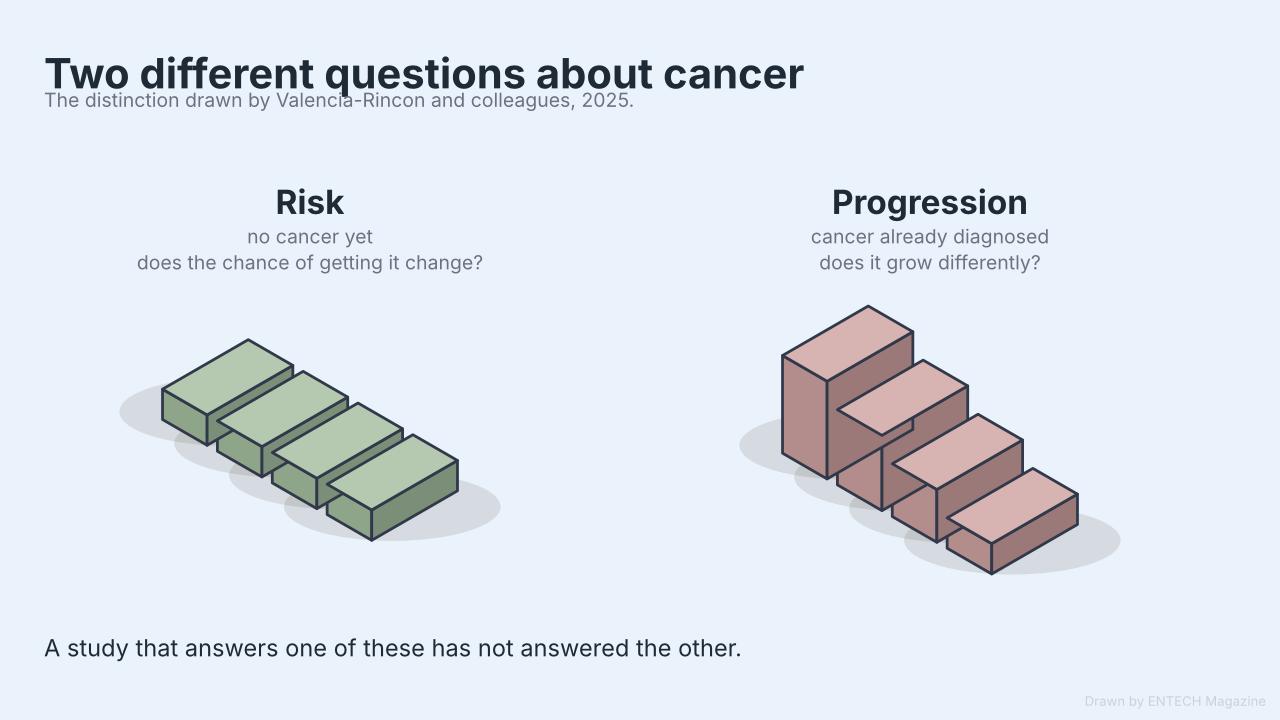
Both cancer papers close by saying what is still missing. Zhong and colleagues call for long-term trials on a larger scale. Their own pooled studies were all retrospective, which means the records came first and the question second. The Oklahoma review asks for laboratory studies designed with specific choices in mind. It names the timing and duration of treatment as one such choice. It names the use of standard cancer therapies alongside the drug as another. Most of all it separates two questions that are often merged. Whether a drug changes the chance of getting cancer is one question. Whether it changes how an existing cancer progresses is a different one.
* Obesity, cancer types, preclinical findings and the research gaps as reported by Valencia-Rincón and colleagues (2025) and Zhong and colleagues (2025).
Fig. 4: Risk and progression differ
What Students Can Take From This
GLP-1 weight loss is an unusually clear case study in how evidence is weighed. Five papers on one drug family reach conclusions that do not line up. None of them is dishonest, and none is simply wrong. They differ in which studies they admit and what they compare against. Learning to ask those two questions is most of what critical reading means. The field also shows how one molecule can pull several disciplines together. Endocrinology, oncology, cardiology, epidemiology and pharmaceutical chemistry all have a claim on it. Careers that run through this work include clinical pharmacologist, epidemiologist and medicinal chemist. Regulatory science and medical writing sit alongside them.
Conclusion: What GLP-1 Weight Loss Research Shows So Far
On the heart, randomized trials point one way for major events. They do not show an effect on stroke, while a wider review does. On cancer, the published evidence genuinely does not point one way yet. A pooled analysis of cohorts reported a doubled colorectal risk without a matched comparison group. A far larger study built on comparison groups reported lower cancer risk instead. Laboratory work has found no cancer-promoting effect, and sometimes the opposite. The drug most people now take is also the one studied least for cancer. These remain prescription medicines, and the research on them is still moving.
Disclaimer: This article is for information and education only and is not medical advice. See the ENTECH disclaimer.
This article looks at what researchers have found about GLP-1 drugs beyond their effect on weight. It covers the cardiovascular findings first, then turns to cancer, where the published studies point in different directions. Readers who want to understand why two studies of one drug can reach different conclusions will find that set out here.
Editorial note
This article sets out what each study reported and leaves the judgment to the reader. Where the research points in different directions, that disagreement is reported rather than resolved. The papers and pages under References hold the full methods and measurements. Readers are encouraged to consult them and to check each claim for themselves. ENTECH accepts no responsibility for statements made here or in those sources. This article is offered for information and education only, and it is not professional advice.
Ramya Dobbala is a pharmacist and science communicator dedicated to bridging the gap between complex pharmaceutical research and public understanding. A 2024 B.Pharmacy graduate, Ramya has a strong foundational background in formulation science, having spearheaded research into the evaluation and formulation of anti-acne creams. Her work focused on optimizing topical delivery systems to enhance treatment efficacy and skin health.
Transitioning from the laboratory to the forefront of scientific discourse, she now leverages her technical expertise to translate intricate healthcare concepts into accessible, engaging content. As an author and communicator, Ramya is passionate about empowering audiences with evidence-based insights, particularly in the realms of dermatology and pharmaceutical innovation.