Understand the GLP-1 cost with Medicare and how the $50 Bridge Program can help eligible beneficiaries access medications.
GLP-1 Cost With Medicare: What Older People Need to Know

For eligible Medicare beneficiaries, the current GLP-1 cost through the Medicare GLP-1 Bridge is $50 for a one-month supply. However, this $50 payment is not the same as an ordinary Medicare Part D copay. The Medicare GLP-1 Bridge is a temporary CMS demonstration that operates outside the normal Part D benefit structure. It began on July 1, 2026, and is scheduled to continue through December 31, 2027.
The programme covers certain GLP-1 medicines for eligible people who use them for weight management. Therefore, knowing the difference between the drug’s price, insurance coverage, and your actual out-of-pocket cost is important. This guide explains the current GLP-1 cost with Medicare, who may qualify, which medicines are included, and what medicine access means in simple terms.
Key Takeaways
- The Medicare GLP-1 Bridge can provide certain eligible beneficiaries with GLP-1 medicines for $50 per month.
- The Bridge began July 1, 2026, and is scheduled to run through December 31, 2027.
- The $50 Bridge payment does not count toward the normal Medicare Part D deductible or yearly out-of-pocket limit.
- Eligible medicines currently include Foundayo, Wegovy, and Zepbound KwikPen when prescribed for the Bridge’s weight-management purpose.
- Eligibility is based on Medicare coverage and specific clinical criteria, not simply on being age 65 or older.
- People who already qualify for GLP-1 coverage through their Medicare Part D benefit generally use that pathway instead of the Bridge.
- Students can understand medicine access by separating FDA approval, prescribing, insurance coverage, prior authorization, copays, and pharmacy access.
What Is the Medicare GLP-1 Bridge?
The Centers for Medicare & Medicaid Services (CMS) runs the Medicare GLP-1 Bridge as a temporary demonstration. The program gives certain Medicare Part D beneficiaries access to selected GLP-1 medicines for weight management at a predictable cost.
Under the program, eligible beneficiaries pay $50 for a one-month supply at the pharmacy. The Bridge operates outside the standard Medicare Part D benefit, so the $50 payment does not count toward a beneficiary’s Part D deductible or annual out-of-pocket limit. CMS scheduled the program to run from July 1, 2026, through December 31, 2027.
How Much Does a GLP-1 Cost With Medicare?
For someone who qualifies for the Medicare GLP-1 Bridge, the patient cost is:
$50 for a one-month supply
That amount applies to eligible medicines provided through the Bridge. However, this does not mean every person with Medicare will automatically pay $50 for every GLP-1 medicine.
Your cost depends on the coverage pathway that applies to you.
| Coverage situation | What the patient may pay |
|---|---|
| Eligible for Medicare GLP-1 Bridge | $50 for a one-month supply |
| GLP-1 covered through normal Part D | Cost depends on the specific Medicare plan, formulary, and cost-sharing rules |
| GLP-1 not covered through the applicable pathway | The patient may face a different cash or coverage situation |
| Other insurance or assistance | Rules depend on the program and eligibility |
Therefore, do not assume that a headline price is the amount you personally will pay.
Does the $50 Count Toward Medicare Part D Out-of-Pocket Costs?
No. The Medicare GLP-1 Bridge operates outside the normal Part D payment flow. Therefore, the $50 payment does not count toward the Medicare Part D deductible or annual out-of-pocket limit. The Part D Explanation of Benefits also does not list this payment as ordinary Part D spending.
In addition, the Bridge copay cannot be reduced through Medicare’s Extra Help program. This distinction matters because a $50 monthly payment and a $50 Part D copay are not necessarily the same thing.
Which GLP-1 Drugs Are Included?
As of the current CMS guidance, the Medicare GLP-1 Bridge includes:
- Foundayo (orforglipron)
- Wegovy (semaglutide), including the formulations specified by CMS
- Zepbound KwikPen (tirzepatide)
The Bridge does not cover every medicine in the GLP-1 drug class. For example, do not automatically describe Ozempic, Mounjaro, Trulicity, or other GLP-1 products as bridge-covered medicines. Coverage may depend on the medical indication and the beneficiary’s Medicare Part D benefit. Because CMS may update the list, patients should verify the current medications before filling a prescription.
Who Can Qualify for the Medicare GLP-1 Bridge?
The Bridge does not limit eligibility to people age 65 or older. Adults must meet the programme’s Medicare and clinical requirements. Generally, the clinical criteria include one of the following situations when the patient begins GLP-1 therapy:
BMI of 35 or higher
An adult may qualify if their BMI measured at least 35 when they began GLP-1 therapy, provided they meet the other Bridge requirements.
BMI of 30 or higher with certain health conditions
An adult with a BMI of at least 30 may qualify when they also have certain conditions, including:
- heart failure with preserved ejection fraction;
- uncontrolled hypertension; or
- chronic kidney disease at stage 3a or above.
BMI of 27 or higher with certain health conditions
An adult with a BMI of at least 27 may qualify when they also have one or more specified conditions, including:
- prediabetes;
- previous myocardial infarction;
- previous stroke; or
- symptomatic peripheral artery disease.
The prescribing provider must submit the required information for prior authorization. Importantly, the program evaluates BMI and relevant clinical conditions according to its rules, including the circumstances at therapy initiation.
Who Is Not Eligible for the Bridge?
The Bridge supports beneficiaries who seek GLP-1 treatment for weight management but cannot obtain the medicine through Medicare Part D. For example, beneficiaries with certain medically accepted indications may need to continue using their regular Medicare Part D coverage instead.
CMS specifically identifies conditions such as:
- type 2 diabetes;
- moderate-to-severe obstructive sleep apnea; and
- qualifying metabolic dysfunction-associated steatohepatitis, or MASH.
If you use your GLP-1 prescription for an indication that Part D already covers, the Bridge may not provide the appropriate coverage pathway. Therefore, first ask your healthcare provider and Medicare drug plan which coverage route applies to your prescription.
Why Can the GLP-1 Cost Differ From Person to Person?
The same medicine can have different costs for different patients. That happens because the drug price and the patient’s out-of-pocket cost are not always the same.
Several factors can affect what a patient pays:
- the medical indication;
- the Medicare coverage pathway;
- the drug formulary;
- prior authorization;
- the specific product and formulation;
- deductible and cost-sharing rules;
- eligibility for a particular program.
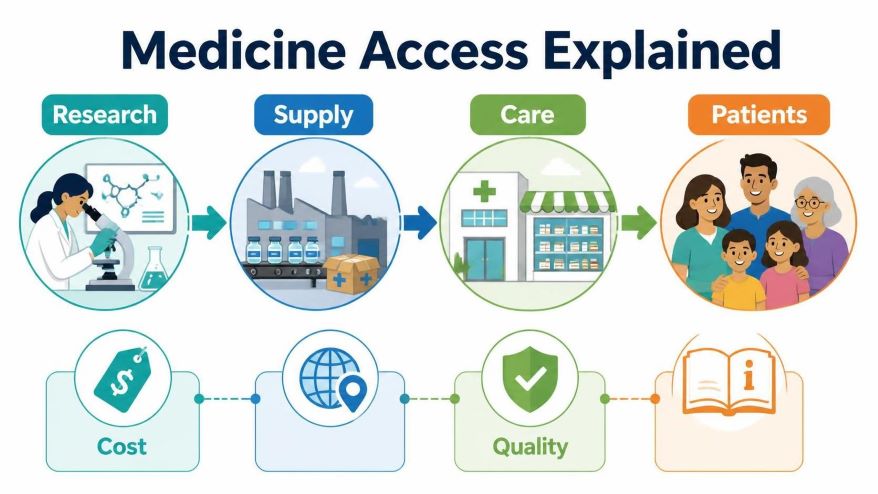
Medicine Access Explained: A Student-Friendly Guide
What does medicine access actually mean? In simple terms, medicine access means that a person can obtain an appropriate medicine when they need it and can realistically afford it.
For students learning pharmacy, public health, or health science, it helps to separate medicine access into several steps.
FDA approval
First, the FDA must approve a medicine for a specific use. This means the FDA has carefully reviewed the medicine and decided that it is safe and effective for that use. The approval also explains how to use the medicine and under what conditions.
Prescribing
Next, a healthcare professional decides if the medicine is right for a specific patient. They consider the patient’s health, medical history, and other medicines they may be taking. Even if the FDA approves a medicine, it may not be safe or suitable for everyone.
Insurance Coverage
Insurance helps decide if a medicine is covered. It also affects how much the patient must pay. Some insurance plans cover the full cost. Others cover only part of the cost. Some plans may not cover the medicine at all. For people with Medicare, Part D rules may affect coverage. Other Medicare programs may also affect access to the medicine. Patients may need to check their plan to learn what it covers and how much they will pay.
Formulary Placement
A formulary is a list of medicines covered by a health plan. Each health plan may have a different list. Some medicines may be fully covered, while others may cost more. Patients should check where their medicine appears on the list. This can help them understand their coverage and expected costs.
Prior Authorization
Some medicines need special approval before insurance will cover them. The prescriber may need to send more information to the health plan. This information can include the patient’s medical history and treatment needs. The health plan reviews the request. If approved, the patient can receive coverage for the medicine.
Patient cost
Finally, the patient needs to know the actual amount they must pay. That amount may be called a copay, coinsurance, or another form of cost sharing. Therefore, medicine access is more than drug approval. A medicine can be scientifically effective and FDA-approved, yet a patient can still face barriers involving coverage, authorization, cost, or availability. This is why pharmacy professionals play an important role in helping patients understand treatment access.
GLP-1 Drugs and Diabetes Medicines Are Not All the Same
GLP-1 medicines are often discussed as if they were a single group with identical uses.
Different medicines can have different:
- active ingredients;
- dosage forms;
- approved indications;
- doses;
- safety warnings;
- insurance coverage;
- costs.
Some GLP-1 medicines are used for type 2 diabetes. Others have approved weight-management indications. Some medicines can have more than one approved use. Therefore, patients should identify the specific medicine and indication, rather than relying only on the phrase “GLP-1.”
Why GLP-1 Medicines Are Important in Diabetes Care
GLP-1 receptor agonists and related incretin-based medicines can influence blood glucose regulation, appetite, and body weight. They generally work by activating pathways related to the naturally occurring hormone GLP-1.
Depending on the medicine, these effects can include:
- glucose-dependent insulin release;
- reduced glucagon activity;
- slower gastric emptying;
- reduced appetite;
- improved blood glucose control;
- weight reduction.
Some medicines in this broader treatment area also have cardiovascular or other health benefits for selected patients. However, the benefits and risks are medicine-specific. Common adverse effects can include gastrointestinal symptoms such as nausea, vomiting, diarrhea or constipation. Therefore, a GLP-1 medicine should be selected and monitored with the guidance of a qualified healthcare professional.
How to Access a GLP-1 Through the Medicare Bridge
If you think you may qualify, start with your healthcare provider.
The general process is:
- Discuss your health history and weight-management goals with your healthcare provider.
- Ask whether an eligible GLP-1 medicine is appropriate.
- Ask whether you may meet the current Medicare GLP-1 Bridge criteria.
- Have the prescription sent to the pharmacy.
- Provide the Medicare information requested by the pharmacy.
- Complete any required prior authorization process.
- Wait for Medicare’s eligibility and coverage determination.
- If approved, obtain the medicine and pay the applicable $50 monthly amount under the Bridge.
The exact process can vary, so patients should follow the instructions provided by Medicare, their pharmacy, and their healthcare team.
What If You Have Type 2 Diabetes?
Do not assume that the Bridge is the correct program simply because you use a GLP-1 medicine. The Medicare GLP-1 Bridge is specifically designed for weight-management access outside the normal Part D pathway. People with type 2 diabetes may have access to GLP-1 medicines through their Medicare Part D plan when the medicine is prescribed for a covered indication.
Therefore, if you have diabetes, ask your Medicare drug plan whether your medicine is covered under your regular Part D benefit. For a broader explanation of treatment choices, see ENTECH Magazine’s guide to diabetes medicines.
Why Pharmacy Knowledge Matters
The cost of a prescription is only one part of medication care.
Pharmacists can help patients understand:
- how a medicine is taken;
- potential interactions;
- common adverse effects;
- prescription coverage;
- prior authorization requirements;
- refill issues;
- safe medication use.
For older adults taking multiple medicines, this support can be especially important. At the same time, patients should never stop, restart, or change a prescription medicine solely because of cost without discussing the decision with their healthcare professional.
This simple checklist can prevent confusion between a medicine’s list price and the amount a patient actually pays.
Conclusion
In conclusion, GLP-1 costs with Medicare can vary. The price depends on the medicine, insurance plan, and reason for use. Older people should check their coverage, copay, and prior authorization rules. A healthcare provider or Medicare representative can help explain the expected cost and available options.
Frequently Asked Questions About GLP-1 Cost
How much does a GLP-1 cost with Medicare in 2026?
In 2026, eligible Medicare patients may pay $50 each month through the temporary GLP-1 Bridge program. Regular Part D costs vary by drug, plan, and medical use
Does the $50 GLP-1 cost count toward my Medicare Part D out-of-pocket limit?
No. The Bridge operates outside the normal Part D benefit, so the $50 payment does not count toward the Part D deductible or yearly out-of-pocket limit.
Which GLP-1 medicines are covered through the Bridge?
CMS currently identifies Foundayo, Wegovy, and Zepbound KwikPen for the Bridge when they are prescribed for the program’s weight-management indication.
Can someone with type 2 diabetes use the Bridge?
The Bridge is intended for weight-management access outside the normal Part D pathway. If you have type 2 diabetes and your GLP-1 is being prescribed for a Part D-covered indication, CMS says you should generally seek coverage through your Medicare Part D.
References
- Freed, M., Cubanski, J., & Williams, E. (2026). What to know about the BALANCE Model for GLP-1s in Medicare and Medicaid and the Medicare GLP-1 Bridge. KFF.
https://www.kff.org/medicare/what-to-know-about-the-balance-model-for-glp-1s-in-medicare-and-medicaid/ - Vafiadis, D. (2026, August 18). Medicare GLP-1 Bridge program: Eligibility, costs, and how to get GLP-1 medications. National Council on Aging. https://www.ncoa.org/article/expanding-access-to-weight-loss-medications-the-medicare-glp-1-bridge-program/
- Author
- Latest Posts

Ramya Dobbala is a pharmacist and science communicator dedicated to bridging the gap between complex pharmaceutical research and public understanding. A 2024 B.Pharmacy graduate, Ramya has a strong foundational background in formulation science, having spearheaded research into the evaluation and formulation of anti-acne creams. Her work focused on optimizing topical delivery systems to enhance treatment efficacy and skin health.
Transitioning from the laboratory to the forefront of scientific discourse, she now leverages her technical expertise to translate intricate healthcare concepts into accessible, engaging content. As an author and communicator, Ramya is passionate about empowering audiences with evidence-based insights, particularly in the realms of dermatology and pharmaceutical innovation.