Noise-cancelling headphones use sound waves to cancel other sound waves
How Do Noise Cancelling Headphones Work? Physics Behind ANC!
Put on a pair of noise-cancelling headphones. The crowd noise around you disappears. That silence feels like magic. At any rate, it is not magic at all. It is applied physics working in real time. Understanding how this works can open a very exciting career path for you.
At this point, noise-cancelling headphones are everywhere — on planes, in libraries, at home. After all, millions of students use them daily. But very few stop to ask: how exactly do they work? To put it simply, they fight sound with sound. And that idea sits at the heart of wave physics.
Key Takeaways
- Noise-cancelling headphones use sound waves to cancel other sound waves — pure physics at work.
- Two types exist: Active Noise Cancellation (ANC) and Passive Noise Isolation — both matter.
- The global headphone market will exceed USD 25 billion by 2027, driving strong career demand.
- Core school subjects for this field: Physics, Mathematics, Computer Science, and Electronics.
- Career paths span acoustical engineering, signal processing, audio software development, and more.
- Students can start exploring this field right now with free simulation tools and DIY projects.
The Physics Behind the Noise cancelling Headphones
Sound Is a Wave — And Waves Can Cancel Each Other
Sound travels as a pressure wave through the air. Every wave has a peak (high pressure) and a trough (low pressure). As a matter of fact, when two waves meet, they interact. If one wave’s peak meets another wave’s trough, they cancel each other out. Scientists call this destructive interference.
To illustrate, imagine two ripples on a pond moving toward each other. When they meet, the peaks and troughs line up perfectly. The water goes flat. The same thing happens with sound waves in your headphones. This principle is not new — it goes back to Lord Rayleigh’s 19th-century work on wave theory.
Active Noise Cancellation (ANC) — Step by Step
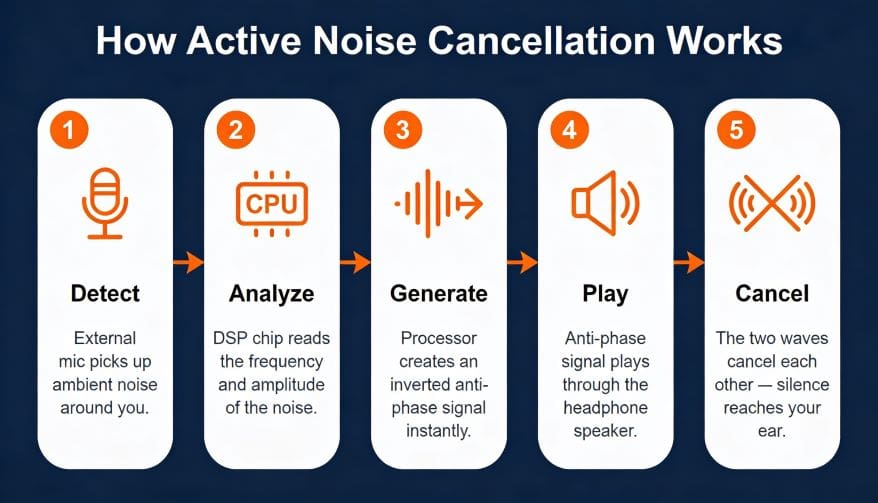
ANC uses a tiny microphone placed outside the earcup. Prior to the sound reaching your ears, the microphone picks it up. A digital signal processor (DSP) analyzes the incoming sound wave instantly. After that, the processor generates an exact mirror image of that wave — called the anti-phase signal. This anti-phase signal plays through the speaker simultaneously. The result: the two waves cancel, and silence reaches your ear.
How ANC Works — 5 Steps
- Step 1 — Detect: An external microphone captures ambient noise around you.
- Step 2 — Analyze: A DSP chip reads the frequency and amplitude of the noise wave.
- Step 3 — Generate: The processor creates an anti-phase (inverted) audio signal.
- Step 4 — Play: Speakers emit the anti-phase signal alongside your music.
- Step 5 — Cancel: The two waves interfere destructively — noise disappears.
Passive Noise Isolation — The Other Type
While it may be true that ANC gets all the attention, passive isolation also matters. It relies on physical materials — foam, silicone, or leather earpads — that physically block sound. No electronics are needed. Seeing that ANC works best for low-frequency sounds like engine hum, passive isolation handles high-frequency sounds better. Most good headphones combine both methods.
ANC vs. Passive Isolation — Noise Reduction by Frequency (dB)
The Engineering That Makes It Happen
Digital Signal Processing — The Brain of ANC
The DSP chip is the real hero. It runs complex algorithms to invert sound waves in under one millisecond. At the present time, modern DSP chips handle multiple noise types simultaneously. Engineers who design these chips work at the intersection of mathematics, electronics, and computer science. To enumerate just a few algorithms used: Fast Fourier Transform (FFT), Least Mean Squares (LMS) adaptive filtering, and Finite Impulse Response (FIR) filtering.
Microphone Placement and Feedback Loops
Not all ANC systems are the same. Feedforward ANC places the mic outside the earcup. Feedback ANC places the mic inside, closer to the ear. Hybrid ANC uses both. Each design has tradeoffs in terms of speed, accuracy, and cost. Balanced against each other, hybrid systems give the best performance — which is why premium headphones use them.
Also Read: Magic Mushroom Brain Effects
The Future of Noise cancelling Headphones Technology
At this time, researchers are pushing ANC far beyond headphones. AI-powered noise cancellation is now being built into laptops, conference call systems, and even cars. Machine learning models are being trained to selectively cancel noise while keeping certain sounds — like a baby’s cry or a siren — fully audible. To say nothing of spatial audio, which allows headphones to simulate 3D sound environments. All in all, this field is growing rapidly, and the careers it supports will grow with it.
In conclusion, noise-cancelling headphones are not just a consumer product. They are a lesson in physics, a triumph of signal processing, and a gateway to a wide range of STEM careers. Provided that you study the right subjects and stay curious, this field has room for you. To sum up: the silence inside those earcups was built by engineers — and with the right education, you can be one of them.
References
- Kuo, S. M., Chen, Y.-R., Chang, C.-Y., & Lai, C.-W. (2018). Development and Evaluation of Light-Weight Active Noise Cancellation Earphones. Applied Sciences, 8(7), 1178. https://doi.org/10.3390/app8071178
- Author
- Latest Posts

I am an inspirational writer and emerging science blogger with a deep-rooted passion for understanding and sharing the wonders of the world around us. My journey began with a Bachelor of Science in Chemistry from AKI’s Poona College of Arts, Commerce and Science, where I developed not only a strong foundation in scientific principles but also a mindset that values curiosity, observation, and critical thinking. Studying chemistry has taught me to approach problems with logic, to look beyond the obvious, and to see patterns where others might only see complexity. These experiences have shaped the way I perceive life and influence the way I express my thoughts, both scientifically and creatively.
I have always believed that knowledge is only as powerful as the way it is shared. This belief has guided me to create content that bridges the gap between science and everyday life. I aim to simplify complex scientific ideas so they become approachable, relatable, and engaging for everyone—whether someone has a formal background in science or is simply curious about the world. Science, in my view, is not confined to textbooks and laboratories; it is a way of thinking, understanding, and connecting with the world around us. By making science accessible, I hope to inspire curiosity, ignite learning, and encourage people to see the beauty and relevance of scientific discovery in their daily lives.
Alongside my love for science, I am deeply passionate about motivational writing. I believe words carry the power to transform perspectives, encourage self-reflection, and inspire action. By combining analytical thinking with creativity, I create content that is intellectually stimulating yet emotionally resonant. Whether I am breaking down a chemical concept, exploring a scientific phenomenon, or crafting motivational narratives, my goal is to communicate ideas in a way that is clear, meaningful, and impactful.
Through my work, I strive to empower my readers – not just by helping them understand the science around them, but by inspiring them to grow, learn, and realize their full potential. Every article, post, or story I write reflects my commitment to turning knowledge into inspiration. I want to spark curiosity, encourage self-improvement, and show that learning and personal growth are deeply connected. For me, writing is not just a craft; it is a way to touch minds, connect hearts, and make ideas come alive in a way that truly resonates.


