Hair growth relies on a pulling force, not pushing.
Scientists Finally Solved the Mystery of How Human Hair Grows — And It’s Not What You Think
Estimated reading time: 3 minutes
The Real Answer to How Human Hair Grows
Hair grows about six inches every year. But scientists never knew exactly how. A new study finally solved this mystery. Researchers used advanced 3D imaging technology. They discovered how human hair grows at the cellular level. As a matter of fact, hair gets pulled, not pushed. With this in mind, let’s explore this fascinating discovery.
Key Takeaways: How Human Hair Grows
- Scientists mapped how human hair grows cell by cell.
- Hair growth relies on a pulling force, not pushing.
- Outer root sheath cells drive this pulling motion.
- Cell division alone cannot explain hair growth speed.
- This research connects biology, physics, and cosmetic science.
How Human Hair Grows: The Big Discovery
How human hair grows puzzled scientists for decades. Most assumed dividing cells simply pushed hair upward. Provided that mitosis created enough pressure, hair would grow. So far, that theory only tells half the story (Tissot et al., 2025). To that end, researchers tested this assumption directly.
The Hidden Pulling Mechanism
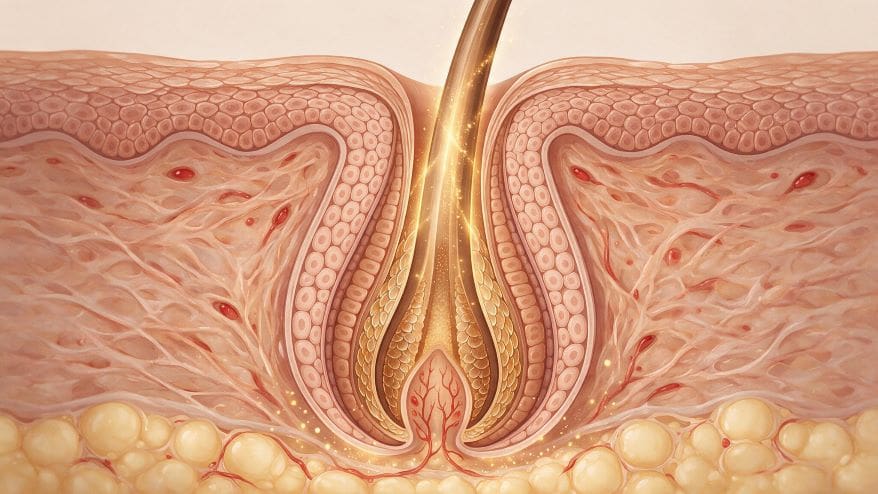
To illustrate their discovery, consider this simple breakdown: Outer root sheath cells move downward in a spiral. This movement creates an active pulling force. The pulling force drags inner hair layers upward. Cell division alone only explains part of the growth. Together with cell division, this pulling force explains everything. In effect, hair growth resembles a rope being pulled, not pushed.
Also Read: Red Hair Gene Natural Selection: The Science Behind its Survival
How Scientists Proved This Theory
At this point, researchers needed solid proof. As can be seen, they ran clever experiments to test it: They removed the growing bulb from hair follicles. Hair still grew for 24 more hours afterward. They blocked cell division using special chemicals. Growth speed dropped only slightly, by 24%. They blocked actin filaments instead. Growth speed dropped drastically, by 82%. While it may be true that cell division matters, actin matters more. In contrast, actin filaments power the real pulling mechanism. All things considered, this changes how we understand hair biology.
What Is Actin, Exactly?
Being that actin sounds unfamiliar, here’s a simple explanation. Actin is a protein filament inside cells. Take the case of muscle movement, actin helps cells contract. So long as actin stays intact, cells can generate pulling force. This same protein appears in many body systems.
Also Read: Zebrafish: How Hair Cell Regeneration Could Solve Hearing Loss
Why This Discovery Matters for Future Careers
This research blends biology, physics, and chemistry directly. Students who enjoy biology class will recognize cell structures immediately. Understanding proteins, cell movement, and tissue growth connects here. What’s more, this study used fluid dynamics equations from physics class.
In similar fashion, this research came from a major cosmetics company. L’Oréal scientists led this groundbreaking study. As a result, careers blending science and beauty industries are growing fast. To sum up, cosmetic science offers exciting real-world applications. Careers in this space include dermatology research, cosmetic chemistry, and biophysics.
Frequently Asked Questions: How human hair grows
1. How does human hair actually grow?
Cells get pulled upward by an actin-powered force. This happens in the outer root sheath layer.
2. Does cell division cause hair growth?
Partly, yes. But it explains less growth than the pulling force.
3. What is the outer root sheath?
It’s an outer layer of cells surrounding the hair follicle. It drives the pulling mechanism.
4. How could this research help hair-loss treatments?
Understanding this mechanism could lead to better hair-growth therapies eventually.
Reference:
- Tissot, N., Genty, G., Santoprete, R., Baltenneck, F., Thibaut, S., Michelet, J.-F., Sequeira, I., & Bornschlögl, T. (2025). Mapping cell dynamics in human ex vivo hair follicles suggests pulling mechanism of hair growth. Nature Communications, 16, Article 10267. https://doi.org/10.1038/s41467-025-65143-x
- Author
- Latest Posts

I am an inspirational writer and emerging science blogger with a deep-rooted passion for understanding and sharing the wonders of the world around us. My journey began with a Bachelor of Science in Chemistry from AKI’s Poona College of Arts, Commerce and Science, where I developed not only a strong foundation in scientific principles but also a mindset that values curiosity, observation, and critical thinking. Studying chemistry has taught me to approach problems with logic, to look beyond the obvious, and to see patterns where others might only see complexity. These experiences have shaped the way I perceive life and influence the way I express my thoughts, both scientifically and creatively.
I have always believed that knowledge is only as powerful as the way it is shared. This belief has guided me to create content that bridges the gap between science and everyday life. I aim to simplify complex scientific ideas so they become approachable, relatable, and engaging for everyone—whether someone has a formal background in science or is simply curious about the world. Science, in my view, is not confined to textbooks and laboratories; it is a way of thinking, understanding, and connecting with the world around us. By making science accessible, I hope to inspire curiosity, ignite learning, and encourage people to see the beauty and relevance of scientific discovery in their daily lives.
Alongside my love for science, I am deeply passionate about motivational writing. I believe words carry the power to transform perspectives, encourage self-reflection, and inspire action. By combining analytical thinking with creativity, I create content that is intellectually stimulating yet emotionally resonant. Whether I am breaking down a chemical concept, exploring a scientific phenomenon, or crafting motivational narratives, my goal is to communicate ideas in a way that is clear, meaningful, and impactful.
Through my work, I strive to empower my readers – not just by helping them understand the science around them, but by inspiring them to grow, learn, and realize their full potential. Every article, post, or story I write reflects my commitment to turning knowledge into inspiration. I want to spark curiosity, encourage self-improvement, and show that learning and personal growth are deeply connected. For me, writing is not just a craft; it is a way to touch minds, connect hearts, and make ideas come alive in a way that truly resonates.