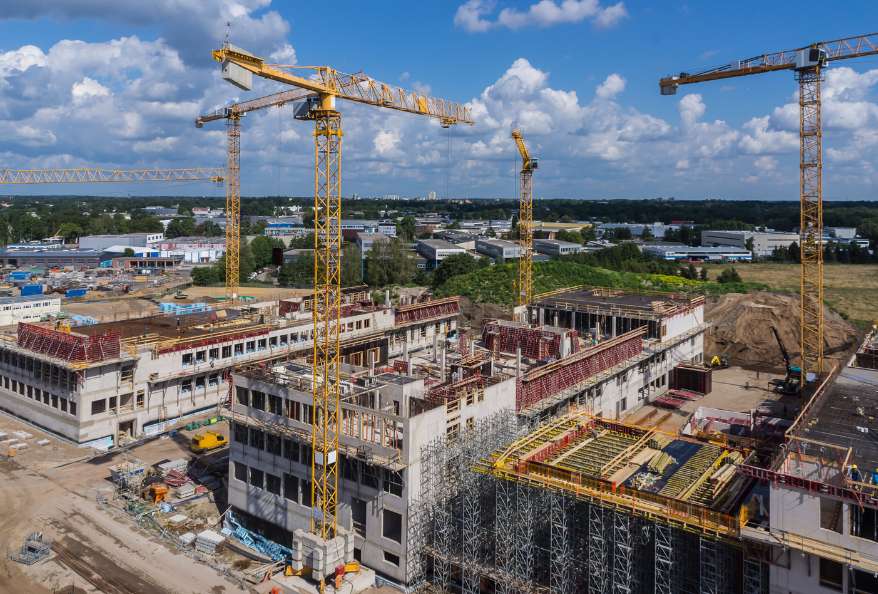
Explore the essentials of commercial construction projects and learn how smart material procurement impacts overall costs.
How Material Choices Impact Efficiency on Commercial Construction Projects
Estimated reading time: 3 minutes
Material procurement is often treated as a straightforward numbers game – find the cheapest option and move on. But the real cost of any building component goes well beyond the price on the invoice. How a material behaves on the jobsite and how it holds up over decades contribute to its true value.
For contractors and project managers working to tight margins and tighter deadlines, those factors can make or break a project.
Why Upfront Cost Is Only Half The Picture
Focusing purely on purchase price tends to backfire during the build phase. A cheaper product that needs specialist tools or significant on-site modification can easily wipe out any initial savings through increased labour costs and delayed timelines. A product that arrives ready to use and performs predictably is often the more economical choice in the long run – even if it costs more at the point of procurement.
It’s also worth considering what happens years down the line. Higher-quality, consistent materials reduce field errors during installation and help contractors avoid the callbacks and schedule overruns that quietly erode profit margins.
Balancing Performance With On-Site Practicality
Commercial projects entail a web of regulatory requirements (fire-resistance ratings, acoustic standards, local building codes) that procurement teams must navigate before a single piece of material is ordered. The best commercial products are engineered to meet those benchmarks without making life harder for the crew installing them.
When a product inherently meets safety and code requirements and is still straightforward to handle and cut on-site, it keeps inspections moving and reduces the risk of costly compliance holdups mid-project.
Choosing Materials That Support Faster Delivery
The interior fit-out phase of any multi-storey commercial build is where scheduling tends to get complicated. Multiple trades working in confined spaces, all dependent on each other – it’s where bottlenecks form quickly if the wrong materials slow things down.
Contractors who consistently hit their deadlines tend to standardise on interior solutions built for speed. When it comes to partition walls, corridor builds, and architectural features, reliable code-compliant drywall board products allow framing and hanging crews to maintain a steady pace. Boards engineered for clean scoring and quick joint finishing cut labour hours per square foot and let taping and painting crews get started sooner, which ripples positively through the rest of the schedule.
The Longer View
The materials locked into a commercial structure shape how that building performs long after the site has been cleared. Resilient, high-performing materials reduce ongoing maintenance demands, support better energy efficiency, and help the structure age well.
Firms that think carefully about material selection during pre-construction and bidding don’t just build faster, they hand their clients a better building.
Additionally, to stay updated with the latest developments in STEM research, visit ENTECH Online. Basically, this is our digital magazine for science, technology, engineering, and mathematics. Further, at ENTECH Online, you’ll find a wealth of information.
- Author
- Latest Posts

Charudatta Pathak was a student at St. Aloysius High School in Bhusawal, established in 1874, making it one of India’s oldest convent institutions. He earned his bachelor’s degree in mechanical engineering from SSVPS College of Engineering, Dhule in 1995, demonstrating exceptional academic achievement. Thereafter, he launched his career as a CNC programmer in a toolroom. He has utilized FANUC, Deckel, Maho, and Mikron controllers to operate 2-axis and 3-axis machines for the fabrication of jigs, fixtures, dies, and molds. He commenced his career as an academic in 1996, when he assumed the role of lecturer at SSVPS College of Engineering, Dhule. Additionally, he earned his post-graduate degree in CAD/CAM from L. D. College of Engineering, Ahmedabad, in 2000, and then acquired a Ph.D. from COEP in 2011 while concurrently engaged in teaching. Until 2023, he occupied many academic roles, including lecturer, assistant professor, professor, dean, principal, director, and vice chancellor at both public and private universities throughout India. From 2008 to 2010, he served as the project lead in the CAE department of a European multinational firm. During his 28-year professional tenure, he identified a need for dependable books targeted at students in grades 8 to 12, particularly for nascent career planning. He founded ENTECH Digital Magazine, a free monthly publication available on entechonline.com and magzter.com. Teens with a strong interest in Science, Technology, Engineering, and Mathematics (STEM) who aspire to pursue careers in these fields may find ENTECH Digital Magazine beneficial.