Isoflavone Biosynthetic Pathway Identifies Novel Enzymes in Iridaceae
Isoflavone Biosynthetic Pathway Discovered in Iridaceae Plants Successfully
Estimated reading time: 7 minutes
The discovery of how Iridaceae plants (like irises) make isoflavones is now out. Researchers identified the full set of steps these plants use to build these important compounds via the isoflavone biosynthetic pathway. This new work is published in Nature Communications.
For the first time, scientists have traced the complete biosynthetic route in this plant family. The pathway shows how the plants turn simple starting materials into the complex molecules called isoflavones. These compounds help the plants fight off germs and attract helpful insects.
This finding is an important advance. It lets scientists understand how these natural chemicals form. It also allows scientists to make these useful compounds in labs or other plants.
ENTECH STEM Magazine has included this research in its list of Top 10 STEM Discoveries and Innovations of June 2026.
Key Takeaways: Isoflavone Biosynthetic Pathway
- Scientists identified the full set of steps that Iridaceae plants (such as irises) use to produce isoflavones.
- This is the first time anyone has mapped the complete biosynthetic route in this plant family.
- The pathway shows how the plants turn simple materials into complex isoflavone molecules.
- Isoflavones help the plants fight off germs and attract helpful insects.
- This finding helps scientists understand how these natural chemicals form.
- It also opens the door to making these useful compounds in labs or other plants.
Iridaceae Metabolic Pathway
First, scientists discovered the full set of steps that Iridaceae plants (like irises) use to make isoflavones by using the isoflavone biosynthetic pathway. This marks the first time anyone has mapped the complete biosynthetic route in this plant family.
Next, the pathway shows how the plants turn simple starting materials into complex isoflavone molecules. Specifically, the plants use a series of enzymes to change one chemical into another.
As a result, these isoflavones help the plants fight off germs and attract beneficial insects. For example, the compounds act like natural defenses against diseases.
Finally, this finding helps scientists understand how these natural chemicals form. Moreover, it allows scientists to produce these useful compounds in labs or other plants. In short, researchers can now use this pathway to create new medicines or improve crop resistance
Isoflavone Synthase Identification
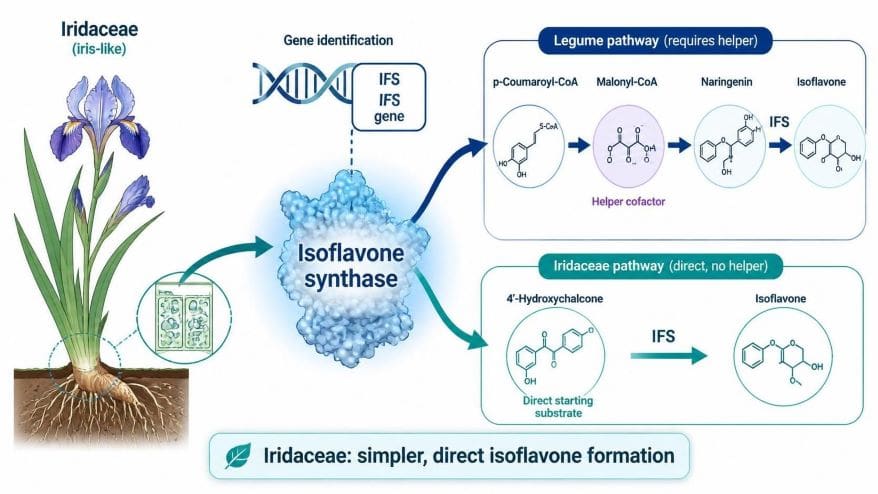
First, scientists found the key enzyme that builds isoflavones by using the isoflavone biosynthetic pathway in Iridaceae plants. This enzyme, called isoflavone synthase, drives the central step in the whole pathway.
Next, the team examined the plant’s genetic code to identify the gene encoding this enzyme. They discovered a new version of the isoflavone synthase gene that works differently from the one found in soybeans and other legumes.
In fact, the Iridaceae enzyme uses a different starting material. Unlike the legume enzyme, it does not need a special helper molecule to begin its work. This makes the Iridaceae version simpler and more direct.
As a result, this discovery helps scientists understand how nature evolved two separate ways to make the same important chemicals. It also gives them a new tool to produce isoflavones in other plants or in lab settings.
Finally, by identifying and characterizing this new enzyme, the researchers have opened the door to producing isoflavones more quickly and efficiently. This could lead to better medicines or stronger crops in the future.
Plant Biochemistry Insights
First, this discovery changes what scientists know about how plants make isoflavones. For a long time, researchers believed that only legumes (such as soybeans and peas) could produce these compounds. Now, they know that Iridaceae plants (like irises) also make them, but they use an entirely different set of steps.
Next, the biochemistry is simpler in Iridaceae plants. The pathway uses fewer enzymes and does not rely on the same helper molecules that legumes need. This tells scientists that nature evolved two separate solutions to solve the same chemical problem.
In addition, the new pathway shows how flexible plant metabolism can be. Plants can take the same starting materials and build very different final products. They need to switch on the right set of genes.
Furthermore, this insight helps scientists understand how plants defend themselves. Isoflavones act like a chemical shield. By learning how irises build this shield, researchers can now look for similar pathways in other plant families.
Finally, these biochemistry lessons have a practical side. Scientists can now use the simpler Iridaceae pathway to produce isoflavones in the lab or in other crops. This could lead to new medicines, better foods, or stronger plants that resist disease on their own.
Evolutionary Isoflavone Biosynthetic Pathway Divergence
To begin with, this discovery reveals a surprising fact about plant evolution. Scientists always thought that only legumes (like soybeans and peas) could make isoflavones. Now they know that Iridaceae plants (like irises) also make them, but the two plant groups use entirely different methods.
In fact, the two pathways evolved separately over millions of years. Legumes and irises do not share a recent common ancestor. This means that nature invented the ability to make isoflavones not once, but twice.
On top of that, the enzymes in each pathway look very different from each other. The legume version needs a special helper molecule to start. The iris version does not need that helper at all. This evidence shows that each plant group found its own unique solution.
Similarly, the genes that control these pathways also differ. Legumes use one set of genes. Iridaceae plants use a different set. This independent evolution is a clear example of convergent evolution, where two species arrive at the same result through different routes.
As a result of this finding, scientists now have a new way to study how plant metabolic pathways change over time. They can compare the two versions and learn how small genetic changes lead to significant differences in plant chemistry.
This evolutionary insight also helps researchers think about the future. If plants can evolve the same chemical ability twice, maybe they can do it again. Scientists can use this knowledge to help other plants gain new chemical powers through genetic engineering.
Frequently Asked Questions on Isoflavone Biosynthetic Pathway
What are isoflavones, and why are they important?
Soflavones are natural compounds that come from plants. They act as antioxidants, helping protect cells from damage. They also reduce swelling and inflammation in the body. On top of that, they have medicinal properties that can help treat certain health problems. In the plant world, isoflavones serve a different but equally important role. They help plants defend themselves against harsh environmental conditions, such as drought or extreme heat. They also fight off harmful germs and pests that try to attack the plant.
How is the Iridaceae pathway different from the soybean pathway?
Iridaceae plants (such as irises) use a different set of enzymes to produce isoflavones. One of these enzymes is called CYP736D, isoflavone synthase. This enzyme helps the plants build their isoflavone compounds.
On the other hand, soybeans use an entirely different enzyme system. They rely on a special enzyme called CYP93C. This enzyme belongs to a pathway that occurs only in the Fabaceae family, which includes beans, peas, and lentils.
Which plants belong to the Iridaceae family?
The Iridaceae family includes many popular ornamental plants. Some well-known examples are iris, gladiolus, crocus, and freesia. People value these plants for two main reasons.
First, they produce beautiful flowers that people love to grow in gardens or use in floral arrangements. Second, these plants contain bioactive compounds. These compounds can have positive effects on health or help protect the plants themselves.
Reference:
- Zhao, Y., Shi, X., Zhang, X., Lyu, M.-J. A., Tian, M., Li, S., Sun, L., Zhong, Y., Dai, Y., Zeng, H., Zhu, Y., Xie, G., Bai, J., Ma, X., Qi, L.-W., & Qin, M. (2026). Discovery of an isoflavone biosynthetic pathway in Iridaceae plants. Nature Communications, 17, Article 5713. https://doi.org/10.1038/s41467-026-74916-x
Editorial Note: This article was written by Rakshanda Jabbar and reviewed for editorial accuracy by our editorial team. It has not yet undergone independent review by a professional.
- Author
- Latest Posts

I completed my Master of Science from the University of Allahabad in 2017 with a strong academic background in life sciences and chemistry. My specialization included Molecular Biology, Microbiology, Genetics, Plant Breeding, Phycology, Paleobotany, and Bioinformatics, along with Organic Chemistry, Inorganic Chemistry, and Physical Chemistry. This multidisciplinary training provided me with a comprehensive understanding of biological systems and analytical scientific approaches.
After completing my postgraduate studies, I gained valuable professional experience in both the education and social development sectors. I worked at A.M. Oxford Public School, where I was actively involved in guiding students toward academic excellence. In this role, I focused on creating an engaging learning environment, encouraging critical thinking, and nurturing students’ curiosity for scientific learning. My experience as an educator strengthened my communication, mentoring, and classroom management skills.
In addition to my teaching experience, I worked with Jeevan Jagriti Foundation, where I contributed to community-based initiatives aimed at improving educational access and awareness among underprivileged sections of society. Through this work, I participated in programs designed to support social development and promote the value of education in marginalized communities.
These professional experiences helped me develop strong interpersonal, leadership, and organizational skills while reinforcing my commitment to education and community service.