This leads to unique electronic and structural properties, making materials not just stronger but also more conductive and more stable.
Multi-Anion Cation Engineering: A New Frontier in Materials Design
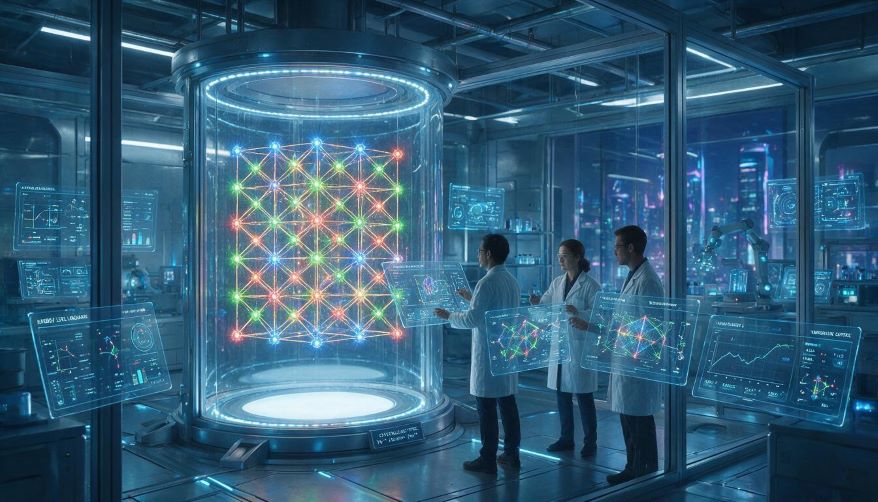
Materials science is changing rapidly, and with it, the way we design new materials. In the past, scientists mostly focused on tweaking cations—the positively charged parts of materials—to improve materials like ceramics, batteries, and catalysts. But now, thanks to research published in Chemical Science, there’s a new approach called multi-anion cation engineering. Instead of just working with one type of negatively charged ion (anion), scientists are purposefully mixing several kinds into the same material. This leads to unique electronic and structural properties, making materials not just stronger but also more conductive and more stable. Grasping this idea opens the door to the next generation of advanced technologies.
ENTECH STEM Magazine has included this research in its list of Top 10 STEM Discoveries and Innovations of June 2026.
What Is Multi-Anion Cation Engineering?
To understand why this is a big deal, let’s go back to some basic chemistry. Most materials have just one kind of anion—for example, oxides use oxygen, and sulfides use sulfur—combined with one or more cations. Titanium dioxide (TiO₂), for instance, contains only oxygen anions. Multi-anion cation engineering shakes things up by mixing two or more different anions (like oxygen, nitrogen, or fluorine) within the same crystal.
Background and Rationale: Multi-Anion Cation Engineering
Before this discovery, scientists mostly tried to tweak materials by swapping out cations—a process called cation doping. But that approach had some problems. Replacing a cation could disrupt the material’s structure or render it unstable. Anions were usually consider as background players and didn’t get much. Before this discovery, scientists primarily focused on tweaking materials by swapping out cations, a process known as cation doping. However, this approach posed several issues.
The big breakthrough was realizing anions aren’t just bystanders. By working with different kinds of anions, scientists can:
- Change the way electrons are arrange around cations—without even touching the cation itself.
- Build totally new shapes and arrangements in the material’s structure.
- Fine-tune how the material reacts to light, electricity, or stress.
So, multi-anion cation engineering gives scientists a powerful new way to design materials—one they hadn’t really used before.
How Multi-Anion Cation Engineering Works: A Step-by-Step Explanation
- Selection of Anions: Researchers first choose two or more anions with different sizes, electronegativities, or charges. Common choices include oxygen (O²⁻), nitrogen (N³⁻), fluorine (F⁻), and sulfur (S²⁻).
- Cation Pairing: Next, they select cations that are able to accommodate these differing anions. For example, a transition metal like titanium or niobium can bond with both oxygen and nitrogen.
- Synthesis Beneath Controlled Conditions: The material is then synthesizes using high temperature solid state reactions, thin-film deposition, or solvothermal methods. Crucially, the atmosphere (e.g., ammonia gas for nitrogen) and temperature are precisely controlls to incorporate the desired anions.
- Structural Rearrangement: Once the anions are integrate, the crystal lattice rearranges. This rearrangement is not random; it frequently results in layered structures or ordered anion arrangements. For instance, oxynitrides often form layers where nitrogen occupies specific sites.
- Property Emergence: Because nitrogen is less electronegative than oxygen, it donates more electron density to the cations. This changes the material’s band gap, making it visible light active (great for photocatalysis). Similarly, fluorine’s high electronegativity can stabilise high voltage cathodes in batteries.
- Characterization and Optimization: Scientists employ advanced techniques such as neutron diffraction and X-ray absorption spectroscopy to confirm the anion arrangement.
Applied Applications Across Industries
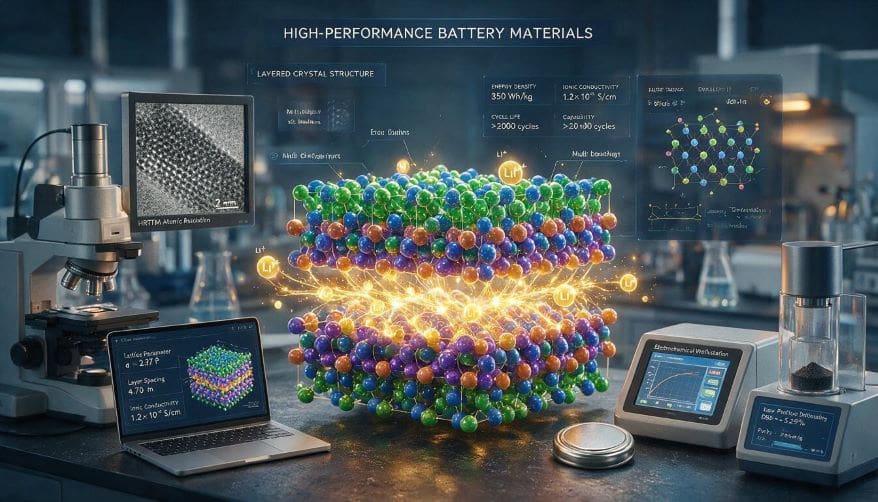
The versatility of multi-anion cation engineering has led to significant applications across various industries. The following sectors are already benefiting from this innovation.
- Energy Storage (Batteries): Technicians are developing oxyfluoride cathodes for lithium-ion batteries. By replacing some oxygen with fluorine, the cathode material resists deterioration at high voltages, leading to batteries that charge faster and last longer. These materials can increase energy density by up to 30%.
- Healthcare (Implants & Sensors): Biocompatible ceramics, such as hydroxyapatite for bone grafts, can be engineered with mixed anions to better replicate natural bone chemistry. Additionally, multi-anion materials are being uses in biosensors for detecting glucose or pathogens with higher sensitivity.
- Environmental Remediation (Photocatalysis): Traditional titanium dioxide photocatalysts only work under ultraviolet light. By engineering titanium oxynitride, the material absorbs visible light, making it effective for breaking down pollutants in water using sunlight—greatly reducing energy costs.
- Engineering & Manufacturing (Coatings): Hard coatings for cutting tools now incorporate carbonitrides (carbon + nitrogen). For example, titanium carbonitride coatings are significantly harder and more wear-resistant than single-anion coatings, extending tool life.
- Education & Research: This concept is now being taught in advanced materials science courses as a basic tool. It provides a new framework for students to think about property-structure relationships beyond simple cation substitution.
- Technology (Optoelectronics): LEDs and laser diodes benefit from multi-anion semiconductors. By tuning the anion composition, researchers can produce light throughout the entire visible spectrum from a single material system, simplifying device manufacturing.
Benefits of Multi-Anion Cation Engineering
Enhanced Property Tuning: Provides a wider palette for modifying band gaps, conductivity, and magnetism compared to cation only approaches.
Improved Stability: Many multi-anion materials show superior thermal and chemical stability, especially at high voltages or temperatures.
Cost-Effectiveness: Often uses earth abundant elements (e.g., nitrogen from air) instead of rare or expensive cations
Synergistic Effects: The combination of anions creates unique properties (e.g., simultaneous high strength and high conductivity) that are impossible with single-anion materials.
Expandable Synthesis: Many multi anion compounds can be synthesized using modified versions of existing industrial processes.
Future Scope: Emerging Trends and Opportunities
The field is still nascent, but several exciting trends are emerging.
High-Throughput Discovery: Using machine learning and automated synthesis robots, researchers can screen thousands of potential multi-anion combinations in weeks, accelerating discovery by orders of magnitude.
Flexible Electronics: Multi-anion oxides and nitrides are being investigated as transparent conductors for foldable screens, offering better flexibility than indium tin oxide.
Quantum Compounds: Certain multi-anion compounds display unusual quantum states, such as topological insulating features or elevated-temperature superconductivity. Engineering these materials could lead to quantum computers.
Clean Hydrogen Production: Multi-anion photocatalysts that efficiently split water using sunlight could make renewable hydrogen economically viable, a major move toward a carbon neutral energy economy.
Smart Coatings: Self-healing coatings that respond to damage or external changes (e.g., humidity) are being developed using anion gradients—where the anion composition varies across the coating thickness.
Frequently Asked Questions
Q1: How is multi-anion cation engineering different from doping?
Doping typically replaces a small fraction of atoms (usually cations) with a different element. Multi-anion engineering frequently involves significant amounts (10–50%) of multiple anions, fundamentally altering the crystal structure and bonding network rather than merely adding impurities.
Q2: What are the most common anion combinations used?
The most studied combinations are oxynitrides (O + N), oxyfluorides (O + F), and carbonitrides (C + N). Sulfur-nitrogen combinations are also attracting attention for battery applications.
Q3: Is this technique limited to ceramics?
No, while ceramics are the most common host, researchers are now applying these principles to coordination polymers, halide perovskites for solar cells, and even some metallic alloys.
Q4: Can machine learning help with multi-anion materials?
Absolutely. Machine learning models can predict stable anion arrangements and their electronic properties much faster than trial-and-error experiments. This is accelerating the discovery of new, useful materials.
Additionally, to stay updated with the latest developments in STEM research, visit ENTECH Online. Basically, this is our digital magazine for science, technology, engineering, and mathematics. Further, at ENTECH Online, you’ll find a wealth of information.
Reference
Xuele Xu, Zihan Yan, Jiachen Ying, Linghao Deng, Mingxing Liu, Yifei Xu, Yao Liu, Yiwen Zhang, Yizhou Zhu, Yongyao Xia, Yonggang Wang; Multi-anion/cation engineering enables fast ion transport and stable interfaces in Zr-based halide electrolytes for all-solid-state batteries. Chem. Sci. 2026; https://doi.org/10.1039/d6sc04008j
- Author
- Latest Posts

I am an inspirational writer and emerging science blogger with a deep-rooted passion for understanding and sharing the wonders of the world around us. My journey began with a Bachelor of Science in Chemistry from AKI’s Poona College of Arts, Commerce and Science, where I developed not only a strong foundation in scientific principles but also a mindset that values curiosity, observation, and critical thinking. Studying chemistry has taught me to approach problems with logic, to look beyond the obvious, and to see patterns where others might only see complexity. These experiences have shaped the way I perceive life and influence the way I express my thoughts, both scientifically and creatively.
I have always believed that knowledge is only as powerful as the way it is shared. This belief has guided me to create content that bridges the gap between science and everyday life. I aim to simplify complex scientific ideas so they become approachable, relatable, and engaging for everyone—whether someone has a formal background in science or is simply curious about the world. Science, in my view, is not confined to textbooks and laboratories; it is a way of thinking, understanding, and connecting with the world around us. By making science accessible, I hope to inspire curiosity, ignite learning, and encourage people to see the beauty and relevance of scientific discovery in their daily lives.
Alongside my love for science, I am deeply passionate about motivational writing. I believe words carry the power to transform perspectives, encourage self-reflection, and inspire action. By combining analytical thinking with creativity, I create content that is intellectually stimulating yet emotionally resonant. Whether I am breaking down a chemical concept, exploring a scientific phenomenon, or crafting motivational narratives, my goal is to communicate ideas in a way that is clear, meaningful, and impactful.
Through my work, I strive to empower my readers – not just by helping them understand the science around them, but by inspiring them to grow, learn, and realize their full potential. Every article, post, or story I write reflects my commitment to turning knowledge into inspiration. I want to spark curiosity, encourage self-improvement, and show that learning and personal growth are deeply connected. For me, writing is not just a craft; it is a way to touch minds, connect hearts, and make ideas come alive in a way that truly resonates.