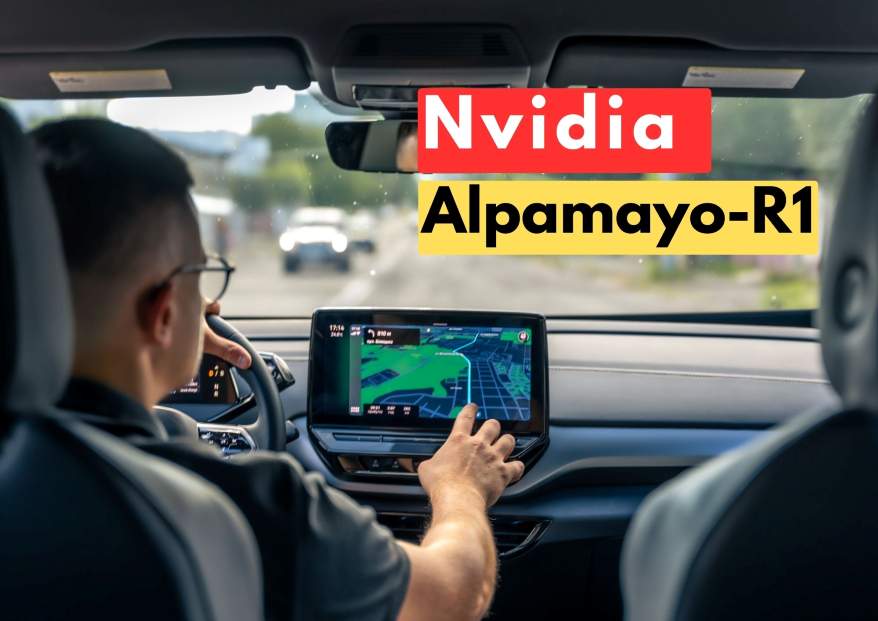
NVIDIA recently announced an exciting new AI model named Alpamayo-R1 (AR1).
NVIDIA’s New AI Is Changing Autonomous Vehicles and Robotics
Estimated reading time: 3 minutes
Introducing AR1: A New AI Model for Autonomous Driving
NVIDIA recently announced an exciting new AI model named Alpamayo-R1 (AR1). This model is the first open reasoning vision-language-action (VLA) model designed specifically for autonomous vehicles. What makes AR1 special is its ability to think step-by-step through driving scenarios, just like humans. It analyzes complex environments such as crowded intersections, double-parked cars, and lane closures. By using chain-of-thought reasoning combined with path planning, this AI helps vehicles choose the safest route possible.
This model runs on NVIDIA Cosmos Reason; consequently, it allows researchers to customize it for non-commercial uses. Furthermore, its training includes reinforcement learning, which improves its safety and decision-making abilities over time. Additionally, you can find AR1 on platforms like GitHub and Hugging Face, along with some training datasets in NVIDIA’s Physical AI Open Datasets, which are part of the Nvidia Alpamayo-R1 project.
How Nvidia Alpamayo-R1 Improves Driving Safety
The key to AR1’s success lies in its clear understanding of situations. The AI breaks down each event sequentially to evaluate risks before making decisions. By using the step-by-step reasoning approach, Nvidia’s Alpamayo-R1 enables cars to react smarter to unexpected obstacles or busy traffic conditions.
Tools that Help Build Smarter Robots and Vehicles
NVIDIA’s Cosmos platform offers various tools beyond AR1, including:
- LidarGen: Creates lidar data used for vehicle simulations.
- Omniverse NuRec Fixer: Cleans neural reconstructions.
- ProtoMotions3: Trains humanoid robots in realistic environments.
Together, these tools help developers improve the autonomy of cars and robots worldwide.
Apart from physical models like AR1, NVIDIA also updated its digital AI toolkit called Nemotron. This toolkit now includes a multi-speaker speech recognition model named MultiTalker Parakeet. It can recognize multiple speakers in real time and sort their voices efficiently using another tool called Sortformer.
The team also launched advanced audio models such as Audio Flamingo 3, which understands speech, music, and sounds all together. These innovations support safer applications through reasoning-based safety models and synthetic datasets tailored for specific tasks.
Easier Access Through Nvidia Alpamayo-R1 Open Source Sharing
NVIDIA supports open-source development heavily. They provide tools, models, and data publicly so researchers everywhere can join the effort. Nvidia encourages participation in the Alpamayo-R1 project to speed innovation across many fields from robotics to autonomous driving systems. For more details on NVIDIA’s open physical AI work visit interestingengineering.com/ai-robotics/nvidia-open-physical-ai-autonomous-driving.
Additionally, to stay updated with the latest developments in STEM research, visit ENTECH Online. Basically, this is our digital magazine for science, technology, engineering, and mathematics. Further, at ENTECH Online, you’ll find a wealth of information.
Reference:
Catanzaro, B. (2025, December 1). NVIDIA advances open model development for digital and physical AI | NVIDIA blog. NVIDIA Blog. https://blogs.nvidia.com/blog/neurips-open-source-digital-physical-ai/
- Author
- Latest Posts

I’m a web developer and science writer with a Master’s degree in Computer Applications (MCA) from Pune University.
I work in tech, building websites and staying updated with the latest developments. I also love writing about physics, chemistry, technology, robotics, mathematics, and breakthrough innovations. My passion is breaking down complex scientific topics into simple, easy-to-understand stories.
My goal is to help everyone stay informed about the exciting changes happening in science and technology. I believe understanding science shouldn’t be complicated—it should be accessible to all.