Quantum computing in air transport enhances efficiency and safety by enabling faster route optimization, smarter air traffic control, and advanced aircraft system simulations.
Quantum Computing in Air Transport: A New Era of Aviation
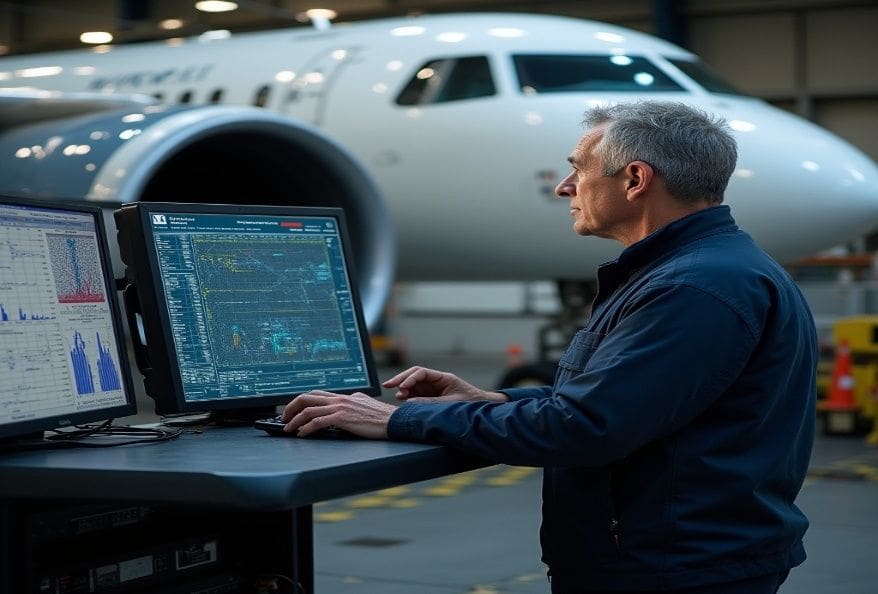
Imagine a world where flights rarely get delayed and routes are always optimized. Quantum computing in air transport promises to make this vision achievable by tackling problems that traditional systems struggle to solve. Today’s aviation industry faces growing congestion, rising fuel costs, and highly complex scheduling demands. As a result, even advanced classical computers reach their limits. However, a new technological shift is emerging that could redefine air travel operations.
Quantum Computing in Air Transport: A New Way to Compute
Modern computers are undeniably powerful, yet they rely on binary bits that exist as either zero or one. In contrast, quantum computers operate using qubits, which can represent multiple states simultaneously through superposition. Because of this, quantum machines can process vast numbers of possibilities at once rather than sequentially.
Classical vs Quantum Computing in Air Transport
To put it another way, consider navigating a maze. A classical computer explores one path after another. A quantum computer, on the other hand, evaluates all possible paths simultaneously. Consequently, quantum computing in air transport becomes especially valuable, since aviation systems involve enormous complexity and constant change.
The Role of Quantum Physics in Air Transport Computing
At its core, quantum computing is built on quantum physics, the science governing subatomic particles. One crucial principle is entanglement, which allows particles to remain connected regardless of distance. Therefore, information can be shared almost instantly across systems.
Addressing Complex Challenges in Air Transport
Air transport systems involve countless variables, including weather conditions, crew availability, air traffic constraints, and airport resources. Although classical systems perform reasonably well, they often deliver near-optimal solutions. By contrast, quantum algorithms excel at optimization, enabling airlines to achieve the best possible outcomes.
As a result, quantum computing in air transport can significantly enhance efficiency, reliability, and sustainability across the industry.
Optimizing Flight Paths with Advanced Computing
Aircraft fuel consumption depends heavily on routing decisions. Wind patterns, atmospheric pressure, and weather disturbances constantly shift. Currently, pilots and systems rely on limited real-time analysis. However, advanced computational models can evaluate all variables simultaneously.
Because of this capability, airlines could select the most fuel-efficient routes in real time. Consequently, emissions would decrease, operational costs would drop, and passengers could benefit from more affordable tickets.
Smarter Airport Operations and Scheduling
Airport congestion often leads to gate delays, baggage bottlenecks, and crew scheduling conflicts. Fortunately, next-generation computing technologies offer a solution by enabling faster and more accurate resource allocation.
Challenges Facing Quantum Technologies in Aviation
Despite its promise, quantum computing is still in its early stages. These machines are extremely sensitive and require ultra-cold environments to function correctly. Additionally, quantum systems are prone to noise, which can introduce calculation errors.
The Hybrid Computing Approach
At present, replacing classical systems entirely is unrealistic. Instead, a hybrid approach is emerging as the most practical solution, combining classical reliability with quantum-based optimization.
Safety, Security, and Risk Management in Quantum Air Transport
Aviation prioritizes safety above all else. For this reason, quantum-driven solutions undergo extensive testing before deployment. Meanwhile, security remains a concern, leading to the development of quantum cryptography for protecting sensitive data.
What This Means for Future Aviation Careers
This technological shift is opening doors to new careers in engineering, physics, and software development. Therefore, quantum computing in air transport represents both a challenge and an opportunity for the next generation.
A Promising Future for Aviation
Overall, the potential impact of quantum computing on aviation is immense. In conclusion, quantum computing in air transport marks the beginning of a transformative journey toward smarter, more efficient flight systems.
Additionally, to stay updated with the latest developments in STEM research, visit ENTECH Online. Basically, this is our digital magazine for science, technology, engineering, and mathematics. Further, at ENTECH Online, you’ll find a wealth of information.
Reference:
- Zanin, M., Du, Z., Giorgi, G. L., Sun, X., & Wandelt, S. (2026). Quantum computation in air transport: A short overview of the fundamentals, challenges and opportunities. Technologies, 14(2), 103. https://doi.org/10.3390/technologies14020103
- Author
- Latest Posts

Kottauppari Venkat Raghava
I am an Information Technology graduate (B.Tech) and a technology writer specialising in artificial intelligence, robotics, automation, and space technologies. I analyse complex scientific research and convert it into clear, practical insights for students, tech enthusiasts, and professionals. My work bridges the gap between academic research and real-world understanding by simplifying findings from peer-reviewed journals into engaging, easy-to-follow content. Alongside my writing, I have hands-on experience developing real-world projects, showcased on my GitHub, including an Expense Tracker web application for managing and visualising spending, and a Simple Video Summariser that generates concise insights from video content using automation techniques. I also produce research-driven articles on topics such as AI-powered corrosion detection, deep learning in engineering, and advanced automation systems. I follow a research-driven approach, ensuring every article is grounded in verified sources, industry knowledge, and practical applications. My goal is to make advanced technology accessible and meaningful, helping readers stay informed about innovations shaping the future.