R2 Transposon Technology Revolutionizes Targeted Plant Genome Editing
R2 Transposon Technology Transforms Plant Genome Engineering
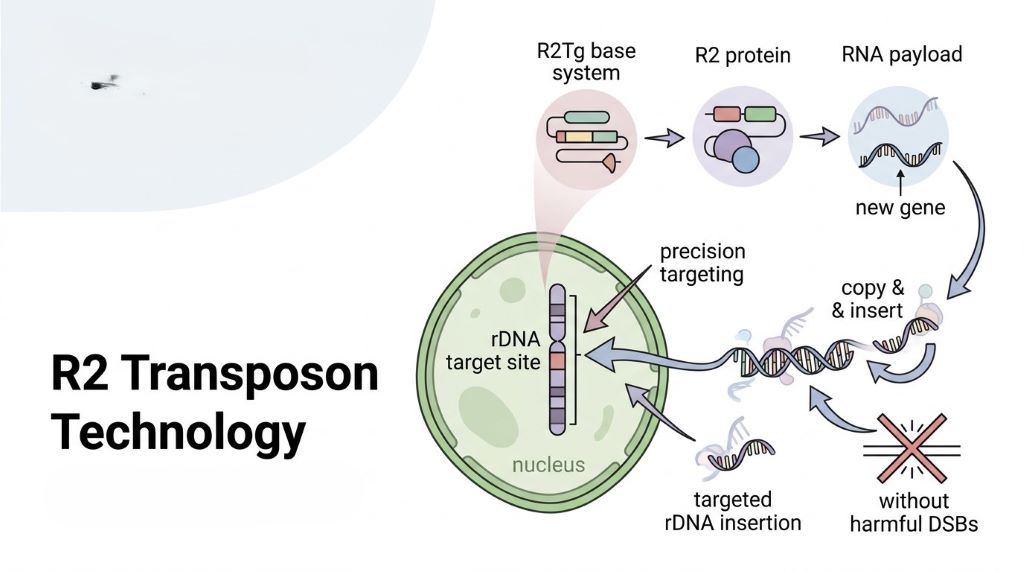
Advances in biotechnology are rapidly transforming how researchers decode, engineer, and manipulate living systems. As a result, new opportunities arise that open doors to solutions once considered impossible. For example, innovations such as R2 transposon technology range from improving human health to revolutionizing agriculture and environmental sustainability. They are also reshaping the future of science. The study published in Nature Biotechnology (2026) highlights another major step forward. It demonstrates how next-generation technologies like R2 transposon technology can expand our ability to understand and harness biological processes. Notably, these changes happen in ways that were unimaginable just a few years ago.
Key Takeaways
- The study adapts the avian zebra finch R2 protein (R2Tg) for targeted DNA insertion into plant genomes. Consequently, it establishes a compact ribonucleoprotein-based platform for precise gene addition.
- First, R2 non-LTR retrotransposons placed new DNA into the 25S rDNA site. As a result, the system added genes without making harmful double-strand DNA breaks.
- Next, the method inserted large DNA pieces that were 2–5 kb long. In addition, it worked in tobacco leaves, Arabidopsis cells, and tomato seedlings.
- Then, the researchers achieved insertion rates of up to 24%. Therefore, the system showed strong potential for large DNA integration in plants.
- Meanwhile, the team developed improved R2Tg expression tools and RNA payloads. Consequently, these changes increased the success of targeted DNA insertion.
- Finally, the study identified key design rules for efficient gene insertion. In turn, intron-based reporters and properly sized rDNA homology arms improved integration and supported the production of functional proteins.
Design and Construction of R2 Retrotransposon Machinery for Plant Activity
First, the researchers chose the R2Tg retrotransposon as the base for the new system. This natural tool can place DNA into ribosomal DNA sites in a precise way, and this process is central to R2 transposon technology in molecular plant biology.
Next, they built plant-ready R2Tg expression units. These units helped plant cells make the R2 protein needed for DNA insertion via R2 transposon technology. As a result, the system could work inside living plant cells.
Then, the team designed RNA payloads that carried the new genes. The R2 protein used these RNA molecules as templates to copy and insert DNA into the target site.
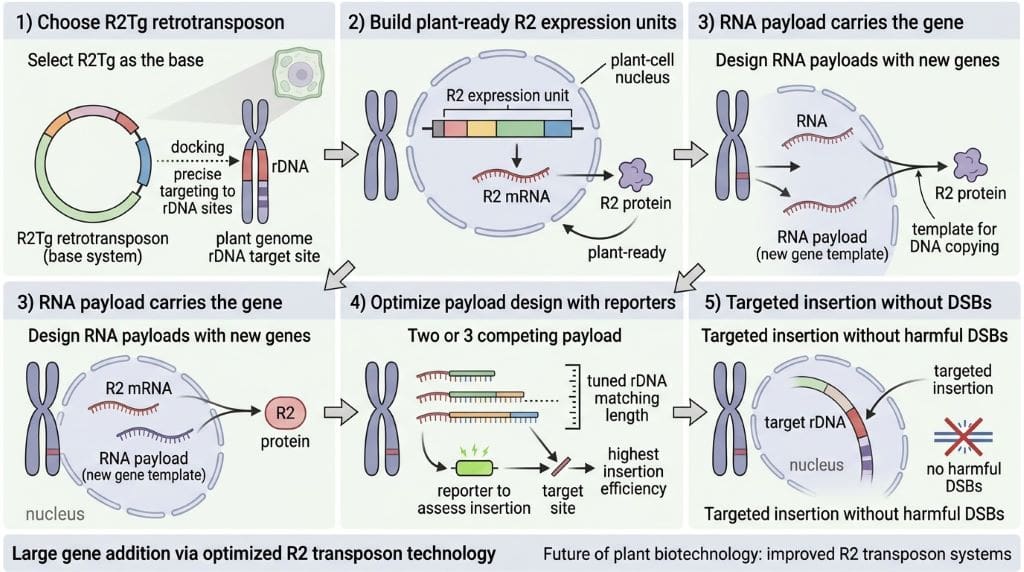
In addition, the researchers tested different payload designs. They adjusted the length of rDNA matching regions and used reporter genes to find the best setup for insertion. Consequently, the system became more efficient.
Finally, the optimized R2 machinery supported targeted gene insertion in plants without relying on harmful double-strand DNA breaks. Therefore, it offers a simple and promising method for adding large genes to plant genomes. In summary, the future of plant biotechnology may rely heavily on advances in R2 transposon technology.
R2-Mediated Integration of Full-Length Gene Cassettes into Plant rDNA
The researchers used the R2Tg system to place full-length gene cassettes into the 25S ribosomal DNA (rDNA) region of plant genomes. This region contains many copies of the same DNA sequence, making it a useful and stable target for gene insertion.
Next, the team designed RNA payloads that carried complete gene cassettes. These payloads included reporter genes such as mCherry and RUBY. When the R2Tg system inserted the payload into the 25S rDNA site, the inserted genes remained intact and could produce visible signals in plant cells.
RT–PCR Analysis
The researchers used RT–PCR to check whether the inserted genes were active in plant cells. This test showed if the new DNA could make RNA after it entered the 25S rDNA site.
First, RNA was collected from plant cells that received the R2 gene insertion system. Next, the RNA was changed into DNA. Then, PCR was used to detect the target gene sequences.
Career Line Inspired
- This research opens new career paths in plant genome engineering and crop biotechnology.
- The study highlights growing opportunities in genetic engineering, plant breeding, and molecular biology.
- Advances in targeted gene insertion are creating demand for skilled plant biotechnology professionals.
- Researchers in genome editing and synthetic biology can use these tools to develop improved crop varieties.
Frequently Asked Questions
What are R2 retrotransposons?
R2 retrotransposons are natural genetic elements that insert themselves into ribosomal DNA. They use target-primed reverse transcription (TPRT) to copy and integrate DNA at specific rDNA locations.
Why is the 25S rDNA locus important?
The 25S rDNA region contains many copies of the same DNA sequence. This makes it a stable genomic site for inserting new genes while reducing the risk of disrupting important genes.
How efficient was the R2Tg insertion system?
The optimized R2Tg system achieved targeted insertion efficiencies of up to 24% in tobacco leaves, Arabidopsis protoplasts, and tomato seedlings. It successfully delivered DNA payloads ranging from 2 kb to 5 kb.
Reference
Ali, Z., Butt, H., Alghamdi, R. et al. Efficient site-specific gene addition using R2 retrotransposons in tobacco and rice. Nat Biotechnol (2026). https://doi.org/10.1038/s41587-026-03181-6
- Author
- Latest Posts

I completed my Master of Science from the University of Allahabad in 2017 with a strong academic background in life sciences and chemistry. My specialization included Molecular Biology, Microbiology, Genetics, Plant Breeding, Phycology, Paleobotany, and Bioinformatics, along with Organic Chemistry, Inorganic Chemistry, and Physical Chemistry. This multidisciplinary training provided me with a comprehensive understanding of biological systems and analytical scientific approaches.
After completing my postgraduate studies, I gained valuable professional experience in both the education and social development sectors. I worked at A.M. Oxford Public School, where I was actively involved in guiding students toward academic excellence. In this role, I focused on creating an engaging learning environment, encouraging critical thinking, and nurturing students’ curiosity for scientific learning. My experience as an educator strengthened my communication, mentoring, and classroom management skills.
In addition to my teaching experience, I worked with Jeevan Jagriti Foundation, where I contributed to community-based initiatives aimed at improving educational access and awareness among underprivileged sections of society. Through this work, I participated in programs designed to support social development and promote the value of education in marginalized communities.
These professional experiences helped me develop strong interpersonal, leadership, and organizational skills while reinforcing my commitment to education and community service.