New Insights into Plant Toxin Distribution in Cycads
Plant Toxin Distribution Across Different Seed Layers
Plants face many threats from insects, yet they cannot run away from danger. Instead, they rely on remarkable defense systems that help them detect attacks. These defenses also allow them to respond quickly. A recent study in Annals of Botany explores how plants use specialized structures and biochemical pathways to interact with insects, including the importance of Plant Toxin Distribution in their responses. This study also explains how they protect themselves from damage. As researchers uncover these hidden defense mechanisms, they gain new insights into plant survival. Moreover, they learn more about adaptation. In addition, they learn about the complex relationships that shape ecosystems. These findings not only deepen our understanding of plant biology, but they also offer valuable knowledge for sustainable agriculture. Furthermore, they contribute to crop protection.
Key Takeaways
- Optimized LC/MS-MS methods enabled comprehensive toxin profiling – Researchers developed protocols to quantify five major cycad toxins (azoxyglycosides, BMAA, and β-sitosterol β-D-glucoside) from the same seed sample. This enabled them to overcome previous limitations of studying individual Plant Toxin Distribution separately.
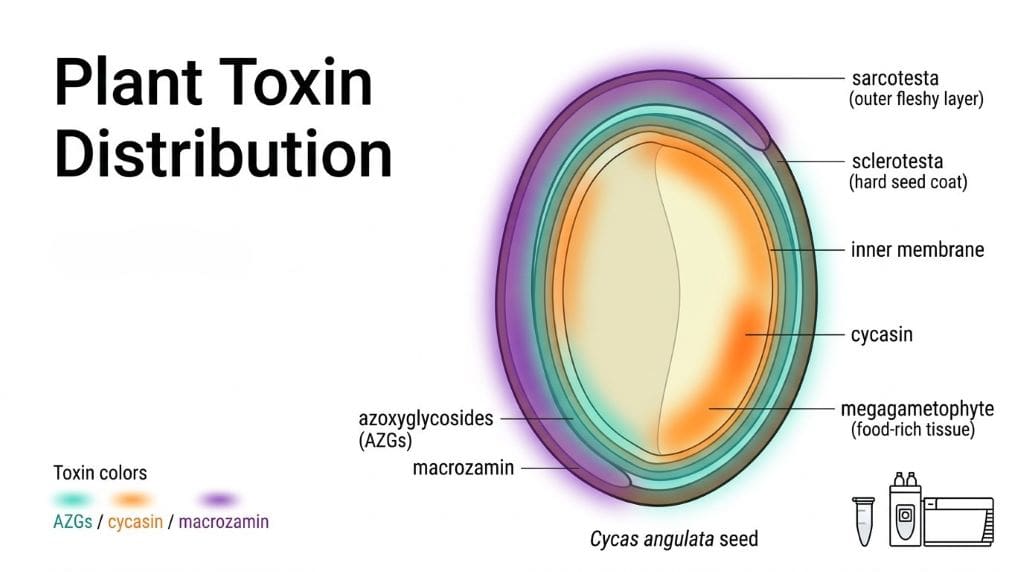
- Azoxyglycosides dominated across all seed layers – AZGs were the most abundant toxins throughout. Cycasin predominated in inner layers, and macrozamin in outer layers. This revealed a distinct spatial toxin distribution.
- Sarcotesta and megagametophyte contained highest toxin concentrations – These two outer seed tissues had the greatest overall toxin levels. In contrast, the inner membrane contained the lowest. This supports their role in herbivore defense.
- Sarcotesta may be as toxic as megagametophyte – Contrary to prior research, the sarcotesta contained high macrozamin levels. This suggests both tissues are equally important for deterring herbivores. Furthermore, animal seed dispersal requires toxin tolerance.
Toxin Distribution in Seed Layers
Researchers studied where major toxins are found in the seeds of Cycas angulata. They looked at four seed parts: the sarcotesta (outer fleshy layer), sclerotesta (hard seed coat), inner membrane, and megagametophyte (food-rich tissue). They used an improved LC/MS-MS method to measure several toxins from the same samples.
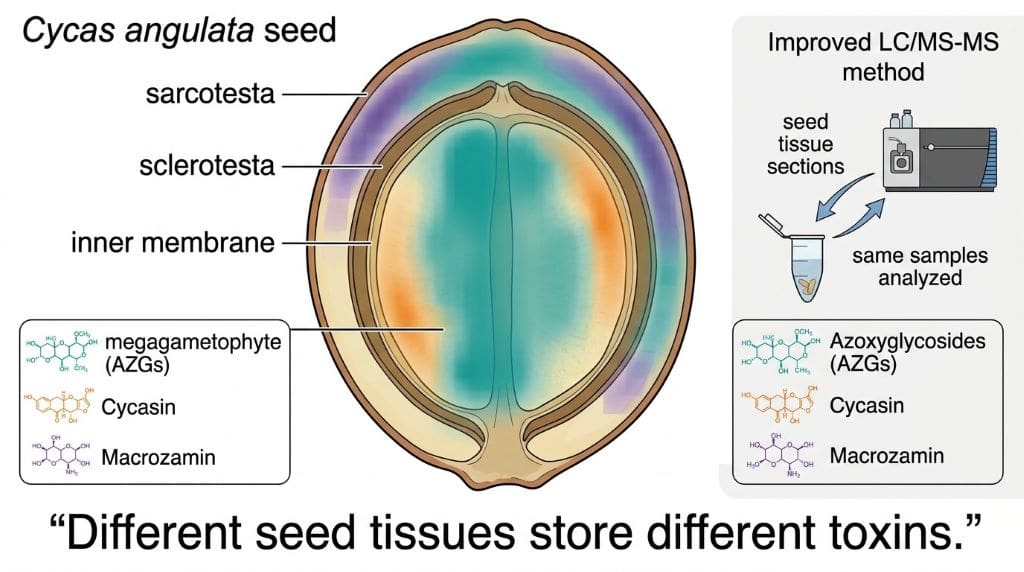
Plant Toxin Distribution found that azoxyglycosides (AZGs) were the main toxins in every seed layer. Cycasin was most common in the inner parts of the seed. In contrast, macrozamin was more common in the outer layers. These findings show that different seed tissues store different types of toxins.
Ecological Defense Function
Researchers found that Plant Toxin Distribution are not evenly spread throughout Cycas angulata seeds. The highest amounts were found in the sarcotesta, the fleshy outer layer, and the megagametophyte, the nutrient-rich inner tissue. This suggests that the plant places more toxins in the parts of the seed that are most valuable.
The study also found high levels of azoxyglycosides, especially cycasin and macrozamin. These compounds are toxic and may help protect the seeds from animals. By discouraging animals from eating the seeds, the toxins increase the chances that the seeds will survive, germinate, and grow into new plants.
The high level of toxins in the fleshy sarcotesta also raises questions about its role. This outer layer may not exist mainly to attract animals that spread seeds. Instead, the study suggests that animals must be able to tolerate these toxins before eating the seeds. As a result, only a few specialized species are likely to act as seed dispersers.
Ethnobotany and Indigenous Processing
For many generations, Indigenous communities have used cycad seeds as food. However, they first removed the toxins through careful preparation. The study of Cycas angulata helps explain why these methods were necessary.
The researchers found high levels of Plant Toxin Distribution in the sarcotesta, the fleshy outer layer, and in the megagametophyte, the nutrient-rich inner tissue. These toxins included azoxyglycosides such as cycasin and macrozamin. Because of these toxic compounds, eating raw seeds could be dangerous.
The findings show why Indigenous peoples developed effective ways to make cycad seeds safe to eat. By removing the toxins before consumption, they were able to use the seeds as a valuable food source.
The study also supports historical records of the Noongar people of southwestern Australia. They used careful methods to make cycad seeds safe to eat. These methods included removing parts of the seed, soaking the seeds in water, leaching out harmful substances, and washing them many times.
Career Paths
- Plant Toxicologist
- Studies harmful chemicals in Plant Toxin Distribution.
- Examines how plant toxins affect people and animals.
- Plant Biochemist
- Studies the chemicals found in plants.
- Investigates how plants make and use these chemicals.
- Analytical Chemist
- Tests and measures chemicals in samples.
- Uses laboratory tools to identify compounds.
- Botanist
- Studies plants and how they grow.
- Researches plant diversity and evolution.
- Plant Ecologist
- Studies how plants interact with their environment.
- Examines seed protection and plant survival.
- Ethnobotanist
- Studies how people use Plant Toxin Distribution.
- Explores traditional knowledge about food and medicine.
- Conservation Biologist
- Helps protect rare and endangered plants.
- Develops plans to conserve plant species.
- Environmental Scientist
- Studies the environment and natural ecosystems.
- Investigates the effects of plant chemicals in nature.
- Plant Research Scientist
- Carries out scientific studies on plants.
- Works in universities, laboratories, or research centers.
Frequently Asked Questions
Which toxins were most common in the seeds?
The researchers found that azoxyglycosides (AZGs) were the main toxins in the seeds. Two of the most common AZGs were cycasin and macrozamin. Both were present in high amounts, but they were not found evenly throughout the seed. Instead, each toxin was more common in certain seed tissues..
Which seed layers contained the highest toxin levels?
The highest toxin levels were found in the sarcotesta, the fleshy outer layer of the seed, and in the megagametophyte, the nutrient-rich inner tissue. In comparison, the inner membrane contained much lower amounts of toxins.
What broader significance do the findings have?
The findings help us better understand how plants protect their seeds, how seeds survive in nature, and how people have used plants over time. The study also shows that modern science and traditional knowledge can work together. By combining both, researchers can gain a clearer understanding of toxic plants and their uses.
Reference
Georgia R Lloyd, Phillip Holt, Kira Maher, Roslyn M Gleadow, Integrated LC/MS-MS approaches reveal toxicity differences across seed layers of Cycas angulata, Annals of Botany, 2026;, mcag169, https://doi.org/10.1093/aob/mcag169
- Author
- Latest Posts

I completed my Master of Science from the University of Allahabad in 2017 with a strong academic background in life sciences and chemistry. My specialization included Molecular Biology, Microbiology, Genetics, Plant Breeding, Phycology, Paleobotany, and Bioinformatics, along with Organic Chemistry, Inorganic Chemistry, and Physical Chemistry. This multidisciplinary training provided me with a comprehensive understanding of biological systems and analytical scientific approaches.
After completing my postgraduate studies, I gained valuable professional experience in both the education and social development sectors. I worked at A.M. Oxford Public School, where I was actively involved in guiding students toward academic excellence. In this role, I focused on creating an engaging learning environment, encouraging critical thinking, and nurturing students’ curiosity for scientific learning. My experience as an educator strengthened my communication, mentoring, and classroom management skills.
In addition to my teaching experience, I worked with Jeevan Jagriti Foundation, where I contributed to community-based initiatives aimed at improving educational access and awareness among underprivileged sections of society. Through this work, I participated in programs designed to support social development and promote the value of education in marginalized communities.
These professional experiences helped me develop strong interpersonal, leadership, and organizational skills while reinforcing my commitment to education and community service.