Metal-organic frameworks combine metal nodes with organic linkers to form ultra-porous crystals.
Metal-Organic Frameworks (MOFs): Applications, Breakthroughs & the 2025 Nobel Prize
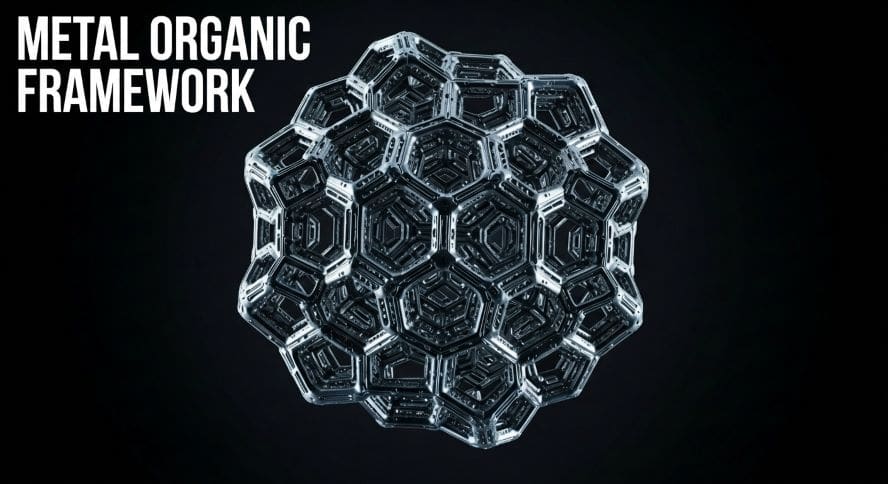
Metal-organic frameworks, or MOFs, are among the most promising materials in modern chemistry. Consequently, they have moved from university laboratories into real industrial systems at remarkable speed. In short, a MOF is a crystalline material built by linking metal ions with organic molecules, which creates a sponge-like pore network with an enormous internal surface area.
However, the field has changed dramatically in recent years. Specifically, the 2025 Nobel Prize in Chemistry was awarded jointly to Susumu Kitagawa, Richard Robson and Omar M. Yaghi “for the development of metal–organic frameworks.” Similarly, commercial systems now capture carbon dioxide, pull drinking water from desert air and store clean fuels. Therefore, this review explains how MOFs work, where they are already uses and where they are heading next.
Key Takeaways
- Metal-organic frameworks combine metal nodes with organic linkers to form ultra-porous crystals.
- The 2025 Nobel Prize in Chemistry was shared by Susumu Kitagawa, Richard Robson and Omar M. Yaghi.
- MOFs are already uses in industrial carbon capture and gas separation.
- Water harvesting from dry air, hydrogen storage and targeted drug delivery are the next commercial frontiers.
- The global market is project to grow roughly 30% per year through 2035.
What Are Metal-Organic Frameworks and Why Did They Win the Nobel Prize?
Fundamentally, a MOF consists of two repeating components: a metal ion or cluster (the node) and an organic molecule (the linker). Furthermore, the linkers join the nodes into a regular, open framework that stays porous even after the solvent is remove. As a result, a single gram of MOF can expose thousands of square metres of surface to incoming gases.
In fact, the conceptual foundations were laid by three chemists who now share the honour. Richard Robson first proposed the idea of linking molecular building blocks into extended porous networks in the late 1980s. Meanwhile, Omar M. Yaghi demonstrated the concept experimentally and later synthesised MOF-5, a landmark structure with record surface area. Similarly, Susumu Kitagawa showed that these frameworks could remain porous and reversibly adsorb gases, a property essential to their practical use. Consequently, the 2025 prize recognised all three scientists jointly for building this new field.
How MOFs Work: A Programmable Molecular Sponge
Essentially, a MOF behaves like a programmable sponge. In other words, chemists can tune the metal and the linker to change the size, shape and chemistry of the pores. Thus, one MOF can be design to capture carbon dioxide, while another selectively holds hydrogen or releases a drug.
Moreover, this tunability comes from strong coordination bonds rather than weak interactions. Accordingly, the skeletons are stable enough to survive repeated adsorption cycles, which is exactly what industrial use demands.
MOF Applications Across Industries
| Application | How the MOF helps | Maturity |
| Carbon capture | Selectively adsorbs CO₂ from flue gas; releases it on demand | Commercial (CALF-20 pilot) |
| Atmospheric water harvesting | Pulls drinkable water from air even below 20% humidity | Scaling up |
| Gas & hydrogen storage | Stores high-purity hydrogen safely below high-pressure tanks | Emerging |
| Chemical purification | Membranes separate propylene and other gases to 99.5% purity | Early commercial |
| Medicine | Nano-MOFs carry drugs and release them inside acidic tumours | Research |
| Electronics & safety | Sub-atmospheric storage of toxic gases for semiconductors | Niche commercial |
From Lab to Market: Where MOFs Are Use Today
Environmental protection and carbon capture
First, MOFs capture carbon dioxide directly from industrial flue gas. For example, the BASF-licensed material CALF-20 is now removing roughly one tonne of CO₂ per day at a cement-plant demonstration. In addition, MOF membranes reclaim refrigerants that would otherwise leak into the atmosphere. Consequently, continued scaling could help hard-to-abate industries reach their net-zero targets.
Atmospheric water harvesting
Second, MOFs can pull water from thin air. Notably, prototype devices already produce drinking water in extremely arid conditions, such as Death Valley, by adsorbing moisture at night and releasing it in the day. Therefore, this technology offers clean water to off-grid and drought-prone regions.
Clean energy and transportation
Third, MOFs store hydrogen at lower pressure for fuel-cell vehicles, and they purify methane and other fuels. Moreover, specialised MOF cylinders now store hazardous semiconductor gases at sub-atmospheric pressure, which reduces the risk of leaks from cylinders used in chip fabrication.
Healthcare and medicine
Finally, nano-MOFs are being engineer for targeted drug delivery. Specifically, they can encapsulate chemotherapeutic drugs and release them only in acidic tumour tissue, which lowers the side effects of treatment while concentrating the dose where it is need.
Also Read: Singlet vs Triplet Oxygen
Frequently Asked Questions
What are metal-organic frameworks (MOFs)?
MOFs are crystalline materials made of metal ions link by organic molecules, which gives them regular, nanometre-scale pores and an extremely high internal surface area.
Who won the 2025 Nobel Prize in Chemistry for MOFs?
The prize was awarded jointly to Susumu Kitagawa, Richard Robson and Omar M. Yaghi “for the development of metal–organic frameworks.”
Are MOFs uses commercially today?
Yes. MOF-based systems such as CALF-20 already capture CO₂ from cement-plant flue gas, and membranes separate industrial gases to high purity; water harvesting and hydrogen storage are now scaling.
What makes MOFs useful for carbon capture?
Their pore size and chemistry can be tune to adsorb CO₂ selectively, then release it on demand, which makes capture more energy-efficient than many solvent methods.
Can MOFs harvest water from dry air?
Yes. They adsorb moisture even at low relative humidity and release liquid water when gently heated, enabling harvesting in arid regions such as deserts.
A Correction Worth Emphasising for Accuracy and Trust
Earlier versions of this article credited the MOF breakthrough to a single researcher. In fact, the 2025 Nobel Prize in Chemistry is share by three scientists. Therefore, the revised text above names Susumu Kitagawa, Richard Robson and Omar M. Yaghi together. As a result, the page now aligns with the official Nobel citation, which strengthens its accuracy and, in turn, its authoritativeness.
References
1. Dutt, S.; Kumar, A.; Singh, S. “Synthesis of Metal Organic Frameworks (MOFs) and Their Derived Materials for Energy Storage Applications.” Clean Technologies 2023, 5, 140–166. https://doi.org/10.3390/cleantechnol5010009
This article was written by Juveriya Khan and reviewed for editorial accuracy by our editorial team. It has not yet undergone independent review by a professional.- Author
- Latest Posts

I am an inspirational writer and emerging science blogger with a deep-rooted passion for understanding and sharing the wonders of the world around us. My journey began with a Bachelor of Science in Chemistry from AKI’s Poona College of Arts, Commerce and Science, where I developed not only a strong foundation in scientific principles but also a mindset that values curiosity, observation, and critical thinking. Studying chemistry has taught me to approach problems with logic, to look beyond the obvious, and to see patterns where others might only see complexity. These experiences have shaped the way I perceive life and influence the way I express my thoughts, both scientifically and creatively.
I have always believed that knowledge is only as powerful as the way it is shared. This belief has guided me to create content that bridges the gap between science and everyday life. I aim to simplify complex scientific ideas so they become approachable, relatable, and engaging for everyone—whether someone has a formal background in science or is simply curious about the world. Science, in my view, is not confined to textbooks and laboratories; it is a way of thinking, understanding, and connecting with the world around us. By making science accessible, I hope to inspire curiosity, ignite learning, and encourage people to see the beauty and relevance of scientific discovery in their daily lives.
Alongside my love for science, I am deeply passionate about motivational writing. I believe words carry the power to transform perspectives, encourage self-reflection, and inspire action. By combining analytical thinking with creativity, I create content that is intellectually stimulating yet emotionally resonant. Whether I am breaking down a chemical concept, exploring a scientific phenomenon, or crafting motivational narratives, my goal is to communicate ideas in a way that is clear, meaningful, and impactful.
Through my work, I strive to empower my readers – not just by helping them understand the science around them, but by inspiring them to grow, learn, and realize their full potential. Every article, post, or story I write reflects my commitment to turning knowledge into inspiration. I want to spark curiosity, encourage self-improvement, and show that learning and personal growth are deeply connected. For me, writing is not just a craft; it is a way to touch minds, connect hearts, and make ideas come alive in a way that truly resonates.