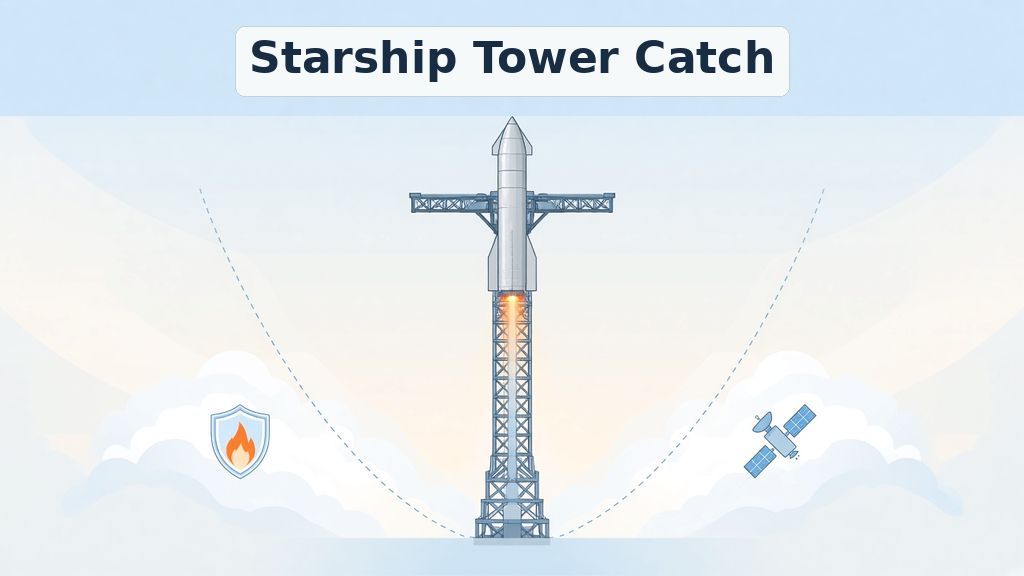
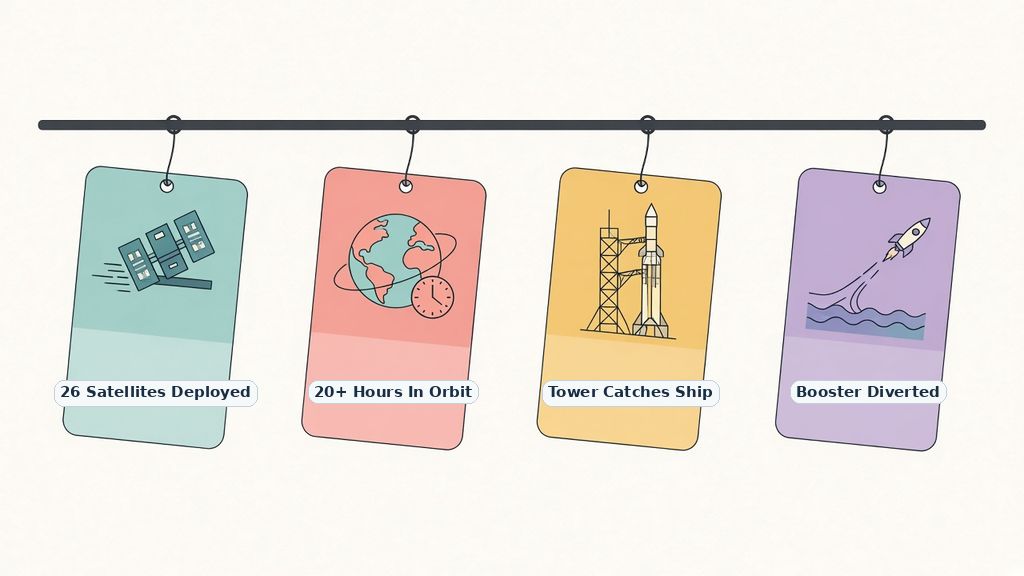
Suppose a friend tosses you a set of keys from across the room. First, your eyes track them. Then your hand snaps shut at just the right moment. Easy, right? Now try the same trick with a spaceship taller than a fifteen-story building. That idea drives the Starship tower catch, a new way home for ships. On November 14, 2026, a SpaceX tower grabbed a returning Starship for the first time. The ship had lifted off a day earlier from Starbase, Texas. To begin with, it released 26 Starlink V3 satellites in orbit. Then it circled Earth for more than 20 hours before it headed home. SpaceX lays out each step in its official Flight 15 recap. So how does a tower catch a falling rocket? This explainer follows the engines, heat shield, and computers. At the same time, it shows why catching rockets matters.
Most rockets in history flew only once. After launch, their big pieces fell into the ocean or burned up. In other words, builders needed a brand-new rocket for nearly every trip. Think of an airline that tossed each jet after one flight. Tickets would cost a fortune. As a result, flights would be rare. For this reason, SpaceX designed Starship to be fully reusable. Both the booster and the upper stage should come back. SpaceX describes full recovery as the Holy Grail of rocketry in its return-to-launch-site plan. It says full reuse could allow an “airplane-like cadence” of flights. Before Flight 15, however, SpaceX planned upper stage flights to end at sea. Even so, the tower had already caught boosters. Our story on SpaceX’s first booster grab covers the first.
Fig. 1: Key Takeaways From the First Ship Catch
Landing Legs Versus Tower Arms
So why not just give the ship legs? Many landing spacecraft use folding legs, a bit like a camera tripod. Starship skips them. Instead, the ship carries two catch fittings just below its front flaps. On the one hand, legs let a vehicle touch down on almost any firm surface. Legs, on the other hand, ride all the way to space and back. What if those legs simply stayed on the ground? Extra weight on any rocket, in general, leaves less room for cargo. In addition, a catch puts the ship right beside its launch tower. SpaceX built its Starbase towers to integrate, test, launch, and catch vehicles. As a result, a caught ship starts its next trip from home. Still, SpaceX has not published a weight comparison of legs and arms. In other words, treat this part as general engineering reasoning.
How a Starship Tower Catch Works
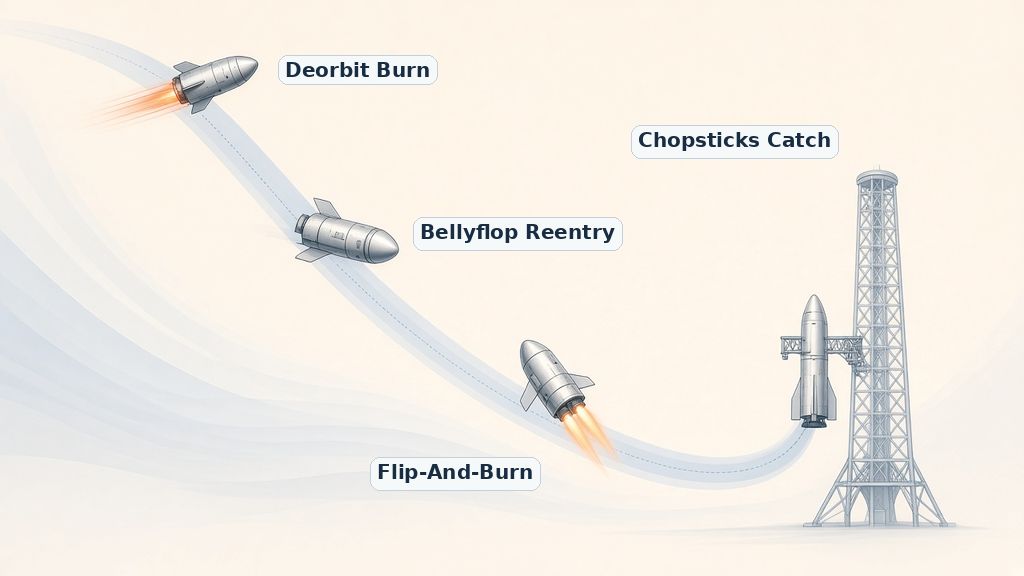
Let’s start with the whole rocket. It stands about 124 meters, or 407 feet, tall. That is longer than an American football field, end zones included. In addition, its two parts stack like building blocks. The bottom part, Super Heavy, does the heavy lifting at launch. Then there is the top part, the ship, which carries cargo into orbit. A little over two minutes after liftoff, the two parts split. Next, the ship keeps climbing on its own six engines. For the Starship catch, it must later slow from orbital speed to a hover. How does it slow? Four steps. To begin with, a deorbit burn starts the fall back toward Earth. After that comes reentry, and then a flip sets up the final grab. The Starship vehicle overview lists the sizes and parts of both stages.
Fig. 2: The Ship’s Path From Orbit to Tower Arms
Raptor Engines Provide the Push
Both stages run on Raptor engines. They burn liquid methane and liquid oxygen. Hot gas rushes out of each engine, so the rocket moves the other way. NASA’s guide to rocket principles explains this with a balloon. Let go of a filled balloon, and escaping air shoves it away. In the same way, exhaust from the engines pushes a rocket upward. Simple idea, but huge engines. Super Heavy carries 33 Raptors, while the ship carries six. Three ship engines work best in air, but three suit the vacuum of space. According to SpaceX, the newest sea-level Raptor 3 makes about 250 metric tons of force. That beats the earlier version’s 230, a gain of almost one tenth. Not only do these engines push hard, but they also relight in flight. On Flight 15, ship engines relit for orbit, for the deorbit burn, and for landing.
Heat Shield Tiles Face the Fire
How fast does a ship orbit Earth? Very fast. SpaceX says low Earth orbit needs about 17,500 miles per hour. In other words, that is 250 times a car’s highway speed of 70 mph. Say you had to stop from that speed. So you would need a giant brake. Instead, the ship uses the air itself. As a result, the air ahead of the ship heats up sharply. Indeed, NASA says returning spacecraft can face up to 7,000 degrees Fahrenheit. Its Ames entry systems team compares the view outside to a wall of fire. A heat shield of tiles protects Starship, much as an oven mitt protects a hand. In addition, SpaceX intentionally removed dozens of tiles in earlier tests. At the same time, four flaps steer the ship like a skydiver’s arms and legs.
Flip-and-Burn Before the Starship Catch
Next comes the wildest part. The ship falls belly first, a bit like a flat sheet of cardboard. SpaceX calls this pose the bellyflop. A flat body catches lots of air, so the fall slows down. But a catch needs the ship upright. So near the tower, the ship fires three sea-level Raptors and swings vertical. At the same time, it folds its flaps out of the way. This flip-and-burn pairs a landing flip with a landing burn. Then the ship drops to two engines and slides between the tower arms. After that, it shuts down one more engine and nearly hovers. In other words, a falling slab turns into a hovering lift within seconds. How many seconds? On Flight 15, the planned timeline gave the landing burn about 18. That is shorter than most TV ads. For this reason, every engine start must happen right on time.
Chopsticks Close for the Launch Tower Catch
SpaceX nicknames its catching tower Mechzilla, and its two giant arms the chopsticks. As the ship hovers between them, the arms close fast. Then they grab the ship by its two catch fittings. Once the ship senses contact, it shuts down its final engine. Let’s say you pinch a dumpling with chopsticks. Then make it skyscraper size. On its newer Pad 2 tower, SpaceX made the chopsticks shorter so they move faster. In addition, engineers swapped hydraulic movers for electromechanical ones. Hydraulic systems push with fluid under pressure, while electromechanical ones use electric motors. SpaceX says the swap therefore improves speed, reliability, and redundancy. Specifically, redundancy means backup parts that keep working if one part fails. The Starship V3 upgrade notes describe these tower changes.
Guidance and Control Steer the Ship
Who flies the ship home? Nobody sits inside. Instead, onboard computers fly the entire return. NASA’s guidance system primer lists sensors, computers, radars, and communication gear. It says guidance keeps a rocket stable and also steers it. Starship V3 carries about 60 custom avionics units, SpaceX reports. Avionics simply means the electronics that fly an aircraft or spacecraft. The ship also blends several kinds of navigation sensors to track its position. During reentry, it moves its four flaps to hold a safe path. In addition, it makes small turns to fly over sparsely populated land. During the long coast, controllers checked engine health, power, and tank pressure. As a result, the ship headed home only after it passed those checks. In the same way, pilots run a checklist before every landing. Careful work? Very careful.
Starlink V3 Satellites Ride Along
Before the Starship catch, it carried 26 Starlink V3 satellites into orbit. What do they do? They beam internet service to people on the ground. According to Starlink’s satellite technology page, they orbit about 550 kilometers up. In contrast, traditional internet satellites sit about 65 times higher. Because Starlink flies lower, signals make a shorter round trip. As a result, the delay, or latency, drops to around 25 milliseconds. Older high satellites need over 600 milliseconds, roughly 24 times longer. So that gap helps with video calls and games. Meanwhile, SpaceX calls the V3 design much more powerful than earlier Starlink satellites. It says one Starship launch of V3 satellites adds huge capacity. In other words, the gain tops 20 times a Falcon launch of older V2 satellites. SpaceX also planned for three of them to photograph the heat shield.
How the Satellites Leave the Ship
Guess what Starlink satellites look like? Compact flat panels, according to Starlink. As a result, flat panels stack tightly, like slices in a loaf. Inside Starship, a mechanism nicknamed the PEZ Dispenser releases them one by one. The name borrows from a candy toy that pushes out one piece at a time. For V3, SpaceX added new actuators that speed up each release. After release, each satellite uses efficient argon ion thrusters to climb higher. At the same time, two solar arrays and a battery supply power. Also, a star tracker reads star positions to find where each satellite points. On Flight 15, SpaceX made contact with every satellite. In addition, it reported that they were raising their orbits. Even so, astronomers watch such fleets closely. Readers can learn how crowded satellite constellations affect space telescopes.
What Flight 15 Did and Did Not Show
Did everything go perfectly? Not quite. Flight 15 was a test flight, and not every step went to plan. The Super Heavy booster flipped and relit 32 of 33 planned engines. However, its boostback burn ended early because of low fuel. SpaceX says engineers are still investigating the root cause. Its computers then triggered an automatic abort and sent the booster offshore. In other words, the booster did not return for a catch this time. It hovered over the Gulf, and its safety system ended the flight. As a result, only the ship met the tower on this mission. Even so, the tower closed around the ship for the very first time. SpaceX shared no reuse, refurbishment, or cost figures from this flight. Earlier setbacks, such as Starship’s fiery 2025 explosion, also shaped today’s design.
Rapid Reuse After Catching Starship
The Starship tower catch shows how many technologies must work together. Raptor engines push, and the heat shield survives the return. Then flaps steer, the flip-and-burn sets up a hover, and the chopsticks close. Meanwhile, computers check every system. SpaceX’s stated goal is rapid reuse without refurbishment between flights. Still, one catch does not prove that goal. In other words, many more flights must show how quickly a ship flies again. Each return over land also follows conditions that safety officials approve. The FAA Starship project page explains the licenses such launches need. Now imagine a STEM career in this work. In addition, propulsion, materials, robotics, software, and radio engineering all played a part. Hard problem? You bet. But it breaks into smaller steps you can learn.
This explainer walks young readers through a complicated return sequence in a calm, orderly way. A simple labeled sketch of the catch fittings and tower arms would make that section even easier to picture. Later coverage could explain what engineers learn once a caught ship actually flies again. For the complete flight account, readers are encouraged to consult the official SpaceX mission page that this story draws on.
Editorial note
ENTECH chose this story because a dramatic test flight doubles as a lasting lesson in how reusable rockets work. Rather than chase the headline, the piece breaks the return into engines, heat protection, steering, and robotic arms, using everyday comparisons. It relies on SpaceX’s own Flight 15 page and technical updates, plus NASA and FAA learning pages, and it leaves out reuse and cost claims the company has not published. Anyone wanting the full mission timeline can go straight to SpaceX’s official Flight 15 page.
Dr. S. A. Hashim holds a Ph.D. in Aerospace Engineering from IIT Kharagpur, with a specialization in rocket propulsion. He currently serves as a Director of COE-Propulsion Systems and Associate Professor at the Department of Aerospace Engineering, Alliance University, Bangalore, India. Reach out to him at [email protected].