The New Glenn rocket showed powerful engineering progress.
Blue Origin’s New Glenn Launch April 2026 Shock: Science Success, Mission Failure

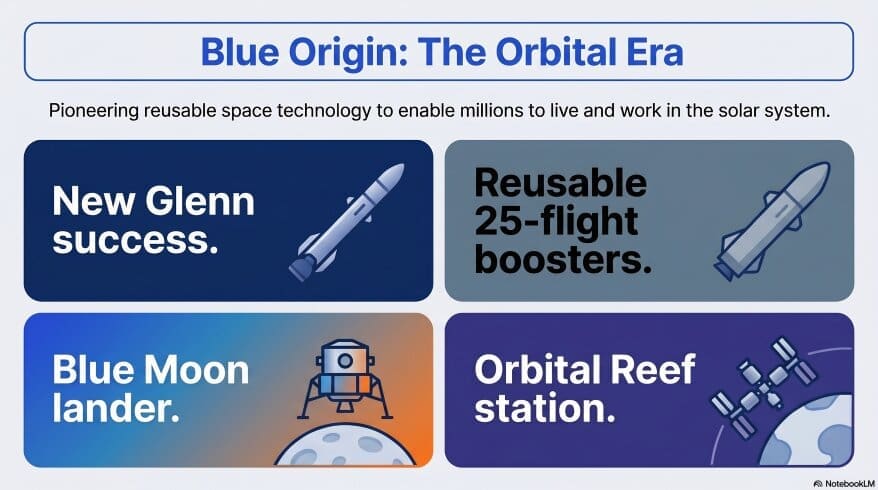
A recent Blue Origin Launch on 19 April 2026 grabbed global attention. The New Glenn rocket showed powerful engineering progress. At the same time, the mission faced a critical orbit failure. This mix of success and challenge makes science exciting. It also connects directly with chemistry concepts you study. Rockets depend on fuels, reactions, and material science. So, this news is not just about space. It is about your classroom knowledge in action. With this in mind, students can see how chemistry shapes real missions. Above all, it opens paths toward pharmacy and research careers.
Key Takeaways for Blue Origin Launch on 19 April 2026
- The New Glenn rocket successfully reused its booster
- The satellite failed to reach the correct orbit
- Rocket fuel chemistry drives launch efficiency
- Material science prevents extreme heat damage
- Research studies support future space innovations
At first, space launches seem distant from textbooks. In reality, chemistry plays a major role. Rockets rely on controlled chemical reactions. These reactions release high energy output. As a result, rockets escape Earth’s gravity. In this case, the Blue Origin mission highlights applied chemistry. Students studying thermodynamics can relate directly. At least, this makes learning more meaningful. With this purpose in mind, let us explore the science behind it.
The Science Behind Blue Origin Launch on 19 April 2026
How Rocket Fuel Works
To explain, rocket engines burn fuel rapidly. This creates hot gases with strong pressure.
- Fuel combines with oxidizers for combustion reactions
- High temperature produces expanding gas molecules
- Gases exit the nozzle to create thrust
- Newton’s third law drives rocket movement
At any rate, this process depends on chemistry basics. Students learn these reactions in school. As can be seen, theory becomes real in space missions.
After that, understanding materials becomes equally important. Rockets face extreme heat and pressure. Therefore, scientists design special materials. These materials resist high thermal stress. They also prevent structural damage risks.
What Chemistry Students Can Learn
At this time, classroom concepts connect strongly with this Blue Origin Launch. Chemistry is not limited to labs. It applies to rockets, medicines, and industries.
Real-Life Chemistry Applications
To list, here are direct connections:
- Thermodynamics explains heat transfer in engines
- Kinetics controls reaction speed of fuels
- Material chemistry ensures durability strength
- Analytical chemistry tests fuel purity levels
In light of this, students can rethink their studies. Chemistry becomes a practical tool. It helps solve real engineering problems.
As a matter of fact, research supports this connection. A study published in Scientific Reports highlights advanced material and chemical analysis. It shows how scientists improve performance systems. This research builds a bridge between theory and application. With this in mind, students can aim for research careers.
Why This Blue Origin Launch on 19 April 2026 Matters for Students
At this point, the Blue Origin launch teaches more than space science. It shows how failures and success go together. This is true in both research and careers.
Lessons You Should Take: Blue Origin Launch
- Failure improves future mission accuracy
- Science needs patience and continuous testing
- Chemistry knowledge has wide career scope
- Innovation depends on student curiosity growth
To put it differently, every experiment matters. Even failed missions teach valuable lessons. Scientists learn and improve systems.
With attention to your studies, you can build strong basics. Articles like Physical Chemistry Fundamentals for Young Minds and SI Units: The Secret Language of Chemistry help strengthen concepts. These topics directly support understanding of real-world science.
Also read: What Exactly is the Interstellar Comet 3I/ATLAS?
FAQs related to Blue Origin Launch on 19 April 2026
1. What is the Blue Origin New Glenn rocket?
The New Glenn rocket is a heavy-lift launch vehicle developed by Blue Origin. It is designed for reusable missions and long-distance space travel.
2. What went wrong in the Blue Origin launch on 19 April 2026?
The satellite failed to reach its planned orbit. As a result, it could not function properly and may deorbit early.
3. How does Blue Origin compare with SpaceX?
Blue Origin focuses on gradual development. SpaceX leads in frequent reusable launches.
4.Why do rockets fail sometimes?
Failures happen due to technical issues or calculation errors. Scientists use these failures to improve future missions.
Reference
https://www.blueorigin.com/news/new-glenn-ng-3-mission
- Author
- Latest Posts

I am an inspirational writer and emerging science blogger with a deep-rooted passion for understanding and sharing the wonders of the world around us. My journey began with a Bachelor of Science in Chemistry from AKI’s Poona College of Arts, Commerce and Science, where I developed not only a strong foundation in scientific principles but also a mindset that values curiosity, observation, and critical thinking. Studying chemistry has taught me to approach problems with logic, to look beyond the obvious, and to see patterns where others might only see complexity. These experiences have shaped the way I perceive life and influence the way I express my thoughts, both scientifically and creatively.
I have always believed that knowledge is only as powerful as the way it is shared. This belief has guided me to create content that bridges the gap between science and everyday life. I aim to simplify complex scientific ideas so they become approachable, relatable, and engaging for everyone—whether someone has a formal background in science or is simply curious about the world. Science, in my view, is not confined to textbooks and laboratories; it is a way of thinking, understanding, and connecting with the world around us. By making science accessible, I hope to inspire curiosity, ignite learning, and encourage people to see the beauty and relevance of scientific discovery in their daily lives.
Alongside my love for science, I am deeply passionate about motivational writing. I believe words carry the power to transform perspectives, encourage self-reflection, and inspire action. By combining analytical thinking with creativity, I create content that is intellectually stimulating yet emotionally resonant. Whether I am breaking down a chemical concept, exploring a scientific phenomenon, or crafting motivational narratives, my goal is to communicate ideas in a way that is clear, meaningful, and impactful.
Through my work, I strive to empower my readers – not just by helping them understand the science around them, but by inspiring them to grow, learn, and realize their full potential. Every article, post, or story I write reflects my commitment to turning knowledge into inspiration. I want to spark curiosity, encourage self-improvement, and show that learning and personal growth are deeply connected. For me, writing is not just a craft; it is a way to touch minds, connect hearts, and make ideas come alive in a way that truly resonates.