Scientists discovered the interstellar comet 3I/ATLAS using advanced space telescopes like JWST.
What Exactly is the Interstellar Comet 3I/ATLAS?
Imagine finding a visitor from another star system. Well, scientists discovered exactly that using the James Webb Space Telescope. The interstellar comet 3I/ATLAS traveled through space from a distant star system. This comet is only the third one of its kind we have ever found. As an illustration, the first two were called 1I/’Oumuamua and 2I/Borisov (Belyakov et al., 2026).
Key Takeaways
- Scientists discovered the interstellar comet 3I/ATLAS using advanced space telescopes like JWST
- This comet comes from outside our solar system, offering clues about other star systems
- Studying comets opens exciting career paths in astronomy, physics, and planetary science
- You need strong skills in math, chemistry, and physics to pursue this field
- This discovery shows how technology and teamwork solve big space mysteries.
Interstellar Comet 3I/ATLAS
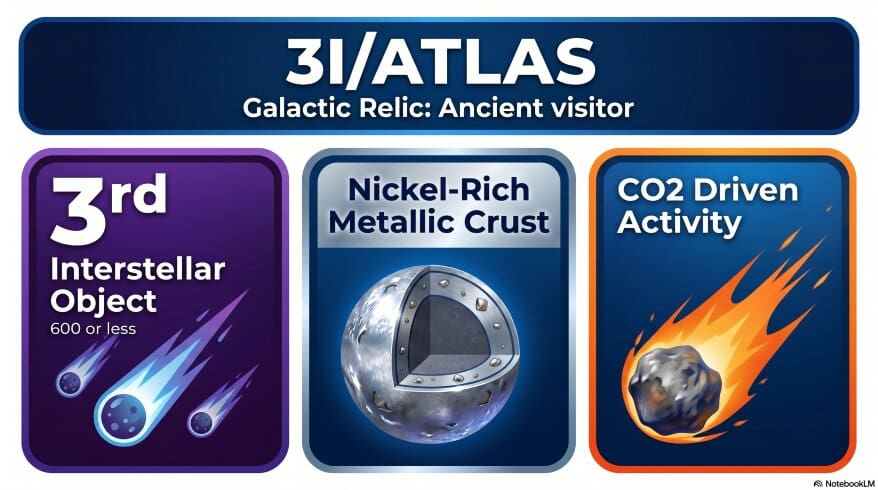
This comet has a nucleus about 2.6 kilometers across. To put it differently, it is roughly the size of a small mountain. The comet became active as it traveled closer to our Sun. It released gases and dust that created a bright, extended coma. With this in mind, scientists saw an excellent opportunity to study it in detail.
The observations occurred between December 15 and December 27, 2025. At that time, the comet was still quite far away. Scientists spotted water vapor, carbon dioxide, methane, and even nickel atoms. Prior to this study, nobody had detected methane directly in any interstellar comet before.
Why Should You Care About This Discovery?
At first, studying distant comets might seem boring. However, this discovery tells us something amazing about space. The interstellar comet 3I/ATLAS shows us how planets and asteroids form around other stars. It gives us clues about whether life-supporting worlds exist elsewhere.
To explain further, comets are like time capsules. They preserve materials from when they first formed. Additionally, by studying them, scientists learn about the building blocks of different star systems. As a result, we understand our place in the universe better.
What’s more, this comet behaves differently from comets in our solar system. Its mix of chemicals is unusual and interesting. This tells astronomers that planetary systems vary greatly across the galaxy. Each star system appears unique in its own special way.
The Technology Behind This Amazing Discovery
How Did Scientists Detect These Gases?
The James Webb Space Telescope (JWST) made this discovery possible. Specifically, scientists used the MIRI instrument’s medium-resolution spectrometer. This tool separates light into different wavelengths, like a prism does. In effect, it shows which chemicals exist in the comet’s atmosphere.
The spectrometer captured light between 5 and 28 micrometers. To illustrate, this is in the infrared part of the light spectrum. Human eyes cannot see infrared light. However, special detectors can capture it and create images scientists can study.
Seeing that this technology is so advanced, it cost billions of dollars to build and launch. At any rate, the results have been worth it. Scientists learned more in a few observations than they could have in years of ground-based studies.
Breaking Down the Chemical Discoveries
| Chemical Found | Significance | Detection Method |
| H₂O (Water) | Shows icy origin | Fluorescence at 5.8-7.0 μm |
| CO₂ (Carbon Dioxide) | Enhanced ratio found | Primary band near 15 μm |
| CH₄ (Methane) | First interstellar detection | Fluorescence bands |
| Ni (Nickel) | Atomic form detected | Forbidden transition at 7.507 μm |
The above table shows the main chemicals scientists found. For the purpose of understanding these discoveries, let me explain what makes them special.
Water is common in comets. However, the amount of carbon dioxide is unusual. To enumerate the differences clearly, this comet has much more CO₂ than typical solar system comets. To point out another difference, the methane detection was completely new for interstellar objects.
What This Means for Your Future Career
Exciting Job Opportunities in Astronomy
By all means, space science offers amazing career paths. The interstellar comet 3I/ATLAS discovery shows why these jobs matter. Several types of careers exist in this field.
Observational Astronomers
use telescopes to study objects in space. They analyze data and write research papers. This job requires strong math and physics skills.
Planetary Scientists
Study planets, moons, and small bodies like comets. They try to understand how solar systems form. This career combines chemistry, physics, and geology knowledge.
Aerospace Engineers
design and build spacecraft and instruments. They created the JWST that found this comet. This job needs excellent problem-solving abilities.
Data Analysts
Process the huge amounts of information from space telescopes. They use computers to find patterns in complex data. Programming skills are essential for this role.
At this point, you might wonder which job suits you best. That depends on your interests and strengths. All in all, every position is equally important to the team.
The Real-World Impact of Comet Science
How This Discovery Helps Us
Studying the interstellar comet 3I/ATLAS teaches us important lessons. Scientists noticed the comet’s activity decreased over 12 days. To that end, they learned how these objects change over time.
The comet’s enhanced carbon dioxide ratio is particularly interesting. Provided that we understand this better, we might learn about formation conditions in other star systems. The methane detection suggests complex chemistry happens in distant space.
As a matter of fact, this research helps answer big questions. Are comets common around other stars? Do all star systems form similarly? These answers might eventually help us find habitable planets.
Real Statistics from the Research
The scientists made observations at two different times:
- First observation date: December 15-16, 2025
- Comet distance: 2.20 astronomical units from the Sun
- Second observation date: December 27, 2025
- Comet distance: 2.54 astronomical units from the Sun
- Water activity drop: Steeper decline than other chemicals
These measurements show the comet is changing. Water production dropped more rapidly than methane or carbon dioxide production. This tells scientists something important about the comet’s structure and composition.
The Big Picture: Why This Matters
In conclusion, the interstellar comet 3I/ATLAS discovery shows how science works. Scientists use advanced technology to answer big questions. They collaborate across institutions and countries. Their work eventually helps humanity understand the universe better.
To sum up, pursuing a career in astronomy is incredibly rewarding. You get to solve mysteries, contribute to human knowledge. You use cutting-edge technology daily. With this intention, start preparing now by taking science seriously.
With attention to your education, you can join this exciting field. The universe is waiting for the next generation of scientists. That could be you.
Also read: Why Most STEM Career Advice Fails—and How to Actually Find Your Dream Job!
Frequently Asked questions about Interstellar Comet 3I/Atlas
Q1. What is comet 3I/ATLAS in simple terms?
It is a comet that came from outside our solar system. The NASA-funded ATLAS survey telescope in Chile first discovered it on July 1, 2025.
Q2. How is a space comet related to my Grade 12 Chemistry?
Scientists used spectroscopy to identify molecules in the comet. Spectroscopy is a key topic in Grade 12 Chemistry. The same technique is used in pharmaceutical labs every day.
Q3. What molecules did scientists find in 3I/ATLAS?
Researchers discovered the relative water, carbon dioxide, and carbon monoxide production rates of 3I/ATLAS differed from typical comets.
Q4. Can I access the comet’s scientific data myself?
Yes! NASA’s scientific data archives are a gold mine of discoveries waiting to be made. TESS data is publicly available in the NASA-funded Barbara A. Mikulski Archive for Space Telescopes.
Reference
Belyakov, M., Wong, I., Bolin, B. T., Davis, M. R., Bromley, S. J., Lisse, C. M., & Brown, M. E. (2026). The volatile inventory of 3I/ATLAS as seen with JWST/MIRI. The Astrophysical Journal Letters, 1001(L11), 1-13. https://doi.org/10.3847/2041-8213/ae5700
- Author
- Latest Posts

I am an inspirational writer and emerging science blogger with a deep-rooted passion for understanding and sharing the wonders of the world around us. My journey began with a Bachelor of Science in Chemistry from AKI’s Poona College of Arts, Commerce and Science, where I developed not only a strong foundation in scientific principles but also a mindset that values curiosity, observation, and critical thinking. Studying chemistry has taught me to approach problems with logic, to look beyond the obvious, and to see patterns where others might only see complexity. These experiences have shaped the way I perceive life and influence the way I express my thoughts, both scientifically and creatively.
I have always believed that knowledge is only as powerful as the way it is shared. This belief has guided me to create content that bridges the gap between science and everyday life. I aim to simplify complex scientific ideas so they become approachable, relatable, and engaging for everyone—whether someone has a formal background in science or is simply curious about the world. Science, in my view, is not confined to textbooks and laboratories; it is a way of thinking, understanding, and connecting with the world around us. By making science accessible, I hope to inspire curiosity, ignite learning, and encourage people to see the beauty and relevance of scientific discovery in their daily lives.
Alongside my love for science, I am deeply passionate about motivational writing. I believe words carry the power to transform perspectives, encourage self-reflection, and inspire action. By combining analytical thinking with creativity, I create content that is intellectually stimulating yet emotionally resonant. Whether I am breaking down a chemical concept, exploring a scientific phenomenon, or crafting motivational narratives, my goal is to communicate ideas in a way that is clear, meaningful, and impactful.
Through my work, I strive to empower my readers – not just by helping them understand the science around them, but by inspiring them to grow, learn, and realize their full potential. Every article, post, or story I write reflects my commitment to turning knowledge into inspiration. I want to spark curiosity, encourage self-improvement, and show that learning and personal growth are deeply connected. For me, writing is not just a craft; it is a way to touch minds, connect hearts, and make ideas come alive in a way that truly resonates.




Hello my friend! I want to say that this article is awesome, nice written and include approximately all important infos. I’d like to see more posts like this.