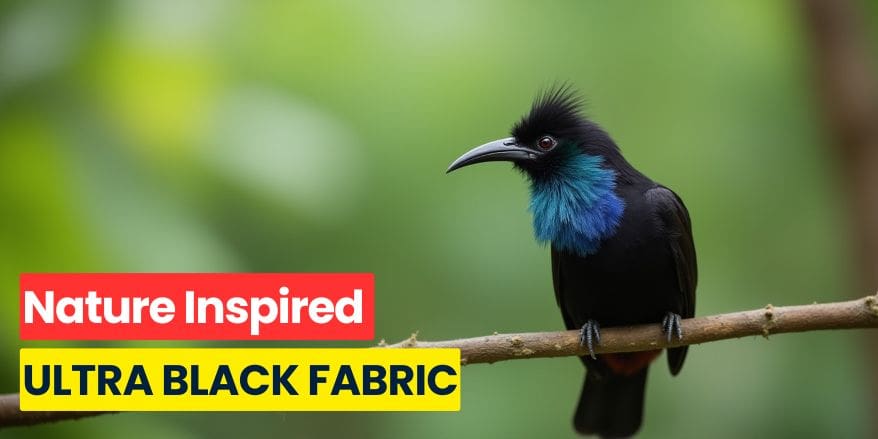
scientists created ultrablack wool fabric inspired by magnificent riflebird feathers. Polydopamine dyeing and plasma etching mimic the birds' nanostructures for superior light absorption.
Ultrablack Wool: Nature-Inspired Fabric Absorbing Nearly All Light
Estimated reading time: 3 minutes
How Ultrablack wool Fabric Mimics Nature’s Deepest Blacks
Scientists created ultrablack wool fabric after studying birds-of-paradise. These birds’ feathers show extremely low reflectance, absorbing almost all visible light. Moreover, their unique feather structures reduce light reflection below 0.05%, inspiring innovations in material science.
Amazing advancements have led to the development of ultrablack wool (UBW). Unlike typical black fabrics, this one reflects less than 0.5% of visible light across angles. It offers true color depth and minimal glare under different lighting conditions.
The Two-Step Method Creating Ultraback Wool
Researchers crafted UBW using a simple two-step process. First, they dyed merino wool with polydopamine (PDA), a pigment similar to natural melanin responsible for ultrablack in birds. Furthermore, this approach closely mimics the optical properties found in nature.
Next, they treated the wool with plasma, forming nano and microstructures that trap light efficiently. As a result, this innovative plasma etching creates tiny fibril bundles increasing light absorption drastically without damaging the wool.
The resulting fabric is flexible, breathable, and biocompatible—qualities rare in artificial ultrablack materials which are often fragile or toxic.
Optical and Structural Features of UBW
Electron microscopy images reveal hierarchical nanostructures on UBW fibers resembling those found in bird feathers. Consequently, these features include nanofibrils and nanopores that increase light trapping.
This texture causes strong secondary interactions such as van der Waals forces that cluster fibrils together while creating gaps, further reducing reflectance.
Also Read : https://entechonline.com/how-denim-fabric-is-made-cotton-to-finished-textile-process/
The Science behind PDA Dyeing and Plasma Etching
PDA penetrates deeply into the wool fibers rather than merely coating them. This secure integration enhances durability even after washing or exposure to sunlight.
The plasma etching not only sculpts the surface but also chemically modifies it by exposing protein structures beneath fatty layers. Such modifications play a critical role in improving light absorption.
Creating wearable ultrablack fabric requires blending nature’s design principles with scalable technology, said one leading researcher involved in this study.
Real-World Benefits of Ultra black Wool
This fabric could revolutionize textiles used for fashion, stealth technology, or optical applications demanding non-reflective surfaces. Its fiber integrity remains intact after treatment ensuring longevity along with ultrablack aesthetics.
Moreover, it offers biocompatibility unlike earlier nanotube-based black materials which were toxic and unsuitable for daily wear.
Additionally, to stay updated with the latest developments in STEM research, visit ENTECH Online. Basically, this is our digital magazine for science, technology, engineering, and mathematics. Also, at ENTECH Online, you’ll find a wealth of information.
Reference
- Jayamaha, H., Park, K., Shepherd, L. M., Jayamaha, H., Park, K., & Shepherd, L. M. (2025). Ultrablack wool textiles inspired by hierarchical avian structure. Nature Communications, 16(1). https://doi.org/10.1038/s41467-025-65649-4
- Author
- Latest Posts

Ashwini Kshirsagar holds a graduate degree in Chemistry and a postgraduate degree in Environmental Science from Shivaji University, Kolhapur. With a strong foundation in scientific principles and a creative flair, she blends her expertise in environmental science with skills in technical writing, graphic design, and video editing. Proficient in Adobe software, Ashwini excels at transforming complex scientific concepts into clear, engaging, and visually compelling content. Her unique ability to merge science and storytelling allows her to create impactful communication materials that are both informative and accessible to a wide audience.