It is important to consider the reputation of the university and its aeronautical engineering program. Look for universities that have a strong track record in producing successful aeronautical engineers and have partnerships with industry leaders.
Aeronautical Engineering Course: The Path to Success at University
Estimated reading time: 11 minutes
Are you thinking about your future STEM career? An Aeronautical Engineering Course is an amazing option. In fact, it prepares you to design flying machines. You can build advanced airplanes and even spaceships. At first, this field might sound very intimidating. However, it is highly rewarding for curious teens. Science and engineering offer endless possibilities for students. Aeronautical engineers shape how we travel the globe. Engineers change the world with their brilliant minds.
To illustrate, you learn to solve real-world problems. Engineers design vehicles that fly faster and safer. At the same time, they focus on sustainability. The aerospace sector desperately needs fresh, creative minds. You can create solutions for autonomous flight operations. As a result, your work impacts millions of people. Global aviation looks for smart teens like you.
Key Takeaways
- Practical learning bridges the gap to industry: Aeronautical engineering programs often use capstone courses and projects. They link class lessons to real jobs. Students team up with experts from various fields to design planes and space items. This builds key technical and communication skills.
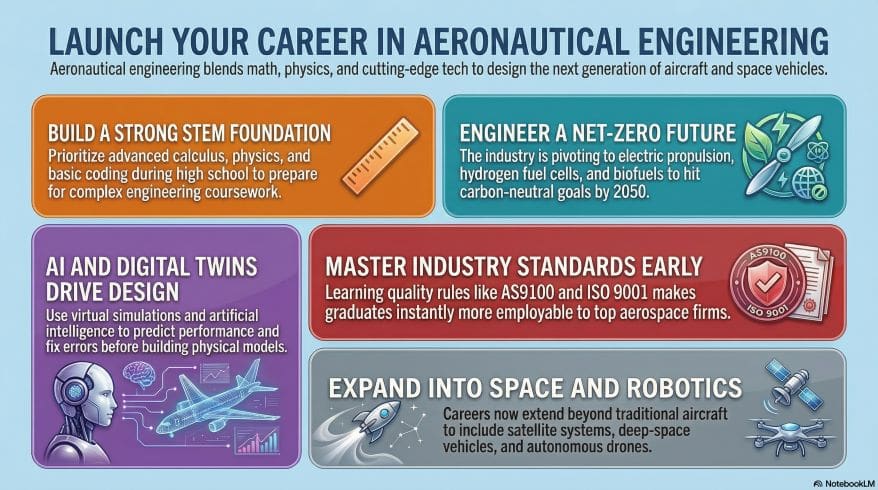
- Industry standards enhance employability: Universities add main industry rules like AS9100 and ISO 9001 to engineering classes. They show students quality, environmental, and risk rules. This helps students attract employers. It shortens job training time.
- Sustainability is driving future innovations: The aviation industry plans to hit net-zero carbon emissions by 2050. Engineers make electric engines, clean hydrogen fuel cells, and durable biofuels. They replace old fossil fuels with these.
- AI is a tool, but human creativity remains essential: Artificial intelligence improves flight operations and manufacturing. But current generative AI tools have big problems with tough, expert engineering tasks. People still need to use critical thinking and creativity for safe and effective aerospace design.
- Next-generation manufacturing is transforming aerospace: Industry 4.0 and 5.0 tech change how we design and make planes. Digital twins help test ideas. 3D printing builds strong parts. Team robots aid factory work and keep staff safe.
What is an Aeronautical Engineering Course?
An Aeronautical Engineering Course mixes math, physics, and design. Students learn how aircraft move through air. You will study aerodynamics and fluid mechanics. It needs strong critical thinking. You must learn hard and soft skills. Hard skills cover structural design and testing systems. You need to understand mechanics for your future job.
In contrast, soft skills matter as much. They cover teamwork, leadership, and clear talk. Engineers often join big teams from different fields. You will tackle design problems with classmates. Here, working together lets you create stronger fixes. Job skills need book learning and smart choices. Engineering classes use projects to show these ideas.
Core K-12 Subjects You Need to Study
Prior to starting college, you need a strong foundation. You must focus on specific K-12 subjects right now. By all means, study high school physics intensely. Math is another key point for future engineers. Take advanced calculus and algebra classes if possible. Computer science also helps you understand digital tools. Basic coding prepares you for complex software programs.
To sum up, strong STEM grades boost your chances. Take chemistry to understand different aviation fuel types. At the same time, join a school robotics club. This time, focus on hands-on project building. Summing up, practical experience makes you a better candidate. You should also practice good communication and writing. Aeronautical students write many technical design reports. Strong writing helps you explain robotics ideas clearly.
Amazing Tech You Will Study
In an Aeronautical Engineering Course, you explore cutting-edge technology. You study things that seem like pure science fiction. For the most part, modern aviation relies on computers. You will learn about digital twins and simulations. These tools predict how an aircraft actually performs. In effect, engineers fix problems before building real models. Virtual testing saves money and ensures flight safety. Advanced tools change how we design new planes.
Another key point is the use of artificial intelligence. AI raises safety and betters daily flight work. Machine learning aids travel through hard spots. You will learn how robots join large aircraft pieces. AI and robotics team up to make plane building very quick. Smart machines block bad and costly errors from workers. Linked factories point to the next stage of plane making.
The Curriculum : Coursework and Practical Experience
| Curriculum of Aeronautical Engineering | Coursework | Practical Experience |
|---|---|---|
| Introduction to Aeronautics | Aerodynamics, Flight Mechanics, Aircraft Structures | Wind Tunnel Testing, Flight Simulators |
| Aircraft Design | Aircraft Performance, Stability and Control, Avionics | Design Projects, CAD Software, Manufacturing Techniques |
| Aircraft Propulsion | Aerothermodynamics, Gas Turbine Engines, Propeller Design | Engine Testing, Maintenance, Repair |
| Aerospace Materials | Metallic and Composite Materials, Material Testing | Material Selection, Failure Analysis, Non-Destructive Testing |
| Space Systems | Orbital Mechanics, Spacecraft Design, Satellite Systems | Spacecraft Testing, Launch Operations, Mission Control |
Cool Materials and Designs
Airplanes must be very strong but light. Engineers use light composite materials for this. Carbon fiber polymers cut aircraft weight. Light planes use less fuel. This boosts flight efficiency a lot. Composite parts fight fatigue and bad rust. Material science is a big part of your degree.
You will learn about high-heat aerospace metals. Jet engines get very hot in flight. For example, nickel superalloys take extreme heat. These metals keep strength in high stress. You will study smart materials too. These change shape from outside factors. Morphing wings fit different flight stages on their own. Smart sensors check plane structure health.
Future Fuels and Drones
Air travel now makes a lot of pollution. To fix this, engineers look at other fuels. You will learn about hybrid and electric propulsion. These systems use electricity to make thrust for flying. Flights then get quieter and cleaner. Electric planes cut our need for fossil fuels. Hydrogen cells make electricity with no harmful gases. Biofuels give another green choice for regular engines.
Drones, or Unmanned Aerial Vehicles, are very popular. Drones fly without pilots. You will learn to build hard drone systems. Drones do watch jobs, deliveries, and rescues. Self-flying systems use GPS and smart cameras. Drones work together on big jobs. Drone tech opens a huge new job area. Self-driving paths change how people and goods move in the future.
Career Opportunities Waiting for You
An Aeronautical Engineering Course opens many exciting doors. You can work for commercial airlines or defense contractors. In reality, the skills you learn are highly valued. Graduates design new aircraft, helicopters, and satellite systems. At the present time, space exploration is growing rapidly. You can design vehicles for deep space missions. Space agencies need experts in complex orbital mechanics. Orbiting satellites connect people across the entire globe.
You might also work on green aviation that lasts. That means you can battle climate change. Engineers try hard to hit zero carbon emissions. The aerospace field wants new ideas. Or you might like fixing airport structures. Airports need changes to manage new high-tech planes. Smart plans keep airline work safe and smooth. New buildings must fit electric cars and flying cars.
Industry Standards Matter
To succeed, you must know key industry rules. These rules are strict standards. Standards make sure things are safe, efficient, and reliable. You will learn standards like AS9100 and ISO 9001. These rules keep airplane passengers safe. Knowing standards helps you get jobs today. Quality control stops big failures in flight systems. Environmental rules protect the planet from factory damage.
Academia often skips these key standards. But new classes now add standards to projects. They do this to get you ready for real work. Employers like people with hands-on knowledge of standards. When you follow these rules, you create new ideas safely. You connect school to work. Risk control gets you set for surprise problems in engineering. Safety steps are the main focus in aviation.
Wrapping Up Your STEM Journey
A career in this field is an exciting adventure. You will face very hard but rewarding challenges. Look at high-speed supersonic flight transportation. Engineers now try to stop loud sonic booms. If you stay curious, you will succeed. The industry needs diverse, passionate, and dedicated teens. Global transportation depends on ongoing aeronautical tech advances. Future innovations will make flying faster and safer.
Let us review the key steps for your success. To enumerate, here are important tips for you. You must prepare yourself during your high school years. In short, preparation makes your college journey much easier. By comparison, unprepared students struggle with advanced engineering concepts. Therefore, follow this simple checklist to stay ahead. STEM education requires dedication and consistent hard work. Future success starts with the actions you take today.
Planning for Aeronautical Engineering Course
To list, follow these vital steps for your career:
- Study heavy mathematics and physics in high school.
- Practice basic computer programming and software coding skills.
- Enroll in an Aeronautical Engineering Course at college.
- Learn about industry standards to boost your employability.
- Work on team projects to build communication skills.
In due time, these steps will bring great results. Career preparation takes significant time and focused effort. Engineering degrees demand passion and intense intellectual curiosity.
Interdisciplinary Subjects
Quantum Computing in Aeronautical Engineering Course
For example, you will also study quantum computing. This sounds unbelievable, but it is real aerospace science. Normal computers are slow. Quantum computers fix hard optimization problems fast. This helps design better engines. New tech changes aerospace fast. Quantum algorithms predict how new materials will act. Strong computing power brings big improvements in flight performance. Quantum science changes everything.
Industry 5.0 in Aeronautical Engineering
Like Industry 4.0, we now have Industry 5.0. This idea centers on manufacturing that puts people first. Robots and humans team up. Cobots help workers build complex airplane parts. This cuts down on mistakes by people. It also boosts safety for workers. People working together stays key in today’s aerospace engineering. Smart wearables track factory workers to stop accidents.
Practical Learning
During your degree, you will finish a capstone project. This is a big final team task. Students create real products to fix current industry issues. You use all you learned in class. You will make prototypes and run flow simulations on computers. It acts like a real engineering job. Capstone projects help you get jobs. Hands-on work shows you can handle the tasks.
Role of AI in Aeronautical Engineering
Another key point is the rise of generative AI. You must learn to use AI tools very responsibly. Some students use AI to cheat on complex exams. However, generative AI struggles with high-level cognitive engineering problems. To point out, AI often gives completely wrong answers. You must be smarter than the artificial intelligence programs. Human creativity is still required for safe airplane design. Critical thinking protects you from relying on bad data.
Closing Remarks
In conclusion, this field offers a bright, exciting future. Air travel will always be needed. We must find green ways to travel the world. If we use technology, we can do this. You can change how people travel. Your ideas might start the next spacecraft. Aviation experts have big duties for world safety. Young scientists are the real future of aerospace.
Start building your STEM skills now. You might create the next big flying machine. The path is tough. But the best prize is watching your design fly. Embrace the math and physics ahead. The world waits for your smart engineering. Aeronautical engineering is a great and respected job. Your future in science and technology looks very bright.
You are ready for the challenge. Also, the main subjects and job chances ahead. Additionally, about new technologies. From drones to biofuels, the options go on forever. Keep reading and learning more. Science and engineering will take you to the stars. Space trips inspire the next group of brave engineers. Aerospace ideas link people in new ways.
Frequently Asked Questions about Aeronautical Engineering Course
What exactly do students study in this Aeronautical Engineering Course?
Students study core subjects like aerodynamics and fluid mechanics. To explain, they also learn about advanced aircraft structures. At the same time, they build vital teamwork skills.
Do students get to build real flying machines?
As a matter of fact, you complete capstone projects. In detail, teams design and build physical scale models. With this in mind, you gain actual professional experience.
How does artificial intelligence change this field?
Engineers use AI to optimize safe daily flight operations. In contrast, generative AI struggles to solve complex math. By and large, human creativity remains completely necessary.
Can this career help protect our planet?
Yes, you can design electric planes using clean energy. To illustrate, hydrogen cells produce zero harmful carbon emissions. Summing up, sustainable aviation fights global climate change directly.
What new technologies will I learn to use?
You will use digital twins to run virtual simulations. In like manner, you learn to program autonomous drones. To point out, 3D printing creates complex airplane parts.
References
Barragán De Los Rios, G. A., Garcia Sepulveda, J. I., Niño Navia, J. A., & Urrea, G. (2025). Shaping the Future of Aeronautical Engineering: Designing a Capstone Course. 23rd LACCEI International Multi-Conference for Engineering, Education and Technology. https://doi.org/10.18687/laccei2025.1.1.2128
Halawi, L., El Sayed, M., Miller, M., White, S., & Dhakal, S. S. (2024). Eagles flight: A curriculum blend of aviation, engineering, and industry standards. Collegiate Aviation Review International, 42(2), 243-252. Retrieved from http://ojs.library.okstate.edu/osu/index.php/CARI/article/view/10017/8906
Smith, A. (2025). Advancements in aerospace engineering: Exploring curriculum innovations. IntechOpen. https://www.intechopen.com/chapters/1194024
- Author
- Latest Posts
Charudatta Pathak was a student at St. Aloysius High School in Bhusawal, established in 1874, making it one of India’s oldest convent institutions. He earned his bachelor’s degree in mechanical engineering from SSVPS College of Engineering, Dhule in 1995, demonstrating exceptional academic achievement. Thereafter, he launched his career as a CNC programmer in a toolroom. He has utilized FANUC, Deckel, Maho, and Mikron controllers to operate 2-axis and 3-axis machines for the fabrication of jigs, fixtures, dies, and molds. He commenced his career as an academic in 1996, when he assumed the role of lecturer at SSVPS College of Engineering, Dhule. Additionally, he earned his post-graduate degree in CAD/CAM from L. D. College of Engineering, Ahmedabad, in 2000, and then acquired a Ph.D. from COEP in 2011 while concurrently engaged in teaching. Until 2023, he occupied many academic roles, including lecturer, assistant professor, professor, dean, principal, director, and vice chancellor at both public and private universities throughout India. From 2008 to 2010, he served as the project lead in the CAE department of a European multinational firm. During his 28-year professional tenure, he identified a need for dependable books targeted at students in grades 8 to 12, particularly for nascent career planning. He founded ENTECH Digital Magazine, a free monthly publication available on entechonline.com and magzter.com. Teens with a strong interest in Science, Technology, Engineering, and Mathematics (STEM) who aspire to pursue careers in these fields may find ENTECH Digital Magazine beneficial.