STAT3 signaling controls cell growth and survival in the body. When overactive, it supports cancer development and tumor progression.
APOC2 Promotes Clear Cell Renal Cell Carcinoma via STAT3 Signaling Pathway

Cancer looks random. Cells grow out of control. However, science shows clear patterns. At the present time, researchers study how genes guide cells. One study found a strong link. A gene named APOC2 boosts tumor growth. In addition, it works with the STAT3 signaling pathway. This pathway controls cell survival and division. Therefore, cancer cells grow faster. In fact, this link connects metabolism and disease. For example, cells use energy in new ways. Students can now connect class ideas to real life. In conclusion, this finding may help future treatments.
TL;DR ‘STAT3 Signaling Pathway’
APOC2 is highly expressed in clear cell renal cancer and drives tumor growth. It activates the JAK-STAT (STAT3) pathway, increasing cell survival and reducing apoptosis.
Key Takeaways
- APOC2 increases cancer growth
- JAK-STAT pathway controls cells
- Blocking APOC2 slows tumors
- Metabolism links to cancer biology
- New drugs may target these pathways
What Happens Inside Cancer Cells?
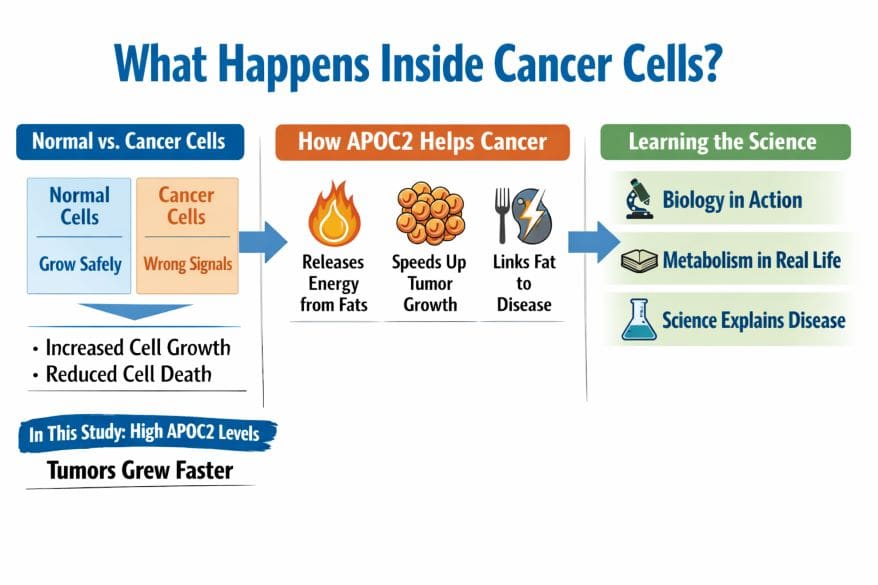
Cells normally grow in a safe way. In contrast, this system fails in cancer. To explain, genes send wrong signals. In other words, these signals raise cell growth and reduce cell death. In this study, APOC2 levels were high. Consequently, tumors grew faster.
How APOC2 Helps Cancer Using Stat3 Signaling Pathway
APOC2 helps break down fats in the body. However, cancer uses it in a new way. It boosts fat use and feeds tumors. To put it simply, cancer cells need energy. Fats give them fast fuel.
- Helps release energy from fats
- Supports fast cancer growth
- Links food energy to disease
At the same time, this shows real use of biology. Students learn metabolism in class. Now, they see its real effect. That is to say, science helps explain disease.
The JAK-STAT Pathway Made Easy
The JAK-STAT pathway sends signals in cells. In this case, it controls cell life and immune actions. On the other hand, in cancer, this pathway stays active.
Why This Pathway Is Important
When APOC2 turns this pathway on, cells grow more. They also avoid death signals. In effect, tumors get stronger.
- Sends signals inside cells, in this way, guiding cell activity
- Helps cells survive longer, in addition, supporting cell stability
- Makes cancer harder to treat, for this reason, reducing treatment success
After that, scientists tested a change. They lowered APOC2 levels. As a result, tumor growth slowed. Cells died more often. This shows a clear link. APOC2 drives cancer through this path. In short, blocking it may help treatment.
What Did Scientists Do to find Stat3 Signaling Pathway?
Scientists used cancer cells in labs. They reduced APOC2 with tools. After that, they checked the results. The changes were easy to see.
Key Findings
- Cell growth dropped after APOC2 loss
- Cancer spread slowed down
- Cell death increased clearly
The study found that APOC2 is highly expressed in clear cell renal cell carcinoma tissues and cells. In this case, higher levels are linked with poor prognosis in patients. Functional experiments showed that reducing APOC2 lowered cancer cell proliferation, migration, and invasion. In addition, apoptosis increased in these cells. To put it differently, APOC2 supports tumor growth and survival.
In addition, the study showed that APOC2 acts through the JAK-STAT (STAT3) pathway. When APOC2 was silenced, phosphorylation of JAK1, JAK2, and STAT3 decreased. Therefore, pathway activity was reduced. To illustrate, using a STAT3 activator reversed these effects. This confirmed the pathway’s role in cancer progression. In conclusion, APOC2 may serve as a therapeutic target in kidney cancer.
In this case, it became less active. This proved the link. In other words, it shows clear cause and effect. APOC2 controls cancer growth. To illustrate, turning it off weakens tumors..
Why the Study of Stat3 Signaling Pathway Matters for Aspiring Doctors
At the present time, biology links to real life. It helps medicine grow fast. Students can use this knowledge. This study shows how genes matter in health care.
Real-Life Uses
- Cancer tests using gene markers
- New drugs for cell signals
- Better care for each patient
Above all, this field needs new minds. Students can build careers here. They can join labs or biotech firms.
Metabolism and Cancer Link
Cancer depends on energy changes. APOC2 proves this link clearly. To put it differently, it connects fat use with tumor growth. To explain, tumors need energy to grow, fats give fast energy, and metabolism helps cancer survive. All things considered, this idea is new. In the past, studies focused on genes alone. Now, metabolism matters too. In turn, this helps build better drugs. Doctors can target both pathways.
Future of Cancer Care
In the final stage, this study gives hope. In this context, doctors can target APOC2. At the same time, they can block the JAK-STAT pathway. To list, gene therapy may target APOC2 directly, drugs may control JAK-STAT signals, and combined treatments may improve outcomes. In conclusion, this approach may improve patient care. In addition, it may lower health risks. Students can shape this future. With this in mind, they can build skills and create new cures. In sum, science leads to change.
Frequently Asked Questions about Stat3 Signaling Pathway
1. What is APOC2?
APOC2 is a gene that helps the body manage fat metabolism. It activates enzymes that break down fats for energy use. In addition, in some cancers, APOC2 levels become abnormally high. In turn, this can promote cell growth and support tumor development..
2. What is JAK-STAT?
JAK-STAT is a signaling pathway that helps cells communicate. In this case, it carries messages from the cell surface to the nucleus. In addition, it controls cell growth, survival, and immune responses. when overactive, it can support cancer development.
3. Why is stat3 signaling pathway study important?
The STAT3 signaling pathway study is important in cancer research. To explain, it controls cell growth, survival, and immune responses. In addition, abnormal activation is linked to many cancers. Therefore, studying it helps develop better treatments and targeted drugs.
Additionally, to stay updated with the latest developments in STEM research, visit ENTECH Online.
Reference
Yun, Y., Ji, X., Wu, T., Liu, Y., Li, Z., Sun, Z., Zhou, P., Yang, L., & Yu, W. (2025). APOC2 promotes clear cell renal cell carcinoma progression via activation of the JAK-STAT signaling pathway. Current Issues in Molecular Biology, 47, 936. https://doi.org/10.3390/cimb47110936
- Author
- Latest Posts

I completed my Master of Science from the University of Allahabad in 2017 with a strong academic background in life sciences and chemistry. My specialization included Molecular Biology, Microbiology, Genetics, Plant Breeding, Phycology, Paleobotany, and Bioinformatics, along with Organic Chemistry, Inorganic Chemistry, and Physical Chemistry. This multidisciplinary training provided me with a comprehensive understanding of biological systems and analytical scientific approaches.
After completing my postgraduate studies, I gained valuable professional experience in both the education and social development sectors. I worked at A.M. Oxford Public School, where I was actively involved in guiding students toward academic excellence. In this role, I focused on creating an engaging learning environment, encouraging critical thinking, and nurturing students’ curiosity for scientific learning. My experience as an educator strengthened my communication, mentoring, and classroom management skills.
In addition to my teaching experience, I worked with Jeevan Jagriti Foundation, where I contributed to community-based initiatives aimed at improving educational access and awareness among underprivileged sections of society. Through this work, I participated in programs designed to support social development and promote the value of education in marginalized communities.
These professional experiences helped me develop strong interpersonal, leadership, and organizational skills while reinforcing my commitment to education and community service.