Can CRISPR silence an extra chromosome? New gene editing research offers clues.
Down Syndrome Gene Editing Just Got a Big Breakthrough
Estimated reading time: 7 minutes
Your body already knows how to switch off a whole chromosome. It does this every day — quietly, in every cell. Scientists borrowed this exact trick. They used it to target the extra chromosome that causes Down syndrome. In the lab, the extra chromosome went silent. Scientists call this research a landmark step forward. This is what down syndrome gene editing looks like today. It is not a cure yet. But it is one of the most exciting ideas in science right now. And the best part? It started by studying something your own body already does naturally.
Key Takeaways
- Down syndrome happens when a person has three copies of chromosome 21 instead of two.
- A gene called XIST can naturally silence an entire chromosome.
- Scientist have already shown that XIST can silence the extra chromosome 21 in lab-grown cells — for the first time ever.
- Today, CRISPR places XIST into the exact right spot on that chromosome.
- Results in the lab are promising, but human treatment is still years away.
- Even so, this research is already helping scientists find new drug targets for Down syndrome.
What Is Down Syndrome?
The Problem With an Extra Chromosome in Down Syndrome
Down syndrome is a genetic condition. It happens when a person is born with an extra copy of chromosome 21. Most people have two copies. People with Down syndrome have three. Doctors call this trisomy 21. That extra copy is not one broken gene — it is an entire extra chromosome. Every cell in the body carries it. As a result, hundreds of extra gene instructions are active at once. Over time, this affects brain growth, heart health, and the immune system.
At the present time, there is no cure. But that is starting to change.
Why It Is Hard to Treat
Most genetic diseases have one faulty gene. You find it. You fix it. But Down syndrome is different. The whole extra chromosome is the problem — not just one gene. Prior to this research, no tool could tackle an entire chromosome at once. Standard gene therapy was simply not built for that. To explain, it is like trying to fix an entire library by rewriting one book at a time. You need a way to close the whole section. That is what down syndrome gene editing research is trying to do.
Nature Already Has a Chromosome Off-Switch
What XIST Does in Your Body
In fact, here is something cool you probably did not learn in class. Every female body has two X chromosomes. But only one is active. The other is switched off permanently. A gene called XIST does this job. XIST makes a long RNA strand. That strand wraps around one X chromosome like a blanket. It then signals the cell to stop reading genes from that chromosome. All of a sudden, an entire chromosome goes quiet. The cell still works fine. Scientists call this X-chromosome inactivation. It is one of the most elegant systems in all of biology.
The Discovery That Started Everything
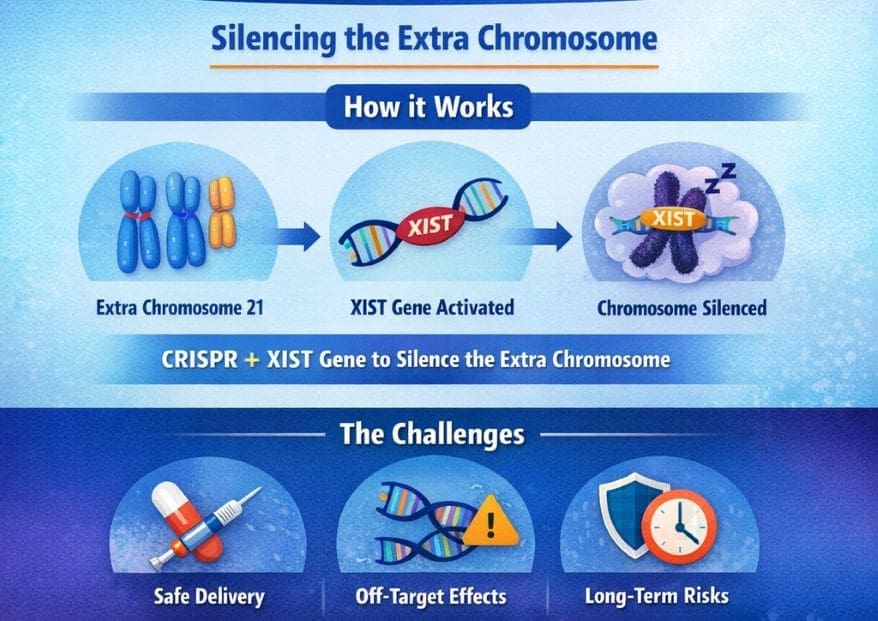
Scientists had a bold idea. What if XIST could silence chromosome 21 — not just the X chromosome? As Gupta et al. (2024) described, researchers tested this in iPSCs (lab-grown stem cells from Down syndrome patients). To explain, they placed a copy of the XIST gene directly into the extra chromosome 21. After that, the XIST RNA coated that chromosome. Gene activity across it dropped sharply. The extra chromosome was, in effect, silenced. As can be seen, this was the first time scientists had ever switched off an extra autosome in the lab. In short, it was a landmark moment for Down syndrome gene editing.
How CRISPR Made Down Syndrome Gene Editing Smarter
CRISPR-Cas9 in Down Syndrome Gene Editing
At this point, you have heard of CRISPR in class. Think of it as a GPS + scissors for DNA. A guide RNA finds the exact DNA location you want. Then the Cas9 enzyme cuts right there. Scientists can then slip a new gene — like XIST — into that cut. Prior to CRISPR, older tools worked too slowly for this. They also missed too often. CRISPR is faster, cheaper, and far more precise. This made it the right tool for Down syndrome gene editing research.
Down Syndrome Gene Editing: What Happens in the Lab
Here is how researchers use CRISPR + XIST together:
- Scientists design a guide RNA that targets a unique spot on the extra chromosome 21 only.
- The Cas9 enzyme cuts at that exact location.
- The XIST gene is inserted into that cut site.
- XIST RNA begins to coat the extra chromosome.
- Gene activity across that chromosome starts to fall.
Gupta et al. (2024) noted that using lab stem cells makes this a powerful system for studying Down syndrome. While this may be true that the method is still early-stage, results so far are encouraging.
What Comes Next For Down Syndrome Gene Editing
Three Challenges in Down Syndrome Gene Editing
Seeing that this is early research, a few big hurdles remain:
- Delivery: Getting CRISPR safely into the right cells in a living body is hard.
- Off-target cuts: CRISPR might accidentally edit the wrong part of the DNA.
- Timing: Down syndrome begins affecting the body very early in development. Treating it later may not reverse that early damage.
So far, no human trials exist. All the work has been in lab-grown cells. That said, the science is moving fast.
This Research is Already Changing How We Study Down Syndrome
Provided that a treatment is years away, this research still makes a real difference today. Gupta et al. (2024) showed that switching off chromosome 21 in lab cells lets scientists compare two versions of the same cell — one with the extra chromosome active, one with it silent. After that comparison, scientists can see exactly which genes drive which symptoms. To put it differently, they now have a way to find drug targets they could not see before. All in all, Down syndrome gene editing research is not just about a future cure — it is building the map that gets us there.
Frequently Asked Questions (FAQs) about Down Syndrome
Is Down syndrome gene editing available as a treatment yet?
In short, no. All current studies have been done in lab-grown cells. Human clinical trials have not started. Scientists expect this is still many years away from clinical use.
Does CRISPR directly silence the chromosome?
No. CRISPR places the XIST gene into the right spot on the extra chromosome. After that, XIST does the silencing. CRISPR is the delivery method. XIST is the tool that does the work.
What is an iPSC and why do researchers use them?
iPSC stands for induced pluripotent stem cell. Scientists make them by reprogramming regular adult cells. As a result, they can grow into many cell types. This makes them useful for testing gene edits in the lab without needing embryos.
Could this approach work for other genetic conditions too?
Possibly yes. Gupta et al. (2024) noted that XIST-based silencing could apply to other chromosomal conditions where an extra chromosome copy causes the problem. Down syndrome is the main focus for now.
Has XIST ever actually silenced chromosome 21 in a real experiment?
In fact, yes. As Gupta et al. (2024) described, researchers have already shown this works in lab-grown stem cells. XIST RNA successfully coated and silenced the extra chromosome 21. That proof of concept is what all current Down syndrome gene editing research builds on.
Reference
Gupta, K., Czerminski, J. T., & Lawrence, J. B. (2024). Trisomy silencing by XIST: Translational prospects and challenges. Human Genetics, 143(7), 843–855. https://doi.org/10.1007/s00439-024-02651-8
- Author
- Latest Posts

Ayushi Shukla is a biotechnologist and science communicator specializing in the intersection of genomic data and public health. Previously, she served as a Core Member and R&D Lead at the HealthTech venture Eat Wisely Bro, where she spearheaded research initiatives and translated emerging medical data into product strategy. She holds an M.Sc. in Biotechnology from the TERI School of Advanced Studies, where her research at The Energy and Resources Institute (TERI), New Delhi, focused on Environmental Biotechnology and Bioremediation.
As a Research Scholar at TERI, Ayushi developed a plant growth-promoting bacterial consortium for high-salinity agricultural conditions, managing daily laboratory procedures and molecular workflows. Her technical portfolio on GitHub demonstrates her dry lab expertise, featuring end-to-end bioinfomatics pipelines for RNA-Seq analysis, Phylogenetic modeling, and a functional prototype for Mycobacterium tuberculosis Genomic Surveillance & Dashboard.
Her clinical foundation includes advanced training in Somatic NGS and Precision Oncology from the Cancer Research Centre at Tata Memorial Centre, and a professional certification in Good Clinical Practice (GLP) from the NIDA Clinical Trials Network. Ayushi bridges the gap between raw genomic data and student-friendly narratives to help the next generation of scientist understand the transformative power of modern biology.