Master the use of a blood pressure monitoring cuff to ensure accurate readings and safeguard your health effectively.
The Truth About Your Blood Pressure Monitoring Cuff

Your doctor relies on a simple test. It is a blood pressure monitoring cuff. This device saves lives. It detects high blood pressure. It prevents heart attacks. But most people use it incorrectly. A wrong reading can change your treatment. You might get the wrong drug dose. You could miss a stroke risk. This guide fixes that problem. We use science and official data. We will teach you the right way. Follow these steps exactly. Your health depends on it.
Key Takeaways
- A wrong cuff size causes false readings.
- Arm position changes results by up to 10 mmHg.
- Home monitoring beats office checks for accuracy.
- Follow the CDC and OSHA safety rules for best results.
Why Your Blood Pressure Monitoring Cuff Matters for Health
Understanding the Silent Killer
High blood pressure is a silent killer. It has no symptoms. It damages arteries for years. A blood pressure monitoring cuff is your first defense. The Centers for Disease Control and Prevention (CDC) states that nearly half of US adults have hypertension (CDC, 2023). A home cuff helps you track it.
Official Data from CDC & ECDC
The CDC runs a strong surveillance program. It tracks hypertension trends. In 2020, 119.9 million US adults had high blood pressure (CDC, 2023). The European CDC (ECDC) reports similar rates. Over 30% of Europeans have this condition (ECDC, 2024). A reliable cuff helps catch it early. Above all, use a validated device. Do not buy unknown brands.
What’s more, the National Institutes of Health (NIH) explains the physics behind the measurement. A cuff inflates to stop blood flow. It then releases pressure slowly. The device detects vibrations in the artery. To explain, this is called oscillometry (NCBI, 2023).
Public Health Impact
High blood pressure costs billions in healthcare. It leads to heart failure. It causes kidney damage. The Occupational Safety and Health Administration (OSHA) also cares about this. OSHA sets workplace standards for blood pressure screening (OSHA, 2023). A good cuff protects workers too.
| Section | CDC Recommendation |
|---|---|
| Cuff Size | 80% of the upper arm circumference |
| Bladder Width | 40% of the arm circumference |
| Measurement Position | Arm at heart level on a table |
The CDC Guideline Rules
At the present time, the CDC offers clear rules. First, you must rest for five minutes before a reading. Before measuring, do not smoke or drink coffee. Next, sit in a sturdy chair and then keep your feet flat on the floor. After that, place your arm on a flat surface and make sure the cuff is at heart level. Also, remember that a wrong position adds 10 to 15 mmHg to your reading. For example, a patient got a 145/90 reading at home. However, in clinic, the correct position gave 130/85—therefore, the difference can be dramatic.
Accuracy and Device Validation
Not all cuffs are accurate. First, the FDA does not test home devices, so you must check validation lists. Next, use devices from known brands. With this intention, look for “clinically validated” on the box. In addition, the Association for the Advancement of Medical Instrumentation (AAMI) has a standard. However, even if a monitor looks credible, keep in mind that some wrist cuffs are less accurate. For the most part, upper-arm cuffs are the gold standard.
Frequency of Monitoring
How often should you check? As a matter of fact, it depends on your condition. The American Heart Association says:
- Once daily for new hypertension.
- Twice daily for medicine changes.
- Weekly for controlled blood pressure.
After all, consistency matters more than frequency. Measure at the same time each day. Morning is best. Do it before you eat or take medicine. Summing up, follow your doctor’s specific plan.
The Right Way to Use a Blood Pressure Monitoring Cuff
Step-by-Step Setup
At first, gather your supplies. To begin with, you need a validated upper-arm cuff. Also, you need a quiet room. Analogous to a lab experiment, control the environment. Next, sit still for five minutes. During that time, no talking and no phones. Then, make sure your arm is bare. After that, do not roll up a tight sleeve. Because it can compress the arm and block blood flow, as a result the reading will be wrong.
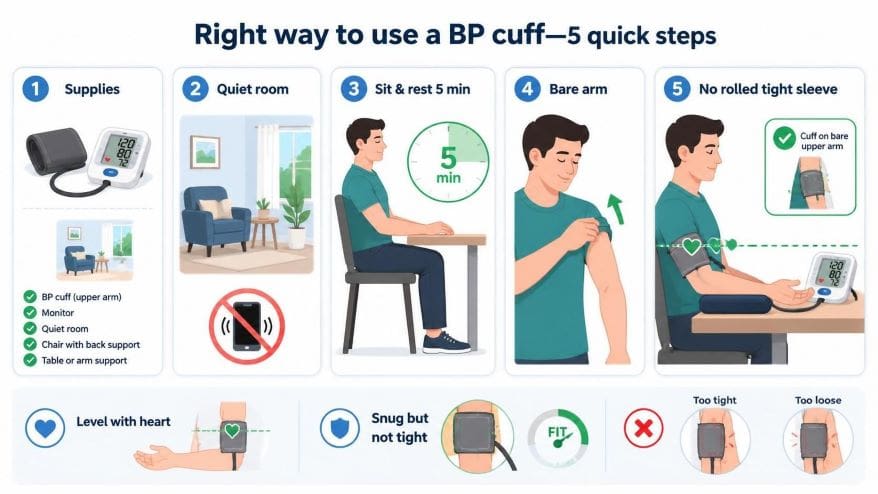
Fig. 1: Right way to use a BP cuff-quick steps
Choosing the Correct Cuff Size
While it may be true that one size fits most, it is not correct. The cuff bladder width must be 40% of your arm circumference. The length must be 80% of that circumference. Up to 40% of people use the wrong cuff size. At any rate, this error can cause misdiagnosis. The NIH explains that a small cuff overestimates systolic pressure by 10 mmHg (NCBI, 2023).
| Arm Circumference | Recommended Cuff Size | Bladder Dimensions |
|---|---|---|
| 22–26 cm | Small adult | 12 x 22 cm |
| 27–34 cm | Adult | 16 x 30 cm |
| 35–44 cm | Large adult | 16 x 36 cm |
| 45–52 cm | Extra-large adult | 16 x 42 cm |
Positioning Your Body and Cuff
So as to get an accurate reading, position matters. First, sit with your back supported. To that end, use a chair with a backrest. Next, place your feet flat on the ground. Then, do not cross your legs. Because crossing legs adds 2 to 8 mmHg, it can raise your reading. After that, place the cuff on your bare upper arm. At this point, make sure the bottom edge of the cuff is 1 inch above your elbow. Finally, align the center of the cuff over your brachial artery.
Step-by-Step Measurement Process
- Apply the cuff snugly. It should be tight but not restrictive. You should be able to slide one finger under it.
- Press the start button. Remain still and silent. Do not tense your arm.
- Wait for the device to finish. Reading the display. Note both systolic and diastolic numbers.
- Record the result in a log. Include the date and time.
- Wait one minute. At length, take a second reading. Average the two results.
Common Mistakes That Ruin Results
To put it differently, many people make simple errors. At the same time, they wonder why numbers vary. Here are the top mistakes:
- Using a full bladder: This can add 10 mmHg.
- Talking during the test: This adds 10 mmHg.
- Arm hanging at your side: This adds 10 mmHg.
- Eating a big meal: This can lower blood pressure.
- Taking caffeine too close to the test.
After that, you can correct these issues. All things considered, a quiet room and a still body give the best data.
Advanced Insights and Surveillance Data
CDC Surveillance and OSHA Workplace Rules
The CDC runs a national surveillance network. It monitors hypertension trends across the US. This system uses validated cuffs (CDC, 2023). It helps identify high-risk populations. OSHA also has rules. In the workplace, employers must provide first aid. This includes accurate blood pressure checks. OSHA guidelines say cuffs must be clean. They must be calibrated. To enumerate, faulty equipment is a safety hazard (OSHA, 2023).
The ECDC European Data
The ECDC publishesannual epidemiologic reports (ECDC, 2024). By and large, European hypertension rates are stable. The surveillance data shows regional differences. Northern Europe has lower rates. Eastern Europe has higher rates. To point out, these reports use the same cuff methods. They compare data across countries. At this point, the global health community can act.
The NIH Perspective on Blood pressure Cuff Physics
The physics behind the cuff is simple. The device measures blood pressure by oscillometry. It detects the vibrations of the arterial wall. The NIH library book on the topic explains this well (NCBI, 2023). As the cuff deflates, the device tracks pressure changes. It finds the systolic and diastolic points. Analogous to a microphone, it listens to your artery. Seeing that, a loose cuff cannot hear these signals.
Home Monitoring vs. Office Blood Pressure Blood pressure cuff
In effect, home monitoring is better than office checks. Many people have “white coat syndrome.” This is a temporary rise in blood pressure due to anxiety at the doctor’s office. A blood pressure monitoring cuff at home gives real data. It shows your true baseline. In a similar fashion, you can track changes over time. For the purpose of treatment decisions, doctors prefer home logs.
Practical Tools and Avoiding Pitfalls
Validated Device Lists
So long as you use a validated device, you are safe. By way of the internet, you can find lists. The American Medical Association (AMA) has one. The British and Irish Hypertension Society (BIHS) has another. Provided that you check these lists, you avoid junk cuffs. To put it another way, a cheap cuff is not a bargain.
The 4 Key Tips for Perfect Readings
- Tip 1: Always use the correct cuff size. Measure your arm.
- Tip 2: Sit in a quiet room for five minutes before the test.
- Tip 3: Keep your arm supported at heart level.
- Tip 4: Take two readings, one minute apart. Average them.
When to Call Your Doctor
Sooner or later, you will get a high reading. At this instant, do not panic. Wait five minutes. Check again. If the reading is above 180/120, call 911. This is a hypertensive crisis. At least once a month, check your device. Compare it to the clinic reading. In the event that your home cuff is wrong, replace it immediately.
Frequently Asked Questions about Blood Pressure Monitoring Cuffs
How often should I change my blood pressure monitoring cuff?
Replace it every two years. Check the tubing for cracks. At the present time, many cuffs have a 2-year warranty.
Can I use a wrist cuff?
The wrist must be at heart level. With attention to position, wrist cuffs can be accurate. While this may be true, upper arm cuffs are more reliable.
Why is my home reading different from the clinic?
This is normal. To explain, office visits cause anxiety. All things considered, your home reading is likely correct.
Do I need a prescription for a cuff?
No. You can buy one at any pharmacy. In this case, pick a validated one.
Is 140/90 really high?
Yes. For the most part, 130/80 is the new threshold. Consult your doctor for personalized goals.
Conclusion: Blood Pressure Monitoring Cuff.
A blood pressure monitoring cuff is a powerful tool. Use it correctly. Follow the CDC guidelines. Check your cuff size. Sit in a chair. Arm at heart level. Be still. Above all, stay consistent. Track your numbers. Share them with your doctor. To sum up, a small habit can save your life. At last, check your device today. Buy a validated cuff. Start monitoring. Your heart will thank you.
References
- Cohen, J. B., Byfield, R. L., Hardy, S. T., Juraschek, S. P., Miller, N. H., Mukkamala, R., Picone, D. S., Thiele, R. H., Yang, E., & Brady, T. M. (2026). Cuffless devices for the measurement of blood pressure: A scientific statement from the American Heart Association. Hypertension, 83(3), 876–886. https://doi.org/10.1161/HYP.0000000000000254
- Man, P. K., Cheung, K. L., Sangsiri, N., Shek, W. J., Wong, K. L., Chin, J. W., Chan, T. T., & So, R. H. (2022). Blood Pressure Measurement: From Cuff-Based to Contactless Monitoring. Healthcare (Basel, Switzerland), 10(10), 2113. https://doi.org/10.3390/healthcare10102113
- Author
- Latest Posts

Ramya Dobbala is a pharmacist and science communicator dedicated to bridging the gap between complex pharmaceutical research and public understanding. A 2024 B.Pharmacy graduate, Ramya has a strong foundational background in formulation science, having spearheaded research into the evaluation and formulation of anti-acne creams. Her work focused on optimizing topical delivery systems to enhance treatment efficacy and skin health.
Transitioning from the laboratory to the forefront of scientific discourse, she now leverages her technical expertise to translate intricate healthcare concepts into accessible, engaging content. As an author and communicator, Ramya is passionate about empowering audiences with evidence-based insights, particularly in the realms of dermatology and pharmaceutical innovation.