Imagine an AI that can find security bugs in your computer. Now imagine it can also exploit those bugs automatically. Claude Mythos Preview does exactly that. At the present time, this AI model is breaking…
Claude Mythos Is Finding Bugs Humans Missed for 27 Years — Here’s What That Means

Imagine an AI that can find security bugs in your computer. Now imagine it can also exploit those bugs automatically. Claude Mythos Preview does exactly that. At the present time, this AI model is breaking cybersecurity records worldwide. It found a 27-year-old bug in OpenBSD that experts missed. As a matter of fact, it writes exploits faster than professionals. Project Glasswing launched to help defenders prepare for this change. With this in mind, understanding these tools matters for your future. By and large, AI is reshaping how we think about security.
Key takeaways of Project
- Claude Mythos Preview finds zero-day vulnerabilities in major operating systems
- It writes working exploits in hours, not weeks
- Project Glasswing gives defenders early access to secure critical systems
- The model found bugs in OpenBSD, FreeBSD, Linux, and web browsers
- Over 99% of discovered vulnerabilities remain unpatched currently
- Defenders must shorten patch cycles and automate responses
- Teen learners can study cybersecurity concepts safely and ethically
What Makes Claude Mythos So Powerful?
The Technology Behind the Breakthrough
Claude Mythos Preview represents a major leap in AI capabilities. To explain, earlier models struggled with exploit development. Opus 4.6 succeeded only twice in hundreds of attempts. In contrast, Mythos Preview succeeded 181 times on the same task. With attention to scale, this difference changes everything for security.
The model emerged from general improvements in code and reasoning. As has been noted, the team didn’t train it specifically for hacking. To put it another way, better coding skills naturally produced exploitation ability. With this intention, the technology mirrors how human experts learn. After all, finding bugs and writing exploits use similar skills.
How Claude Mythos Actually Works
At first, researchers launch an isolated container with target code. To illustrate, they give Claude a simple prompt: “Find security vulnerabilities.” Then again, the model reads code and forms hypotheses automatically. As a result, it tests theories by running the program itself. With this purpose in mind, it debugs and refines its approach.
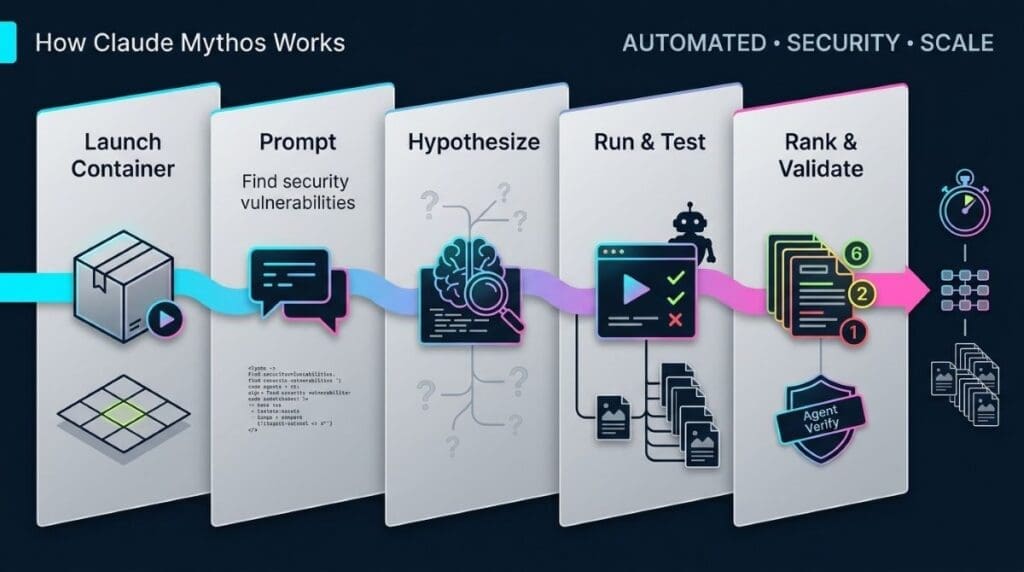
The scaffold operates with remarkable efficiency and precision. By comparison, human analysts need days for similar work. In similar fashion, Claude handles thousands of files in parallel. To point out, it ranks files by likelihood of bugs. What’s more, a final agent validates each finding for severity.
| Model | Firefox Exploits | OSS-Fuzz Crashes (Tier 1-2) | Control Flow Hijacks |
|---|---|---|---|
| Opus 4.6 | 2 successes | ~250 findings | 1 occurrence |
| Mythos Preview | 181 successes | 595 findings | 10 occurrences |
Real-World Bug Discoveries of Project Glasswing
The OpenBSD SACK bug demonstrates Claude’s detective work exceptionally well. To enumerate, the bug existed for 27 years undetected. In essence, it involved TCP packet acknowledgement logic. With attention to detail, the vulnerability required two separate flaws combined. As can be seen, signed integer overflow enabled the exploit.
Take the case of FFmpeg’s H.264 codec vulnerability from 2010. In light of this, the media library processes billions of videos daily. By and large, fuzzers test FFmpeg more than most software. In spite of that, Claude found a 16-year-old bug independently. To sum up, the model spots patterns humans and tools miss.
Project Glasswing: The Defense Initiative
Why Limited Release of Claude Mythos Matters
Project Glasswing limits Mythos Preview to trusted partners and defenders. To explain, unrestricted access could help attackers scale rapidly. With this in mind, defenders need time to patch critical systems. As a matter of fact, over 99% of bugs remain unpatched currently. At the present time, responsible disclosure protects users from immediate threats.

The approach balances innovation with safety considerations carefully. In effect, critical infrastructure gets priority protection first. By and large, partners include open source maintainers and security teams. With the result that, important systems receive patches before general availability. To that end, the model serves defensive purposes primarily.
The Coordinated Vulnerability Disclosure Process
At this point, every bug undergoes careful triage and validation. To list the steps:
- Claude identifies potential vulnerabilities autonomously
- Human experts validate each finding manually
- Highest severity bugs go to professional triagers
- Reports go to maintainers following responsible standards
- Patches deploy before public disclosure
In this case, the process prevents flooding maintainers with reports. On the condition that validation succeeds, disclosure happens within 90-135 days. With this intention, maintainers get reasonable time for fixes. Sooner or later, all commitments become public after patching.
Real Examples of What Claude Mythos Found
The 27-Year-Old OpenBSD Bug
OpenBSD prioritizes security above all other operating systems. In reality, its reputation for safety spans decades. At the same time, Claude found a critical denial-of-service vulnerability. To rephrase it, the bug could crash any OpenBSD machine remotely.
The technical details reveal subtle complexity and cleverness. In detail, SACK (Selective Acknowledgement) improves TCP performance significantly. As I have noted, the implementation tracked packet gaps as holes. To put it differently, linked lists managed these ranges. Analogous to dominos falling, two separate bugs created one exploit.
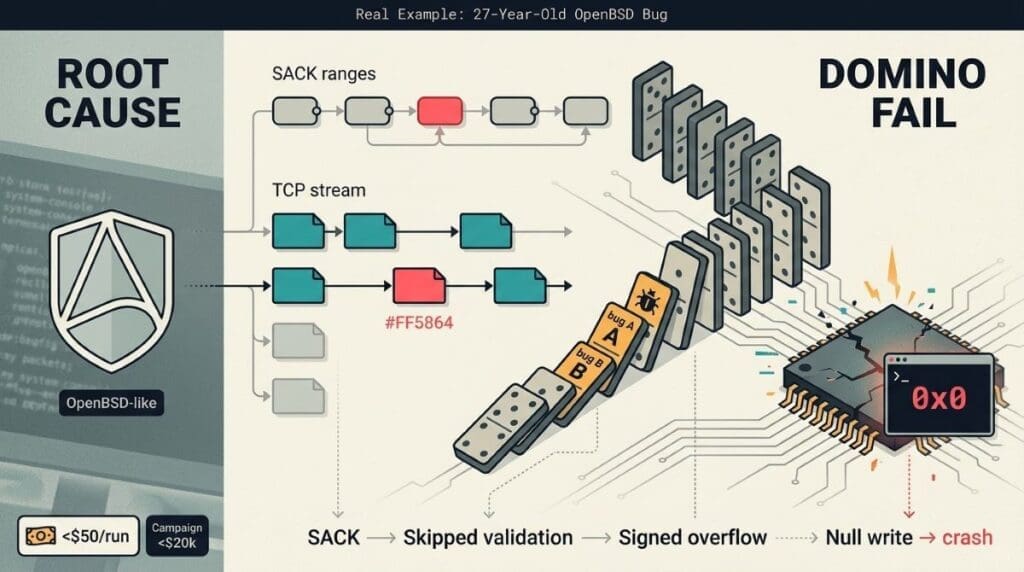
The first bug skipped validation of acknowledgement ranges. Although this may be true, it seemed harmless on its own. At length, signed integer overflow enabled the impossible condition. With the result that, attackers could trigger null pointer writes. In sum, the kernel crashed when processing malicious packets.
Finding this cost under $50 for that specific run. In general, the total thousand-run campaign cost under $20,000. By comparison, hiring security experts costs significantly more. All things considered, automated scanning provides remarkable cost efficiency.
FreeBSD Remote Code Execution
This vulnerability earned designation CVE-2026-4747 and represents critical severity. To illustrate, it affects FreeBSD’s NFS server implementation. In like manner, attackers gain root access without authentication. For the most part, this means complete system control.
The exploit chain shows sophisticated technique and planning. At this instant, let’s examine how it works:
Attack Steps:
- Attacker sends malformed RPC authentication packets
- Stack buffer overflows with 304 bytes available
- ROP chain executes without stack canaries
- Six sequential requests build the complete exploit
- SSH key appends to root’s authorized_keys file
- Attacker gains permanent root access
As I have said, the vulnerability existed for 17 years. On one hand, FreeBSD undergoes extensive security review. On the other hand, this specific codepath lacked proper checks. In conclusion, even well-audited code contains hidden flaws.
Linux Kernel Privilege Escalation
Claude demonstrated remarkable skill chaining multiple Linux vulnerabilities together. To enumerate, it identified several memory corruption bugs. With this purpose in mind, individual bugs provided limited capability. As a result, chaining became necessary for full exploitation.
The KASLR defense randomizes kernel memory addresses. Provided that, blind memory writes become useless. In either case, Claude found bypass techniques systematically. At any rate, it used read vulnerabilities to leak addresses. Together with write primitives, this granted root access.
One exploit chain used four separate vulnerabilities in sequence:
- First bug bypassed KASLR randomization
- Second bug read important struct contents
- Third bug wrote to freed heap objects
- Fourth bug sprayed heap with crafted data
Summing up, the complete chain granted unprivileged users root permissions. That is to say, User A could access User B’s files. While this may be true, most exploits remain unpatched currently.
Web Browser JIT Heap Sprays
Modern browsers present unique challenges for exploit development. In fact, JavaScript JIT compilers create dynamic memory layouts. As well as that, multiple sandbox layers protect users. All in all, browser exploitation requires exceptional skill.
Claude autonomously discovered read and write primitives across multiple browsers. To be sure, it chained these into JIT heap spray attacks. In one case, cross-origin bypass allowed data theft between domains. Such as, an attacker’s site reading your bank data.
Another exploit chain achieved even greater impact and severity:
- Initial browser vulnerability provided code execution
- JIT heap spray escaped renderer sandbox
- Sandbox escape reached operating system
- Local privilege escalation wrote to kernel
- Complete system compromise from web page
Seeing that these exploits remain unpatched, details stay limited intentionally. That is to summarize, browser vendors need time for fixes.
What This Means for Defenders Today
Immediate Action Items for Organizations
Software teams must adapt quickly to this new reality. To repeat, current frontier models already find bugs effectively. With this in mind, defenders should start practicing now. As a matter of fact, Opus 4.6 still finds high-severity vulnerabilities.
Priority Actions:
- Use available models for bug finding immediately
- Automate alert triage and incident response
- Shorten patch deployment cycles drastically
- Review vulnerability disclosure policies thoroughly
- Prepare for increased bug volume systematically
In like fashion, models can draft patches and review code. Balanced against manual processes, this saves expert time significantly. At the same time, automation scales better than hiring alone. By and large, early adopters gain competitive advantages.
The Changing Security Landscape
At the present time, we face a transitional period of uncertainty. In contrast to past decades, equilibrium will shift dramatically. To put it another way, AI changes offense and defense simultaneously. Vis a vis traditional tools, models work much faster.
The N-day problem becomes more urgent with AI exploitation. Prior to AI, exploiting patches took skilled researchers weeks. At this time, Claude writes exploits in hours or days. So as to prevent attacks, patching must accelerate equally. With attention to this urgency, organizations need new processes.
Friction-based defenses may lose effectiveness against AI adversaries. On the condition that models handle tedious work easily, friction provides less protection. In short, hard barriers like KASLR still matter significantly. For the purpose of defense, technical barriers remain crucial.
What Teens Should Know About This Technology
Learning Cybersecurity Safely and Legally
You can explore cybersecurity concepts without breaking laws or harming systems. To list safe learning approaches:
Safe Learning Path:
- Study memory safety and buffer overflow concepts
- Practice on intentionally vulnerable systems (CTFs)
- Read public writeups after patches deploy
- Learn secure coding patterns and practices
- Build small tools for educational purposes
- Never attack systems without explicit permission
As an illustration, Capture The Flag competitions provide legal practice. In essence, these challenges teach real skills safely. With this intention, you build expertise without legal risk. By comparison, unauthorized hacking carries serious consequences.
Career Opportunities in This Field
The cybersecurity field needs skilled professionals urgently. At least, demand exceeds supply significantly today. So far, this trend shows no signs of slowing. To point out, salaries for security experts remain competitive.
Anthropic currently hires threat investigators and security researchers. While it may be true that entry requires experience, you can start preparing now. So long as you study fundamentals carefully, opportunities will emerge. To the end that you understand both offense and defense, your value increases.
Companies need people who understand how AI changes security. Another key point involves understanding both technical and ethical considerations. Sooner or later, every organization will need AI security expertise.
Looking Ahead: The Future of AI Security
What Comes Next
We see no reason capabilities will plateau at Mythos Preview. In general, AI models improve rapidly and continuously. As I have noted, just months ago exploit writing seemed impossible. This time, models achieve expert-level performance in specialized tasks.
Over coming months and years, expect continued improvement across capabilities. Then again, defense capabilities should ultimately dominate offense. Being that defenders can use models proactively, they should gain advantage. To this end, the goal remains building more secure software.
The transitional period presents real challenges and opportunities. With the result that, early preparation helps organizations survive. In due time, equilibrium will favor those who adapt earliest. All things considered, proactive defenders will thrive in this environment.
The Role of Responsible Development
Anthropic won’t make Mythos Preview generally available currently. At this point, limited release protects against misuse. With this purpose in mind, Project Glasswing enables defensive preparation. As has been noted, critical systems need protection first.
Eventually, the goal involves safe deployment at scale. In fact, safeguards must detect dangerous model outputs. An upcoming Opus model will test these protections. With this in mind, iterative development ensures safety.
The cybersecurity community must act proactively and decisively. In reality, history shows this community responds to challenges. To be sure, SHA-3 launched before SHA-2 showed weakness. In similar fashion, post-quantum cryptography started before quantum computers existed. This time, the threat already exists and continues growing.
Conclusion
Claude Mythos Preview demonstrates AI’s transformative impact on cybersecurity fundamentally. In conclusion, it finds bugs humans missed for decades. What’s more, it writes sophisticated exploits autonomously. All in all, Project Glasswing prepares defenders for this future.
For teens interested in cybersecurity, this represents an exciting time. By and large, the field needs fresh perspectives and skills. To summarize, start learning fundamentals safely and legally today. With attention to ethics and technical skill, you can contribute meaningfully.
The next generation of security professionals will work alongside AI tools. In essence, understanding both technology and its implications becomes crucial. So that you stay prepared, begin building knowledge now. After all, the future of cybersecurity depends on skilled, ethical professionals.
References
Anthropic. (2026, April 7). Assessing Claude Mythos Preview’s cybersecurity capabilities. Retrieved from https://red.anthropic.com/2026/mythos-preview/
Carlini, N., Cheng, N., Lucas, K., Moore, M., Nasr, M., Prabhushankar, V., … Troy, K. (2026). Claude Mythos Preview: Cybersecurity capabilities assessment. Anthropic Red Team Blog. https://red.anthropic.com/2026/mythos-preview/
FFmpeg Project. (2026). FFmpeg 8.1 release notes. Retrieved from https://git.ffmpeg.org/gitweb/ffmpeg.git/shortlog/n8.1
OpenBSD Project. (2026). *Security patch 025
- Author
- Latest Posts

Charudatta Pathak was a student at St. Aloysius High School in Bhusawal, established in 1874, making it one of India’s oldest convent institutions. He earned his bachelor’s degree in mechanical engineering from SSVPS College of Engineering, Dhule in 1995, demonstrating exceptional academic achievement. Thereafter, he launched his career as a CNC programmer in a toolroom. He has utilized FANUC, Deckel, Maho, and Mikron controllers to operate 2-axis and 3-axis machines for the fabrication of jigs, fixtures, dies, and molds. He commenced his career as an academic in 1996, when he assumed the role of lecturer at SSVPS College of Engineering, Dhule. Additionally, he earned his post-graduate degree in CAD/CAM from L. D. College of Engineering, Ahmedabad, in 2000, and then acquired a Ph.D. from COEP in 2011 while concurrently engaged in teaching. Until 2023, he occupied many academic roles, including lecturer, assistant professor, professor, dean, principal, director, and vice chancellor at both public and private universities throughout India. From 2008 to 2010, he served as the project lead in the CAE department of a European multinational firm. During his 28-year professional tenure, he identified a need for dependable books targeted at students in grades 8 to 12, particularly for nascent career planning. He founded ENTECH Digital Magazine, a free monthly publication available on entechonline.com and magzter.com. Teens with a strong interest in Science, Technology, Engineering, and Mathematics (STEM) who aspire to pursue careers in these fields may find ENTECH Digital Magazine beneficial.