Combinatorial Decision Making Through Multicomponent Surface Condensates
Combinatorial Decision Making Shapes Cellular Signal Processing
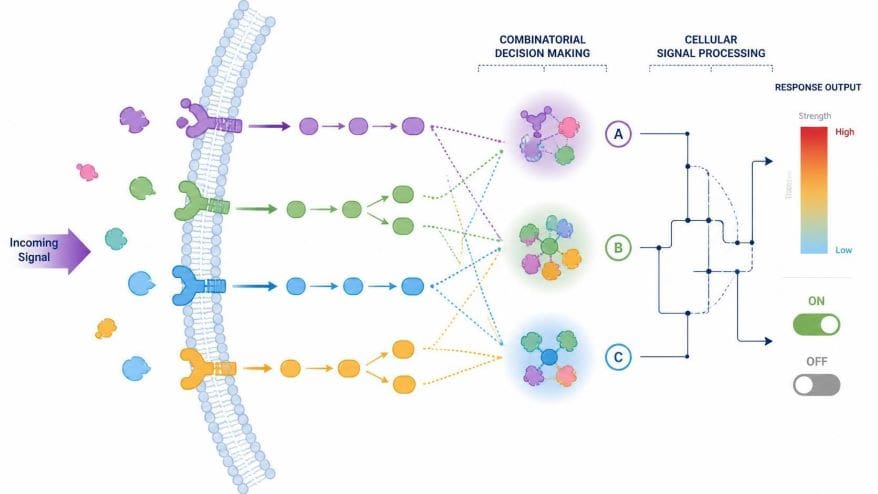
Cells must make choices every day. To do this, they receive many signals at the same time. They need to understand these signals and react in the right way. New research shows that small groups of proteins and other signaling molecules on the cell surface help with this job. These groups, called multicomponent surface condensates, bring many signals together in one place and play a key role in how cells perform combinatorial decision making. They do more than simply turn cell activities on or off. Instead, they help cells compare different signals and choose the best response. This process helps cells grow, communicate, fight disease, and adjust to changes around them. By studying how these protein groups collect and handle signals, scientists are learning more about how cells make clear, accurate, and flexible decisions.
Key Takeaways
- Cells receive many signals at the same time.
- They combine these signals to choose the best response, which is an example of how combinatorial decision making can work in biology.
- Multicomponent surface condensates are small clusters of proteins and signaling molecules on the cell surface.
- These clusters bring different signaling molecules together in one place.
- They help cells process many signals at the same time.
- They do more than simply turn signals on or off.
- They help cells compare and combine information from different sources during their decision making, sometimes in a combinatorial fashion.
- Different signal combinations can produce different cell responses.
- This process helps control cell growth and development.
- It supports communication between cells.
- It helps the immune system respond to harmful threats. It allows cells to adjust to changes in their environment.
- Surface condensates keep cell signaling organized, and this organization underpins more complex combinatorial decision making strategies.
Role of Protein–Protein Interactions in Condensate Assembly
Firstly, Protein–protein interactions are the main force behind the formation of multicomponent surface condensates. Secondly, These interactions allow proteins to recognize, bind, and cluster with one another on the cell membrane. Through many weak but cooperative connections, proteins gather into dense molecular assemblies that can organize cellular signaling, which is vital for efficient combinatorial decision making in cells.

A key feature of condensate assembly is multivalency, where a single protein contains multiple binding sites. Thirdly, These sites enable one protein to interact with several partners at the same time, creating a network of interconnected molecules. As more proteins join the network, a condensate forms and grows on the cell surface, supporting the complex nature of combinatorial decision making in cell environments.
Phase Separation and Biomolecular Condensates
Firstly, Phase separation is a natural process that helps organize materials inside cells. Secondly, In this process, certain proteins and other molecules come together and form small groups. These groups are called biomolecular condensates. They do not have a membrane around them, but they still stay organized. Altogether, these processes influence how combinatorial decision making can occur at the cellular level.
Conclusion
Cells get lots of signals every day. To work well, they need to understand these signals and pick the right response. To help with this, special surface groups bring proteins and signals together in one spot. This makes it easier for cells to take in and use information. It helps cells make smart choices.
These surface groups also let cells handle many signals at once. This helps cells grow, fight germs, talk to other cells, and change when needed. They can form and break apart very fast. So cells can respond quickly when things change. In short, these groups make cell talk simpler, faster, and better. This shows how important they are for smart decision making in cells.
Frequently Asked Questions
What is combinatorial decision-making in cells?
Cells often receive many signals at the same time. They combine this information to decide the best response. This process is called combinatorial decision-making.
What are multicomponent surface condensates?
Multicomponent surface condensates are clusters of proteins, receptors, and signaling molecules that form on the cell surface. They organize these molecules and help cells receive, process, and respond to signals more effectively.
How do surface condensates help cells make decisions?
Surface condensates gather different signaling molecules in one place. This helps cells compare many signals at the same time and choose the right response as conditions change..
Reference
A. Zentner, E.V. Halingstad, C. Chalk, M.P. Brenner, A. Murugan, E. Winfree, & K. Shrinivas, (2026)Combinatorial decision-making driven by multicomponent surface condensates, Proc. Natl. Acad. Sci. U.S.A. 123 (27) e2527873123, https://doi.org/10.1073/pnas.2527873123
- Author
- Latest Posts

I completed my Master of Science from the University of Allahabad in 2017 with a strong academic background in life sciences and chemistry. My specialization included Molecular Biology, Microbiology, Genetics, Plant Breeding, Phycology, Paleobotany, and Bioinformatics, along with Organic Chemistry, Inorganic Chemistry, and Physical Chemistry. This multidisciplinary training provided me with a comprehensive understanding of biological systems and analytical scientific approaches.
After completing my postgraduate studies, I gained valuable professional experience in both the education and social development sectors. I worked at A.M. Oxford Public School, where I was actively involved in guiding students toward academic excellence. In this role, I focused on creating an engaging learning environment, encouraging critical thinking, and nurturing students’ curiosity for scientific learning. My experience as an educator strengthened my communication, mentoring, and classroom management skills.
In addition to my teaching experience, I worked with Jeevan Jagriti Foundation, where I contributed to community-based initiatives aimed at improving educational access and awareness among underprivileged sections of society. Through this work, I participated in programs designed to support social development and promote the value of education in marginalized communities.
These professional experiences helped me develop strong interpersonal, leadership, and organizational skills while reinforcing my commitment to education and community service.