WNT Pathway Mutations Show Simple Feedback Loop Failure
WNT Pathway Mutations Break Self-Regulation in Cells
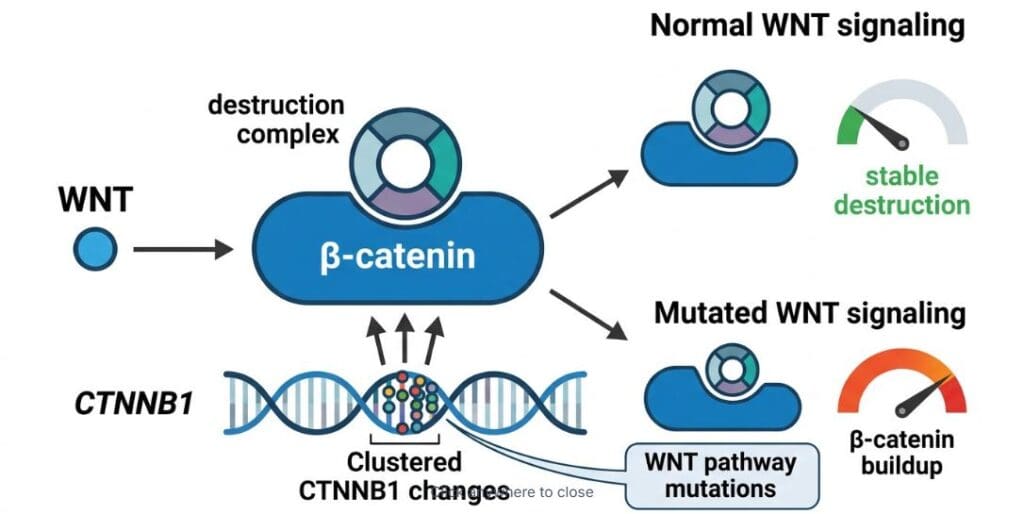
A recent study in Nature Genetics focused on WNT pathway mutations and used a clever technique called mutational scanning to better understand how cells control the WNT signaling pathway. This pathway is critical for growth and development, and when it goes wrong, it can lead to cancer. The researchers focused on a group of proteins known as the “destruction complex,” which normally blocks WNT signals. By testing thousands of tiny mutations, they discovered that the complex regulates itself with direct help from its own target, the WNT signal itself. This “substrate-assisted autoregulation” is a simple but powerful feedback loop that keeps the system in check. The findings give us a fresh, clear view of a key cellular process. In particular, WNT pathway mutations were central to their investigation.
Key Takeaways
- The Big Question: How does a cell’s “WNT destruction complex” know when to turn itself on and off?
- The Tool Used: Scientists used a method called “mutational scanning.” They made thousands of tiny changes (mutations) to a key protein to see what happens.
- The Main Discovery: The destruction complex does not work alone. It needs help from the very thing it destroys—the WNT signal itself.
- The Simple Mechanism: Think of it like a thermostat. When the WNT signal is weak, the complex turns it off. When the signal is strong, the signal itself tells the complex to calm down. This is called “substrate-assisted autoregulation.”
- Why It Matters: This self-regulation keeps the WNT pathway balanced. When this balance breaks, it can lead to cancer and is often linked to WNT pathway mutations.
- The Takeaway: This study gives us a much clearer, simpler view of how a key cell process really works. It shows that feedback loops are often direct and easy to understand.
The Role of the β-Catenin Destruction Complex in Cells
- Keeping the Peace Normally, the destruction complex is always active. It grabs β-catenin and breaks it down right away. This stops β-catenin from building up and sending signals. The cell stays quiet and stable.
- The “Off” Switch The complex acts as a constant brake. By destroying β-catenin, it keeps a key growth signal turned off. Without this complex, the signal would stay on all the time, which can cause problems like cancer.
- A New Twist: Self-Help This new study shows that the complex is smarter than we thought. It does not just destroy β-catenin. The complex uses β-catenin itself to decide when to slow down. When β-catenin levels rise, the complex gets a signal to ease up. This is called “substrate-assisted autoregulation.”
- Simple Balance In short, the complex has two main jobs:
- Destroy: Break down β-catenin to keep signals off.
- Listen: Pay attention to β-catenin levels and adjust its own activity.
Gain-of-Function Mutations in β-Catenin
Sometimes, a tiny change in a gene can cause big problems. This is true for β-catenin. A “gain-of-function” mutation makes β-catenin too active. Normally, the destruction complex grabs β-catenin and breaks it down. But a mutation can change β-catenin’s shape just a little. This makes it harder for the complex to catch it. As a result, β-catenin builds up in the cell. It then sends a constant “grow” signal, even when it should not. The new study shows that this mutation also breaks the self-regulation loop. Since β-catenin can no longer be destroyed, it can’t tell the complex to slow down either. The system gets stuck in the “on” position. This is a key cause of many cancers, especially in the colon and liver. Thus, understanding the impact of WNT pathway mutations is crucial for figuring out how these diseases develop.
Functional Analysis of CTNNB1 Mutations
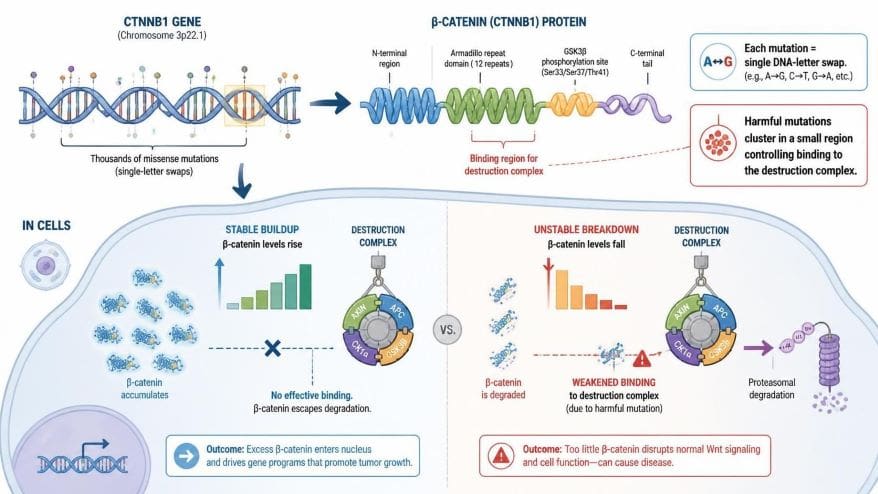
The study tested thousands of tiny changes in the CTNNB1 gene. This gene carries the instructions for the β-catenin protein. Each change was a single DNA letter swap. The researchers looked at how each change affected the protein’s function. They set up a clear test. They put each mutant form into cells and measured how much β-catenin built up. Some mutations made β-catenin very stable. It resisted destruction by the complex. Other mutations made β-catenin less stable. It broke down faster than normal. The team mapped each result back to the gene’s structure. They found that most harmful mutations clustered in one small region. This region controls how β-catenin binds to the destruction complex. The analysis revealed a simple pattern. Mutations that weakened this binding caused the most trouble. In the context of WNT pathway mutations, these insights are especially valuable for researchers.
Future Directions in WNT Pathway Drug Development
First, this study gives scientists a clear target for new drugs. Specifically, drugs can now aim to restore the self-regulation loop in the destruction complex. Second, researchers can use the mutation map from the study to design better tests. For instance, they can quickly check if a patient’s tumor has a harmful CTNNB1 mutation. Third, new therapies might focus on making the destruction complex work again. For example, a drug could help the complex grab and break down mutant β-catenin. Additionally, the study shows which parts of the complex are most important. As a result, drug designers can build molecules that fit exactly into those spots. Finally, this work lays a simple foundation. It tells us exactly what goes wrong in WNT-driven cancers. Therefore, future drugs will have a much clearer path to follow. To sum up, WNT pathway mutations continue to inform the future of targeted treatments.
Frequently Asked Questions
What is “substrate-assisted autoregulation”?
Simply put, it is a self-control loop. The destruction complex destroys β-catenin. However, β-catenin also tells the complex when to slow down. As a result, the system balances itself.
How did the team find which mutations are harmful?
They tested each mutation one by one. First, they put each mutant gene into cells. Next, they measured how much β-catenin built up. Finally, they mapped the harmful changes to specific spots in the protein’s structure.
How did scientists discover new mutations affecting WNT signaling?
Firstly, The researchers used advanced base-editing technology to create precise mutations across key destruction-complex genes. Next, they measured how each mutation changed WNT signaling activity. Through this approach, they mapped functional regions of the proteins and uncovered mutations that either increased or decreased signaling strength.
Reference
Padmanarayana, M., Sakalas, S., Sarkar, P. et al. Mutational scanning reveals substrate-assisted autoregulation of the WNT destruction complex. Nat Genet (2026). https://doi.org/10.1038/s41588-026-02662-3
- Author
- Latest Posts

I completed my Master of Science from the University of Allahabad in 2017 with a strong academic background in life sciences and chemistry. My specialization included Molecular Biology, Microbiology, Genetics, Plant Breeding, Phycology, Paleobotany, and Bioinformatics, along with Organic Chemistry, Inorganic Chemistry, and Physical Chemistry. This multidisciplinary training provided me with a comprehensive understanding of biological systems and analytical scientific approaches.
After completing my postgraduate studies, I gained valuable professional experience in both the education and social development sectors. I worked at A.M. Oxford Public School, where I was actively involved in guiding students toward academic excellence. In this role, I focused on creating an engaging learning environment, encouraging critical thinking, and nurturing students’ curiosity for scientific learning. My experience as an educator strengthened my communication, mentoring, and classroom management skills.
In addition to my teaching experience, I worked with Jeevan Jagriti Foundation, where I contributed to community-based initiatives aimed at improving educational access and awareness among underprivileged sections of society. Through this work, I participated in programs designed to support social development and promote the value of education in marginalized communities.
These professional experiences helped me develop strong interpersonal, leadership, and organizational skills while reinforcing my commitment to education and community service.