Histone H3 Lysine Mutations and Mammalian Epigenetic Regulation
Histone H3 Lysine Mutations Mapped Using CRISPR Prime Editing
Scientists used a new, rapid gene-editing tool called “prime editing” to identify which histone H3 lysine mutations are most important in humans. By testing many small changes at once, they identified the key sites. These spots control how our DNA works. Moreover, this simple approach helps us understand which parts of this protein are essential for life.
Key Takeaways: Histone H3 Lysine Mutations
- This study looked at a protein called histone H3.
- Histones help pack DNA inside our cells.
- Lysines are small parts of this protein.
- Some lysines are very important for life.
- The team used a new tool called prime editing.
- Prime editing lets scientists change DNA with high precision.
- The team tested many lysines at once.
- They wanted to find the most critical ones.
- They did this in living human cells.
- They saw which lysines cells need to survive.
- Some lysines help turn genes on and off.
- Other lysines help keep DNA stable.
- The method was fast and high-throughput.
- This means they tested many changes in a short time.
- These findings help us understand how cells work better.
CRISPR Prime Editing Technology
First, let’s discuss a new tool called CRISPR prime editing. This tool is like an intelligent pair of scissors. It can change a tiny part of our DNA with high precision. In this case, the team focused on a protein called histone H3. This protein helps pack our DNA inside cells.
At the same time, the team wanted to find which lysines are really important. Lysines are small building blocks inside histone H3 in the study of histone H3 lysine mutations. Some lysines are critical for life. So, the team used prime editing to test many lysines at once. They did this in living human cells.
As a result, they found which lysines cells need to stay alive. For example, some lysines help turn genes on and off. In addition, other lysines help keep DNA stable and safe. In other words, without these key lysines, cells can fail.
On top of that, the method was high-throughput. That means the team tested hundreds of changes very fast. In fact, this is much faster than older methods.
Furthermore, these results help us understand how our cells work. In conclusion, CRISPR prime editing is a powerful way to find critical parts of proteins like histone H3.
Histone Post-Translational Modifications
First, this study looked at how cells make small changes to histone H3. These small changes are called post-translational modifications. For example, a common change is adding a small tag to a lysine. At the same time, the team wanted to find which lysines are most important for these changes. In other words, they wanted to see which tags help cells work well.
As a result, they used CRISPR prime editing to test many lysines at once. They did this in living human cells. On top of that, they saw which lysines need to be modified for cells to stay alive. For instance, some lysine tags help turn genes on. In addition, other lysine tags help keep DNA packed safely.
In fact, without the right tags on the right lysines, cells can stop working. This study shows that post-translational modifications on histone H3 are not random. Instead, they are very precise and critical for life.
Stem Cell Self-Renewal
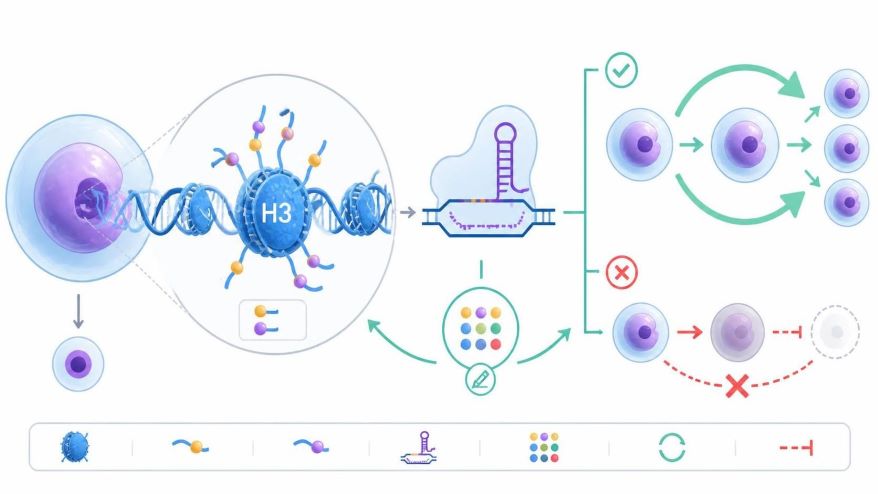
First, this study examined stem cells and how they keep making more of themselves. This process is called self-renewal. For stem cells to work right, they need to stay healthy and keep dividing. At the same time, the team wanted to know which lysines in histone H3 help with this job.
As a result, they used CRISPR prime editing to test many lysines at once. In other words, they changed one lysine at a time in living stem cells. In fact, this let them see which lysines are critical for self-renewal. For example, some lysines help keep stem cells young and ready to divide. In addition, other lysines stop stem cells from turning into other cell types too fast.
On top of that, when the team blocked a key lysine, the stem cells stopped growing. In other words, they lost the ability to renew themselves. In conclusion, this study shows that specific lysines on histone H3 are essential for stem cell self-renewal. Without them, stem cells cannot survive or keep dividing.
Frequently Asked Questions: Histone H3 Lysine Mutations
Why are histone H3 lysines important?
Histone H3 has small parts called lysines. These lysines are important spots for tiny changes. For example, cells can add small tags called acetylation or methylation to these spots. As a result, these tags help control how DNA is packed inside cells. In other words, they help keep DNA stable and safe. Additionally, these tags also help turn genes on and off. In fact, without these tags on the right lysines, cells cannot work well.
Which lysine residues were found to be critical?
The team found some key lysines on histone H3. For example, they found H3K4, H3K9, H3K14, H3K18, H3K79, and H3K56. In other words, these are specific spots on the protein. As a result, they are very important for cells. In fact, when the team made small changes to these spots, the cells had trouble.
How did CRISPR prime editing help in this research?
CRISPR prime editing enabled precise, reversible, and combinatorial mutations of histone H3 genes directly within their native genomic locations, allowing systematic functional analysis of individual lysine residues.
Reference
Price, D., Zemlyanskiy, G., Trakarnphornsombat, W., Forne, I., Volkova, N., Dubusse, L., Cooper, A. J., Imhof, A., & Radzisheuskaya, A. (2026). Identifying critical lysines in mammalian histone H3 with high-throughput CRISPR prime editing. Nature Genetics. Advance online publication. https://doi.org/10.1038/s41588-026-02675-y
- Author
- Latest Posts

I completed my Master of Science from the University of Allahabad in 2017 with a strong academic background in life sciences and chemistry. My specialization included Molecular Biology, Microbiology, Genetics, Plant Breeding, Phycology, Paleobotany, and Bioinformatics, along with Organic Chemistry, Inorganic Chemistry, and Physical Chemistry. This multidisciplinary training provided me with a comprehensive understanding of biological systems and analytical scientific approaches.
After completing my postgraduate studies, I gained valuable professional experience in both the education and social development sectors. I worked at A.M. Oxford Public School, where I was actively involved in guiding students toward academic excellence. In this role, I focused on creating an engaging learning environment, encouraging critical thinking, and nurturing students’ curiosity for scientific learning. My experience as an educator strengthened my communication, mentoring, and classroom management skills.
In addition to my teaching experience, I worked with Jeevan Jagriti Foundation, where I contributed to community-based initiatives aimed at improving educational access and awareness among underprivileged sections of society. Through this work, I participated in programs designed to support social development and promote the value of education in marginalized communities.
These professional experiences helped me develop strong interpersonal, leadership, and organizational skills while reinforcing my commitment to education and community service.