Blended Genome Exome Reveals Hidden Genetic Variation
Blended Genome Exome Delivers Cost-Effective Sequencing

A new way to read DNA can find genetic changes cheaply and fairly. It mixes two methods: whole-genome sequencing and exome sequencing, often referred to as a blended genome-exome strategy. The first method reads all of a person’s DNA, but it costs a lot. The second method only reads the parts that make proteins, missing other important areas. This new mix takes the best from both. It first reads the key coding parts closely, then reads the rest with less detail. This cuts down the cost a lot. At the same time, it still finds a wide range of genetic differences, including rare or difficult-to-spot ones. This means scientists can study genetic variation more fully without spending too much money. The method is unbiased because it does not focus only on known genes. It helps in finding new links between genes and diseases. In short, this blended approach is a smart and fair tool for genetic research.
Key Takeaways: Blended Genome Exome
Scientists found a smart way to read DNA. It mixes two methods. One reads all DNA but costs a lot. The other only reads protein parts. The new mix is cheap and fair. First, it reads key parts closely. Then, it reads the rest with less detail. This cuts costs. It also finds many genetic changes, even rare ones. Consider the blended genome and exome sequencing technique, which does not focus only on known genes. This helps find new links to disease. In short, this method is a cheap, fair, and powerful tool for genetic research.
High Depth Exome Sequencing
A new DNA reading method is both cheap and fair. It mixes two ways to read our genes. One way reads all DNA, but it costs too much. The other way only reads the parts that make proteins. The new mix is better. First, it reads the key parts very closely. This is called high depth. It provides a clear look at important genes, thanks to this blended genome and exome approach. Then, it reads the rest of the DNA with less detail. This keeps the cost low. At the same time, it still finds many types of genetic changes. It even finds rare ones that other tests miss. It is fair because it does not look only for known gene problems. This helps doctors and scientists understand disease better. In short, high-depth exome sequencing in this mixed method is a smart, low-cost way to identify many genetic clues.
Unbiased Variant Discovery Approach
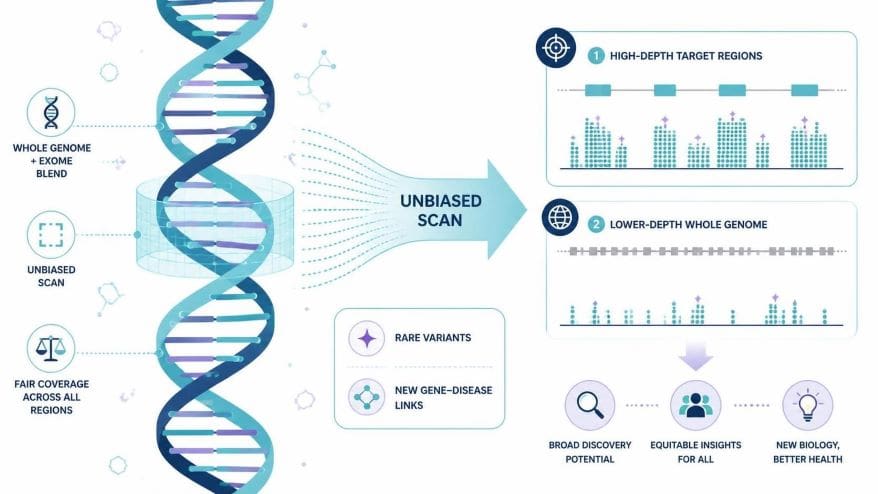
A new DNA reading method finds genetic changes in a fair and cheap way. It mixes whole-genome and exome sequencing. The key idea is an unbiased approach. This means it does not look only for known gene problems. Instead, it scans all DNA without picking favorites. With the blended genome and exome sequencing, it first reads important gene parts at high depth. Then it reads the rest with less detail. This cuts cost but still finds many types of changes. It catches rare and hard-to-spot variants that other tests miss. Because it is unbiased, it can discover new links between genes and disease. This is a big step forward. Scientists can now explore DNA fully without spending too much money. In short, this method is a fair, low-cost way to discover all kinds of genetic variation, not just the ones we already know about.
Copy Number Variant Detection
A new DNA reading method can find large missing or extra DNA pieces. These are called copy number variants (CNVs). They are important because they can cause disease. The problem is that some DNA tests miss them. This new mix of whole genome and exome sequencing does better. For copy number variant detection, the blended genome and exome technique first reads key DNA parts at high depth. This provides a clear, strong signal. Then, it also reads the rest of the DNA with less detail. This broad view helps spot large CNVs that other tests skip. The method is fair because it does not focus only on small changes. It catches big ones, too. Plus, it keeps costs low. This means more people can get tested for CNVs. Doctors can find gene problems that were hidden before. In short, this blended method is a cheap and effective way to detect copy number variants and improve genetic diagnosis.
Genomic Research Cost Reduction
A new way to read DNA helps scientists save a lot of money. It mixes two methods: whole genome and exome sequencing. Using the blended genome-exome method, reading all DNA costs too much for many studies. The new mix is smarter. First, it reads key gene parts with high detail. Then, it reads the rest with less detail. This drops the cost way down. At the same time, it still finds many types of genetic changes. It does not miss rare ones. It is also fair because it does not only look for known problems. This means researchers can study more people for less money. Big studies become possible on a small budget. Labs can do more science without spending more cash. In short, this blended method is a cheap, fair, and powerful tool. It makes genomic research more affordable for everyone.
Conclusion: Blended Genome Exome
In short, this new DNA reading method is a major advance. It mixes two ways to read genes. One way reads all DNA but costs too much. The other way only reads protein parts. The mix is better. It also finds many types of genetic changes in a fair way. It does not only look for known problems. All of this helps doctors and scientists learn more about disease. More people can be tested because it is cheap. With this blended genome and exome approach, big studies are now possible on small budgets. This method is a smart, fair, and low-cost tool for the future of genetic research. It opens the door to new discoveries for everyone
Frequently Asked Questions: Blended Genome Exome
What is BGE sequencing?
BGE mixes two DNA reading methods in one test. It finds changes in both coding and non-coding parts of genes. And it does all this at a low cost.
Why is BGE cost-effective?
BGE finds many types of DNA changes. It costs only about 28% of what deep whole-genome sequencing costs. And it stays highly accurate.
What variants does BGE detect?
BGE identifies common SNPs, rare coding variants, and protein-coding copy number variants across diverse populations.
Reference
Boltz, T.A., Chu, B.B., DeFelice, M. et al. A blended genome and exome sequencing method captures genetic variation in an unbiased and cost-effective manner. Nat Genet (2026). https://doi.org/10.1038/s41588-026-02669-w
- Author
- Latest Posts

I completed my Master of Science from the University of Allahabad in 2017 with a strong academic background in life sciences and chemistry. My specialization included Molecular Biology, Microbiology, Genetics, Plant Breeding, Phycology, Paleobotany, and Bioinformatics, along with Organic Chemistry, Inorganic Chemistry, and Physical Chemistry. This multidisciplinary training provided me with a comprehensive understanding of biological systems and analytical scientific approaches.
After completing my postgraduate studies, I gained valuable professional experience in both the education and social development sectors. I worked at A.M. Oxford Public School, where I was actively involved in guiding students toward academic excellence. In this role, I focused on creating an engaging learning environment, encouraging critical thinking, and nurturing students’ curiosity for scientific learning. My experience as an educator strengthened my communication, mentoring, and classroom management skills.
In addition to my teaching experience, I worked with Jeevan Jagriti Foundation, where I contributed to community-based initiatives aimed at improving educational access and awareness among underprivileged sections of society. Through this work, I participated in programs designed to support social development and promote the value of education in marginalized communities.
These professional experiences helped me develop strong interpersonal, leadership, and organizational skills while reinforcing my commitment to education and community service.