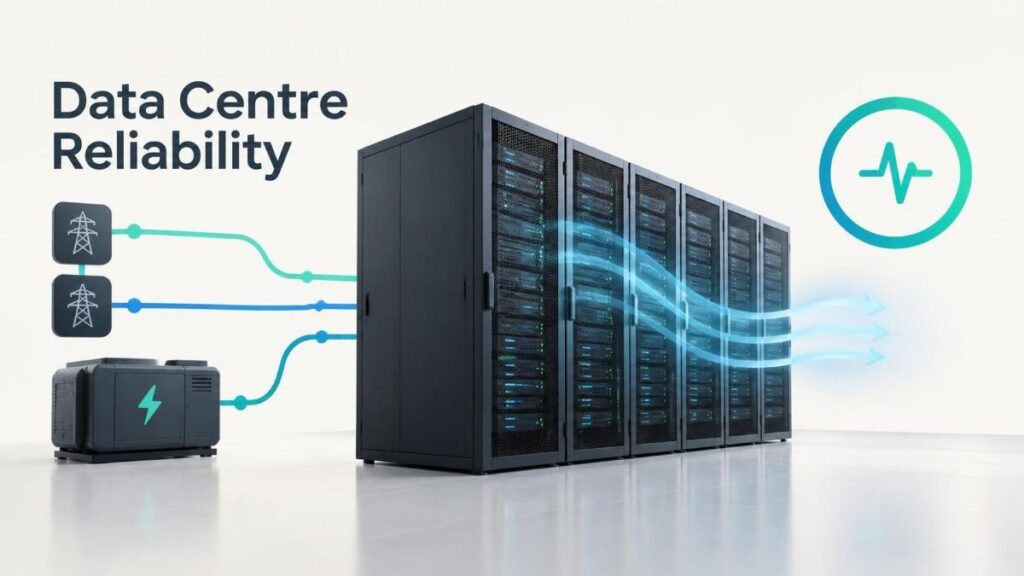
Every time a smartphone streams a HD video or a business accesses a cloud database, an invisible yet massive physical infrastructure gets to work. We rarely think about the complex engineering required to maintain mobile network uptime and data center reliability. However, keeping these critical telecommunications and cloud facilities running seamlessly requires sophisticated electrical and structural engineering. Modern connectivity requires reliable power and cooling systems. These systems must handle grid fluctuations, extreme heat, and equipment failures. The challenge is continually evolving as user demands increase, making resilient infrastructure an absolute necessity for our digital future.
The modern digital economy requires a staggering amount of power to stay online. In 2024, global data center energy consumption reached 415 terawatt-hours. This accounts for roughly 2% of total worldwide electricity usage. Locally, data centers consumed just 3% of the national grid’s energy in 2026. However, the Australian Energy Market Operator projects this figure will jump to 13% by 2035–2036. This massive surge reflects the rapid expansion of digital services. Ultimately, it places immense strain on existing power generation and distribution networks across the country.
Telecommunications networks are equally power-hungry. Radio Access Network components consume about 73% of total network energy. Furthermore, 5G energy usage could double or triple compared to 4G networks. Engineers must implement aggressive countermeasures to prevent this surge. As covered in broader discussions on the future of cloud computing, the physical hardware behind these networks is changing rapidly.
Mitigating the High Cost of Grid Instability
With such immense power requirements, grid instability becomes a severe operational risk. Unstable power quality, such as subtle voltage sags, surges, or electrical noise, contributes to roughly 33% of all data center disruptions. When these power anomalies lead to unexpected downtime, the financial impact is devastating. The average cost of an unplanned data center outage has reached approximately $9,000 per minute, meaning a single hour-long disruption can cost large enterprises upwards of $540,000. These financial stakes mean that companies must invest heavily in fail-safes and layered redundancies to ensure continuous operations.
To protect against these fluctuations and prevent catastrophic hardware failures, facility engineers implement multiple layers of electrical redundancy. The cornerstone of this fail-safe architecture is an industrial UPS which continuously conditions incoming grid power while providing immediate battery backup during an outage. This equipment supplies servers and network switches with clean, uninterrupted power. It bridges the critical gap between a mains failure and the start of backup diesel generators. Without this robust intermediary, sensitive hardware would simply crash during power transitions.
Power Infrastructure Vulnerabilities That Threaten Data Center Reliability
Even with robust backup systems in place, infrastructure failures remain a persistent challenge in structural and electrical engineering. A recent industry analysis on ensuring data center uptime highlighted insights from the Uptime Institute 2024 Annual Outages Analysis report. The report found that power-related issues are the primary cause of major data center outages. In fact, they account for 52% of all disruptions. Notably, 42% of these power outages stem directly from failures in uninterruptible power supply systems. These system failures happen largely due to improper sizing or a lack of maintenance.
Beyond mechanical faults, human error remains a significant vulnerability in facility management. Roughly 22% of unplanned data center outages occur during routine maintenance or emergency responses. Industry experts estimate that more than 75% of all facility outages are entirely preventable through rigorous testing, modernized power infrastructure, and strict operational protocols. Comprehensive training and automated monitoring are critical components of a resilient infrastructure strategy.
Advanced Cooling and Thermal Management Systems for Data Centers
Power and thermal engineering are inherently linked in high-density computing environments. A single cooling system failure can cause critical hardware damage exceeding millions of dollars in under ten minutes. Therefore, backup power systems must sustain heating, ventilation, and air conditioning operations alongside the servers.
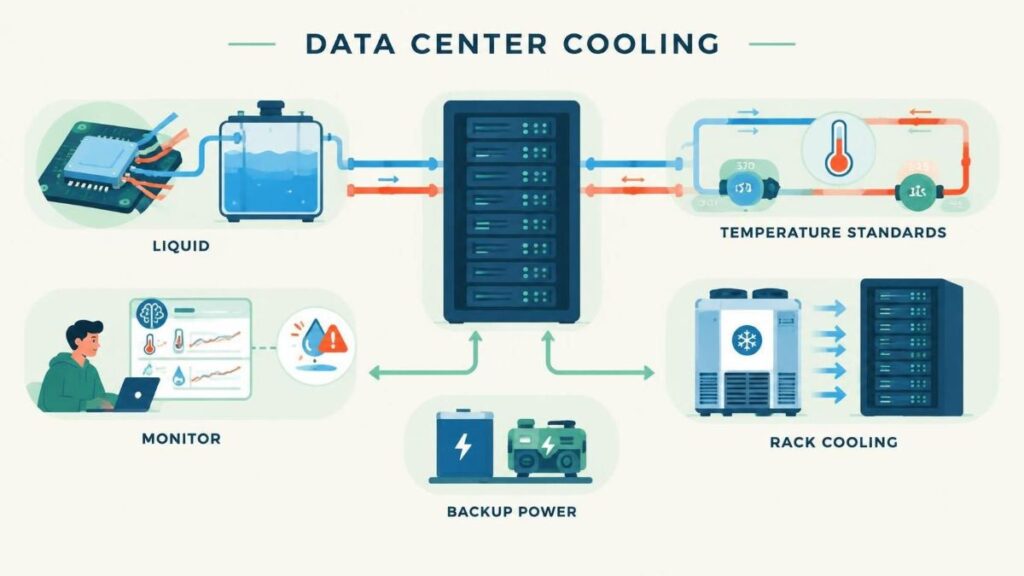
Fig. 1: Data Center Cooling – different techniques (illustration – AI Generated)
To manage the intense heat generated by modern workloads, engineers are moving away from traditional air conditioning and adopting advanced thermal management strategies. For example, many teams now use liquid cooling. Non-conductive fluid tanks and cold plates attach directly to the chips, so heat leaves the hardware quickly and efficiently. In addition, engineering standards keep improving. The American Society of Heating, Refrigerating and Air-Conditioning Engineers regularly updates supply water temperature standards such as S30 and S45. These guidelines balance cooling efficiency with hardware reliability.
Facilities also rely on predictive maintenance. Artificial intelligence and sensor data help engineers spot thermal anomalies and coolant leaks before they trigger a full system shutdown. Finally, localised rack cooling brings cooling units closer to the highest-density server racks. Because cold air travels a shorter distance, the facility uses far less energy to cool vast server room floors.
The reliability of mobile networks and cloud data centers relies entirely on the invisible engineering framework supporting them. By integrating advanced cooling techniques with resilient electrical infrastructure, engineers can ensure the digital services we depend on remain active, efficient, and secure against an increasingly unpredictable power grid.
FAQs
What causes most data center outages?
Power-related issues cause 52% of all significant outages. Additionally, unstable power quality such as voltage sags and surges accounts for roughly 33% of disruptions.
How much does an unplanned outage cost?
An unplanned outage costs about $9,000 per minute. Therefore, a single hour of downtime can cost a large enterprise upwards of $540,000.
Why do UPS systems fail?
Improper sizing and poor maintenance cause 42% of power-related outages inside the UPS itself. As a result, regular testing and correct sizing are essential for data center reliability.
How do engineers improve data center reliability?
Engineers layer electrical redundancy, starting with an industrial UPS that conditions power and bridges the gap to backup generators. Moreover, they adopt liquid cooling and predictive maintenance to protect sensitive hardware.
Are most data center outages preventable?
Yes. Experts estimate that more than 75 percent of facility outages are preventable. However, prevention requires rigorous testing, modernized power infrastructure, and strict operational protocols.
How does data center reliability affect mobile networks?
Radio access network components consume about 73% of total network energy. Consequently, resilient power and cooling directly protect mobile network uptime.
References:
Energy Demand from AI. (n.d.). iea.org. https://www.iea.org/reports/energy-and-ai/energy-demand-from-ai
Council, C. (2026, October 13). Seizing the opportunity to do data centres right. Climate Council. https://www.climatecouncil.org.au/what-does-the-data-centre-boom-mean-for-australias-switch-to-renewables/
Thantharate, A., Tondwalkar, A. V., Beard, C., & Kwasinski, A. (2022). ECO6G: Energy and cost analysis for network slicing deployment in beyond 5G networks. Sensors, 22(22), 8614. https://doi.org/10.3390/s22228614
Aditya Joshi is an SDE Intern at Coneixement India, the company behind ENTECH STEM Magazine and STEMQuiz. He is a Computer Engineering graduate from Savitribai Phule Pune University (SPPU), with honours in Machine Learning and Data Science. His academic background and hands-on project experience have developed his interest in artificial intelligence, emerging technologies, software development, and the practical applications of computing.
His areas of technical interest include Artificial Intelligence (AI), Generative AI, Machine Learning, Data Science, Large Language Models (LLMs), Natural Language Processing (NLP), Retrieval-Augmented Generation (RAG), GraphRAG, and knowledge graphs. Through projects involving locally hosted language models, Neo4j knowledge graphs, multilingual chatbots, and AI-powered analytics, he has explored how emerging technologies can be used to solve practical problems.
Aditya's professional experience includes work in frontend development, AI/ML application development, and full-stack software projects. During his internships at Maharashtra Knowledge Corporation Limited (MKCL) and Hilwitz Solutions, he worked on applications involving web technologies, Python, Flask, and AI-driven functionality. He has also developed projects such as SalesCope, an AI-assisted sales analytics platform, and a multilingual chatbot designed to help users explore Indian government schemes.
At ENTECH STEM Magazine and STEMQuiz, Aditya brings a technology-focused perspective shaped by his engineering education and practical experience with AI and software systems. He is interested in making complex science and technology concepts easier to understand through clear explanations, relatable everyday examples, and an emphasis on how emerging innovations work and affect real-world applications.
His broader goal is to help bridge the gap between technical concepts and public understanding, encouraging curiosity about artificial intelligence, computing, and the technologies shaping the future.