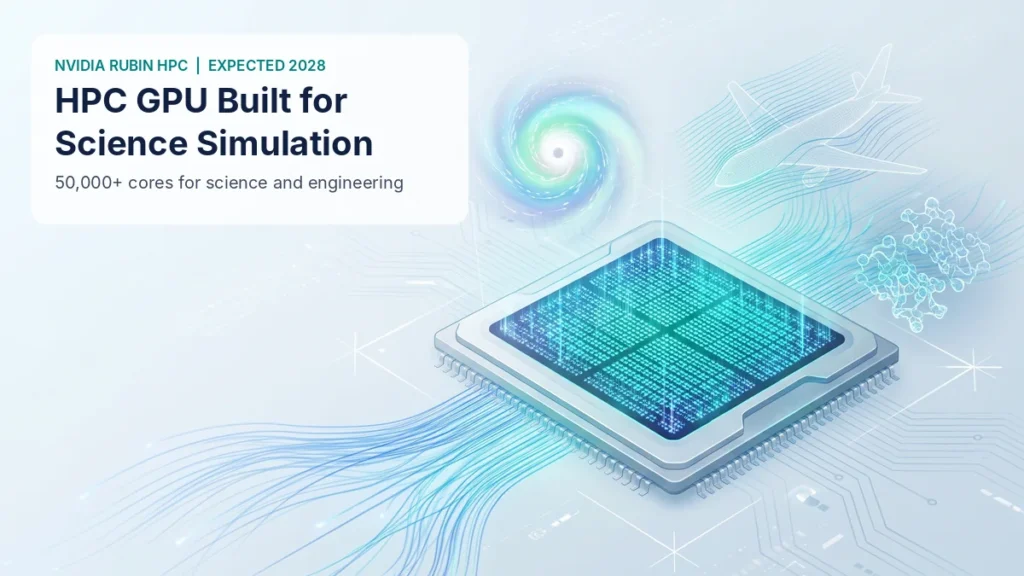
Check a weather app before a school trip, and tomorrow’s rain chance pops up in seconds. Easy, right? Behind that number sits a giant simulation that forecasters run several times a day. In practice, they split the sky into millions of tiny boxes. Then a supercomputer updates every box, step after step. That’s slow, hungry work for any chip. So NVIDIA wants to speed it up. On November 16, 2026, the company announced Rubin HPC, a graphics processing unit built mainly for simulation. According to NVIDIA, this HPC GPU will carry more than 50,000 CUDA cores. In addition, the chip targets climate models, engineering designs, genome studies and financial risk. Those jobs shape weather alerts, safer cars and medicines. But what makes a simulation chip different from an AI chip? Let’s dig in.
The news arrived at the SC26 supercomputing conference in Chicago. Dan Ernst described the chip in an official NVIDIA blog post. NVIDIA, based in Santa Clara, California, says Rubin HPC joins its Vera Rubin platform, a family of data center chips. Here’s the thing. Many recent data center chips chase AI workloads first. Rubin HPC, by contrast, aims at the math inside scientific and engineering simulations. On top of that, NVIDIA ties the chip to AI agents. These programs can plan a test, run it and read the result. After that, they pick the next step without waiting for a person. For now, the company expects the chip to reach buyers in 2028. That’s a while away, sure. Still, the reasons behind it matter right now.
Why Science Simulations Need a Different Kind of Chip
Nobody crashes a real airplane just to test a new wing. And no one can rerun Earth’s climate either. Instead, scientists build digital copies and let computers play them forward. People call this field high-performance computing, or HPC for short. Supercomputers chop these jobs into millions of small pieces. Each piece then runs at the same time on a separate core. Graphics chips have long helped with this parallel work. Even so, simulations behave differently from AI training math. AI training, for one thing, mostly multiplies big, tidy blocks of numbers. Simulations, on the other hand, jump around huge data sets in messy ways. So the chip often sits idle while data travels. Put simply, data movement limits these programs more than raw speed. That bottleneck is what NVIDIA says it tackled.
The Four Math Patterns That Slow Simulations Down
NVIDIA’s announcement names four patterns that keep popping up in science code. To begin with, sparse matrix math works on huge tables that hold mostly zeros. Stencil math, by contrast, updates each grid point using its neighbors. Sorting and reductions round out the list. A reduction just squeezes many numbers into one, such as a total. According to NVIDIA, science programs repeat a simple loop. First of all, they read from big data sets and gather scattered values. Next, they compute a result and repeat it at a giant scale. Gathering those scattered values is the slow bit. Think of a librarian fetching books from shelves all over a building. Earlier ENTECH coverage of brain-inspired computers that solve equations ran into the same struggle. So faster fetching matters as much as faster math.
What the New HPC GPU Brings to the Table
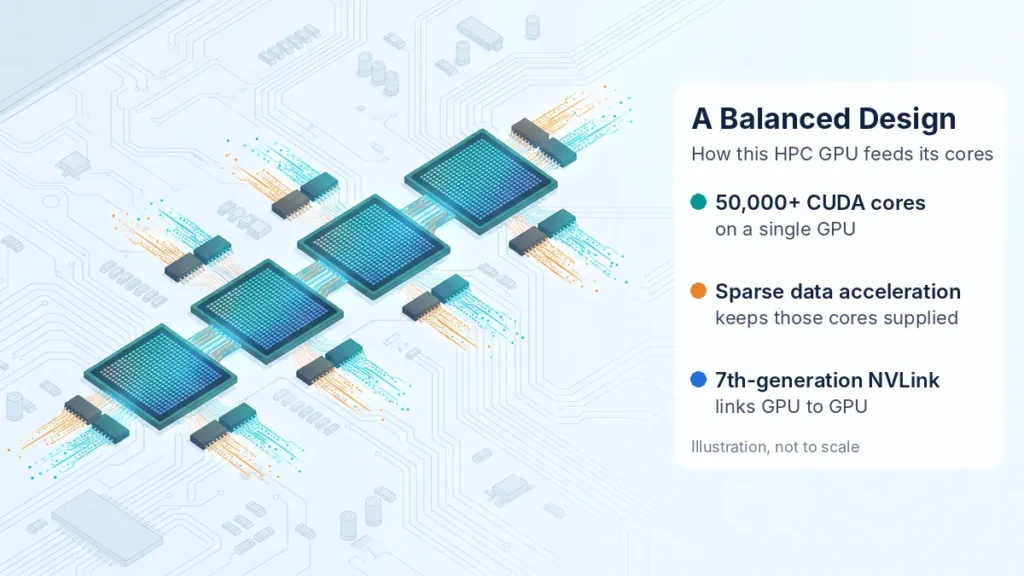
What exactly did NVIDIA announce? The headline number is more than 50,000 CUDA cores on one chip. In fact, NVIDIA calls that a record for a single GPU. Next comes a feature called sparse data acceleration. In other words, its job is to keep all those cores fed with data. How does it work? NVIDIA hasn’t said in detail. Meanwhile, chips will talk through seventh-generation NVLink, NVIDIA’s high-speed link between GPUs. Together, these parts form what the company calls a balanced design. Data movement and compute grow side by side. Adding cores alone would only create more idle workers. At the same time, NVIDIA tuned this HPC GPU for sparse math, stencils, sorting and reductions. If it works as planned, simulations could wrap up sooner. Independent tests must confirm that, though.
Fig. 1: Inside This HPC GPU’s Balanced Design
How This HPC GPU Helps AI Agents Run Experiments
NVIDIA frames Rubin HPC around AI agents that do science. The loop goes like this. To start, an agent proposes a new material or molecule. Then it runs a simulation to test the idea. After reading the result, it decides what to try next. As a matter of fact, one project might spin through that loop thousands of times. Faster simulations shorten every single turn. Ian Buck, NVIDIA’s vice president of hyperscale and high-performance computing, put it plainly. “For agents tackling science and engineering, faster simulation means faster discovery,” he said. On the same day, NVIDIA also expanded its CUDA-X libraries. These are ready-made toolkits of tuned math for agents. A companion NVIDIA post lists tools for molecules, proteins and telescope data. NVIDIA says these libraries can work together with Rubin HPC.
The Science Behind an HPC GPU, Explained
Let’s start with the word core. A computer’s main processor, the CPU, has a few powerful cores. Each one handles tricky tasks quickly, one after another. A graphics processing unit flips that idea around. It packs thousands of simpler cores that chew through small tasks at once. NVIDIA calls its version CUDA cores. Suppose a math exam has ten thousand easy sums. In that case, one brilliant student would need hours to finish alone. A whole stadium of students, though, could finish in seconds. That’s parallel computing in a nutshell. Simulations fit this style well because every grid box needs similar math. There’s one snag, though. Those students still need their question sheets on time. If the papers show up late, the whole stadium waits. So data delivery sets the pace.
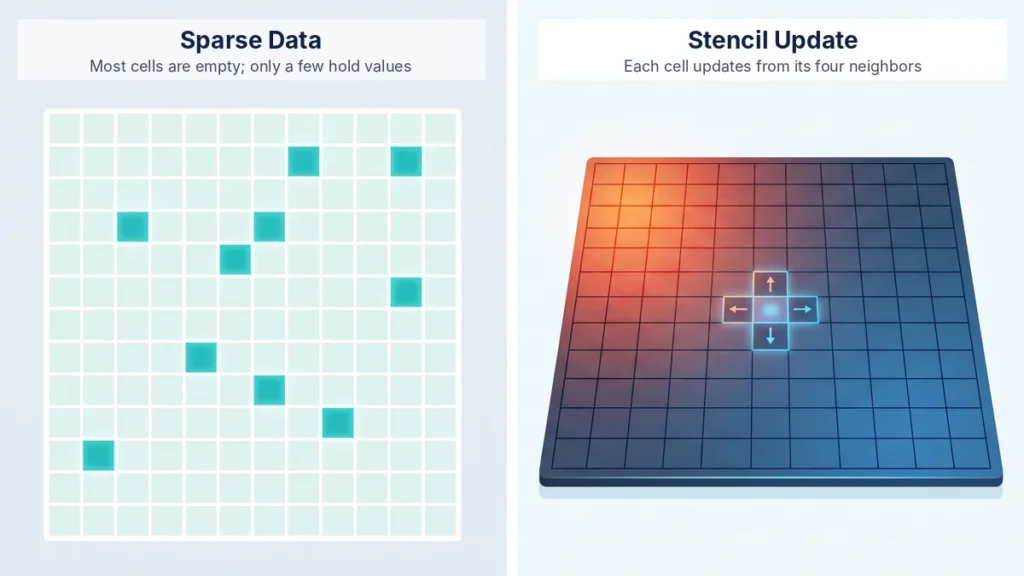
Fig. 2: Sparse Data and Stencils, Simply Explained
What Sparse Data and Stencils Really Mean
Now for sparse data. Say your school keeps a giant chart listing every pair of students. Most pairs never talk, so most boxes read zero. Due to all those zeros, the chart wastes time and memory. That’s why sparse methods keep only the useful numbers and where they sit. The catch? Those numbers end up scattered across memory. Stencils work differently. Think of a metal plate heated at one corner. In order to track the heat, engineers split the plate into a grid. Each cell then updates from the cells around it. Weather models use the same trick for air, wind and moisture. Both patterns need many small trips to memory. As a result, a chip that fetches data faster can finish these jobs sooner. Sounds simple, but it’s surprisingly hard to build.
Why a Simulation GPU Must Move Data Fast
Engineers sometimes call this problem the memory wall. Here’s a kitchen version: fifty busy chefs share one slow pantry runner. Hiring more chefs does nothing if the ingredients arrive late. In fact, extra chefs just make the line longer. No wonder NVIDIA keeps stressing balanced design for this chip. Data movement and compute have to grow together. Beyond that, links between chips matter too. Large simulations often spread across many GPUs at once. After every step, each chip must swap border data with its neighbors. Seventh-generation NVLink acts like a fast hallway between those kitchens. Cooling and power count too, especially when thousands of cores run flat out for days. Our guide to data center cooling solutions covers that side. Bottom line, speed depends on the whole system.
Challenges and Motivation Behind This HPC GPU
Why build a special chip for science at all? Demand from research centers keeps climbing. In June 2026, NVIDIA described supercomputers based on its Vera Rubin platform. Take the case of Blue Lion at the Leibniz Supercomputing Centre in Germany. Doudna at Lawrence Berkeley National Laboratory is on that list too. In addition, Los Alamos National Laboratory plans three new systems of its own. These machines will study the environment, fusion energy, materials and medicine. The June press release examples use the wider platform, not Rubin HPC itself. Even so, they show where the market is heading. Scientists also want AI agents to run many simulations without constant help. That loop only works when each simulation runs quickly. So the motivation is simple: shrink the wait between an idea and an answer.
What NVIDIA Has Not Shared About Rubin HPC Yet
Every big announcement deserves a careful second look. NVIDIA’s post gives no memory size or memory speed for the chip. It also skips the double-precision math rate, a number many scientists watch closely. Power use is missing. So are benchmark results. The company doesn’t say how much sparse data acceleration actually helps. It also leaves out the NVLink speed and any named customers. So far, the record core count is the only hard performance figure we have. On top of that, the chip won’t ship until 2028. After all, a lot can change in two years of chip design. Rival chipmakers will keep improving, too. Until independent tests appear, nobody outside NVIDIA can judge real-world speed. Honestly, that’s normal for early product news. Healthy doubt is simply part of good science.
What an HPC GPU Like Rubin Means for STEM Careers
Chips like this need people who understand both science and computers. Computational scientists turn physics, chemistry or biology into code that runs fast. HPC engineers build and tune the supercomputers themselves. GPU programmers rewrite old programs so thousands of cores can share the load. Chip architects, in particular, decide how cores, memory and links fit together. Meanwhile, AI engineers will build the agents that run simulation loops. Want to join them? To begin with, get comfortable with math, especially algebra, calculus and matrices. Then add programming, ideally Python first and C++ later. Courses in computer science, electrical engineering or applied mathematics all lead here. Physics and mechanical engineering students can enter through simulation work. Even robots now rehearse tasks in virtual training worlds before touching real parts. Clearly, simulation skills open doors almost everywhere.
Rubin HPC shows how chip design is shifting toward science. Until now, AI mostly pushed GPU design forward. Now simulation and AI agents are pulling it in a new direction. NVIDIA promises more than 50,000 cores and a balanced design. If those claims hold up in 2028, forecasts and engineering tests could run faster. New materials and medicines might reach labs sooner as well. Of course, plenty is still unknown, and real tests will decide. Either way, the direction is clear and exciting for young engineers. One day, that weather app on your phone may lean on chips like this. What if the next big discovery comes from an agent running thousands of simulations overnight? Keep an eye on SC27 next year for fresh results. Until then, keep learning and stay curious.
Ernst, D. (2026, November 16). NVIDIA announces Rubin HPC — A new GPU to accelerate agents for science, engineering and analytics. NVIDIA Blog. https://blogs.nvidia.com/blog/rubin-hpc/
The article explains sparse data, stencil updates and data movement in everyday language that new readers can follow. It rightly separates what the company has stated from what still needs independent proof. A short comparison with how earlier supercomputer chips handled the same workloads would give readers more context. Readers who want the complete technical description should turn to the original announcement this story draws on.
Editorial note
We are featuring this announcement because it shows chip design turning toward the simulations that drive weather forecasts, engineering tests and drug research. It gives students a clear reason to learn parallel programming, numerical methods and computer architecture together. The chip is not yet available, and its maker has shared only a few technical details, so its real performance will become clear only after independent testing. For the full details, we invite readers to consult the official announcement this story is based on.
Hrutanshu Kurankar is a Computer Engineering graduate from Marathwada Mitra Mandal’s College of Engineering, Pune. His interests span artificial intelligence, machine learning, cybersecurity, data science, and science communication. He enjoys exploring how emerging technologies work and translating complex technical concepts into clear, accessible explanations for students and young audiences.
His practical experience includes developing FlashCTI, a Retrieval-Augmented Generation (RAG) system for cyber threat intelligence and log analysis, exploring privacy-focused browser extensions, and building machine learning applications. His technical background includes Python, data analysis, machine learning frameworks, web development, vector databases, and cybersecurity tools. Through these projects, he has developed an interest in applying technology to real-world problems and making technical knowledge easier to understand.
Hrutanshu is associated with ENTECH STEM Magazine, where he contributes to science communication and editorial initiatives, including research outreach and activities supporting the Machine Learning Special Issue 2026. His work involves connecting with potential contributors and academic reviewers to encourage participation in STEM research and knowledge sharing. As a science communicator, he aims to bridge the gap between complex scientific ideas and everyday understanding through relatable examples, clear writing, and evidence-based explanations. He is particularly interested in making science and technology engaging and accessible to the next generation of learners.