Explore the impact of deep ocean heat on Antarctica, revealing how it melts ice and influences climate change.
Deep Ocean Heat Closer to Antarctica Study Reveals Warming Shift
Estimated reading time: 6 minutes
Deep ocean heat is quietly advancing toward Antarctica, revealing a hidden force that could reshape the planet’s future. Long-term research shows that this deep ocean heat, once isolated in distant waters, is steadily moving closer to the continent and melting ice from below. As this unseen warmth weakens ice shelves and destabilizes glaciers, it highlights how climate change is not only happening at the surface but also rising from the depths of the ocean.
TL;DR ‘Deep Ocean Heat Closer to Antarctica’
Deep ocean heat has moved closer to Antarctica over the past 20 years, a trend highlighted in April 2026 climate news reports. This warm water, known as circumpolar deep water, is now flowing toward the icy edge of the continent more easily. In contrast, colder surface layers once acted as a barrier, but that natural shield has weakened over time. As a result, the deep ocean heat slips beneath floating ice shelves and melts them steadily from below. In short, this process weakens the frozen barriers that hold back vast inland ice. If this ice were released, it could raise global sea levels by as much as 190 feet, showing how a hidden ocean shift can have massive global impacts.
Key Takeaways
- Deep ocean heat is moving toward Antarctica
- Warm water melts ice from below
- Oceans hold most extra heat on Earth
- Scientists study long-term ocean data
- Climate science links many subjects
Understanding Deep Ocean Heat
Scientists studied ocean layers over time. They tracked temperature at many depths. They used tools called Argo floats. These floats collect global data across oceans. This helps track deep ocean heat Antarctica clearly.
In contrast, warm water stays below colder layers. It moves slowly through ocean currents. In short, this hidden heat travels toward ice shelves. With this in mind, the process is hard to see. Still, data now shows how it works.
Why Heat Stays Below
Density controls how water moves in the ocean. Salt and heat change water weight. In contrast, warm and salty water can sink deeper. This helps move deep ocean heat slowly below.
To put it differently, ocean layers stack like liquids. Each layer has a different weight and temperature. In short, this follows simple physics rules. With this in mind, students can link this idea to basic science lessons.
Ice Melt and Rising Seas: Deep Ocean Heat
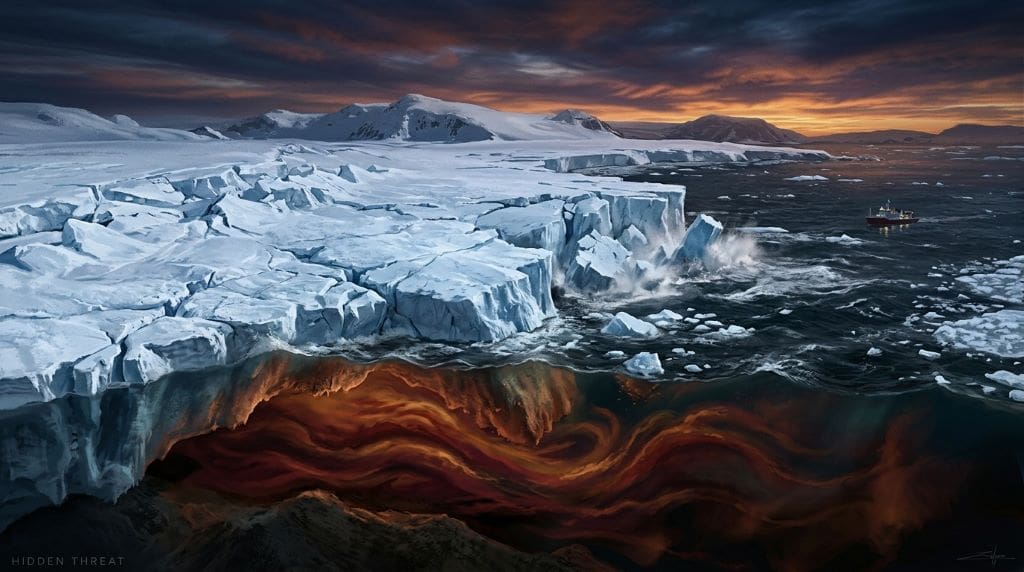
Antarctic ice now faces serious risks. Deep ocean heat moves under the ice. Warm water melts ice from below. In contrast, this weakens the ice base over time. Cracks can grow faster in soft ice. In short, large ice pieces may break away. This adds more water to the ocean. With this in mind, sea levels rise worldwide. Coastal areas face higher flood risk.
Also Read: What is Oceanography?
Real-Life Effect
Deep-ocean heat near Antarctica is pushing warm water closer to the ice shelves that hold back the sea. When that ice melts, rising seas can flood cities and damage homes, roads, and bridges. With that danger in mind, governments use ocean science to plan safety steps before the water reaches shore. Building on that same science, students can learn how real ocean data shapes the decisions that protect millions of people every day.
Tools Used in the Study: Deep Ocean Heat
- Argo floats track ocean movement with global data.
- Satellites monitor ice changes with clear images.
- Long-term records show temperature trends over time.
- Ocean models explain current flow patterns clearly
STEM Learning and Careers
The study came from researchers at the University of Cambridge and Scripps Institution of Oceanography. It shows how ocean science leads to strong careers. In fact, experts like Sarah Purkey and Joshua Lanham study deep ocean heat in Antarctica closely.
In short, their work tracks how heat moves in deep water. With this in mind, students can follow similar paths. They can study oceanography, climate science, or earth science. These fields use real tools and data.
Another key point, scientists use Argo floats and research ships. These tools collect data from remote ocean regions. In general, this work needs curiosity and strong skills. All things considered, ocean science offers exciting future careers.
Careers Linked to This Study
- Oceanographer studies ocean systems and tracks water movement.
- In contrast, a climate scientist studies long-term climate change.
- A data analyst works with data to find clear patterns.
- With this in mind, an environmental engineer solves real-world problems.
- In short, a marine researcher studies ocean life and ecosystems
These jobs use science in real life. In reality, demand for these roles is rising. Students can prepare early.
Why Deep Ocean Heat Matters Globally
In light of this study, climate risks are growing. Antarctica affects the whole Earth. Ice melt changes ocean systems. As a result, weather patterns may shift. This affects farming and water supply. All things considered, this as a global issue.
Science in Daily Life
Science guides real decisions in daily life. In fact, leaders use research for clear climate plans. In contrast, engineers build smart solutions for rising seas. With this in mind, students can shape the future.
Steps Students Can Take
- Learn basic climate science to build strong core knowledge
- In fact, follow new research updates to stay informed
- Practice coding skills for better data understanding
- With this in mind, join science clubs to gain experience
- In short, explore STEM courses online for future growth
These steps build strong skills. At last, learning leads to real impact. Science can shape the future.
Frequently Asked Questions on Deep Ocean Heat Antarctica
What is deep ocean heat?
Deep ocean heat is stored thermal energy in deep ocean water. In short, it stays below the surface for long periods. In contrast, this heat moves slowly through ocean currents. With this in mind, it can travel toward cold regions like Antarctica. In general, this hidden heat affects ice and climate systems. All things considered, it plays a key role in global warming.
Why is Antarctica important?
Antarctica is important for Earth’s climate balance. In short, it stores huge amounts of freshwater ice that control sea levels. In contrast, changes in Antarctica affect global ocean currents. With this in mind, it helps regulate weather patterns worldwide. In general, its ice and oceans support many ecosystems. All things considered, it plays a key role in Earth’s stability.
How do scientists measure ocean heat?
Scientists measure ocean heat using tools like Argo floats and satellites. In short, these tools track temperature data at different depths. In contrast, research ships collect samples from deep water. With this in mind, they give more detailed ocean readings. In general, scientists combine all this data to study heat movement. All things considered, this helps track climate change accurately.
Reference
Monroe, R. (2026, April 24). Deep-ocean heat has been marching closer to Antarctica, reveals new long-term study. Scripps Institution of Oceanography. https://scripps.ucsd.edu/news/deep-ocean-heat-has-been-marching-closer-antarctica-reveals-new-long-term-study
- Author
- Latest Posts

I completed my Master of Science from the University of Allahabad in 2017 with a strong academic background in life sciences and chemistry. My specialization included Molecular Biology, Microbiology, Genetics, Plant Breeding, Phycology, Paleobotany, and Bioinformatics, along with Organic Chemistry, Inorganic Chemistry, and Physical Chemistry. This multidisciplinary training provided me with a comprehensive understanding of biological systems and analytical scientific approaches.
After completing my postgraduate studies, I gained valuable professional experience in both the education and social development sectors. I worked at A.M. Oxford Public School, where I was actively involved in guiding students toward academic excellence. In this role, I focused on creating an engaging learning environment, encouraging critical thinking, and nurturing students’ curiosity for scientific learning. My experience as an educator strengthened my communication, mentoring, and classroom management skills.
In addition to my teaching experience, I worked with Jeevan Jagriti Foundation, where I contributed to community-based initiatives aimed at improving educational access and awareness among underprivileged sections of society. Through this work, I participated in programs designed to support social development and promote the value of education in marginalized communities.
These professional experiences helped me develop strong interpersonal, leadership, and organizational skills while reinforcing my commitment to education and community service.