Tiny particles float high above Earth. These are called aerosols. They play a key role in the aerosol and ozone layer relationship. Over time, they can damage ozone and weaken the shield that protects life.…
Aerosol and Ozone Layer Study: Insights from SABRE

Tiny particles float high above Earth. These are called aerosols. They play a key role in the aerosol and ozone layer relationship. Over time, they can damage ozone and weaken the shield that protects life. In contrast, these same particles can reflect sunlight back into space, which affects how much heat the planet keeps. Because of this dual effect, the process is still not fully clear to scientists. For this reason, NOAA started the SABRE mission to study aerosol and ozone layer interactions. With this goal, scientists use a NASA WB-57 aircraft to fly high into the atmosphere and collect direct measurements. As a result, their research may guide better climate action in the future. In the end, the sky is not just empty space — it is a living laboratory full of answers.
TL;DR ‘Aerosol and Ozone Layer ‘
The SABRE study looks at how tiny particles called aerosols move and change high in the sky. Because of this, it explores the link between aerosol and ozone layer processes. These particles can affect ozone chemistry and the balance of Earth’s climate. On the other hand, aerosols can also change how the ozone layer protects life from harmful rays. For this reason, scientists fly high-altitude aircraft to collect real air samples and get clear results. In the end, this research helps us better understand how the aerosol and ozone layer system shapes our planet.
Key Takeaways
- SABRE studies tiny air particles called aerosols
- It uses high-altitude planes for direct data
- Aerosols affect climate and ozone balance
- The project links school science to real work
- It supports climate research and global action
SABRE Project: Aerosol and Ozone Layer
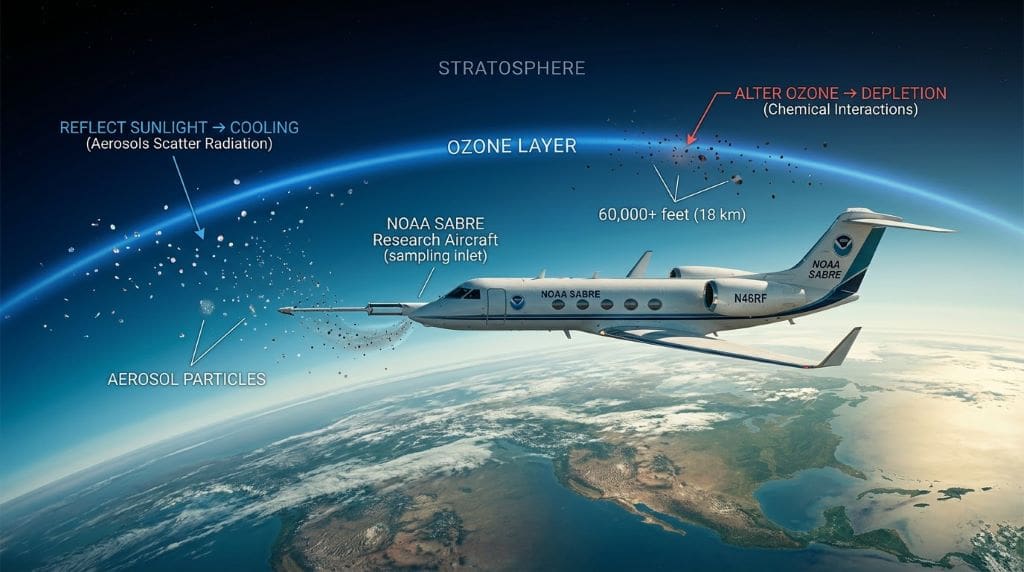
SABRE studies tiny particles in the upper air. These particles are called aerosols. They affect heat and sunlight in simple ways. Because of this, scientists track how aerosols form and change over time. They also study easy chemical reactions in this layer. In contrast, the research explains the link between aerosol and ozone layer systems. It shows how these particles can change ozone behavior and affect climate balance. For this reason, atmospheric science connects closely with climate change here. In the end, the study helps us understand how the aerosol and ozone layer work together to shape our planet.
SABRE uses high-flying planes to study the upper atmosphere. These planes collect air from the stratosphere for testing. Because of this, scientists get fresh and direct data about aerosols and the ozone layer. In contrast, this real data helps them see how the aerosol and ozone layer interact in nature. Students learn about these air layers in school science. For this reason, SABRE connects classroom ideas with real-world science. In the end, it shows how the aerosol and ozone layer work together high above Earth.
Why Aerosols Matter in Ozone Layer Depletion
Aerosols are very small particles in the air. They include dust, smoke, and tiny liquid drops. Because of this, they reflect and absorb sunlight. This changes Earth’s temperature and energy balance. In contrast, the link between aerosol and ozone layer is also important. These particles can affect ozone chemistry and how well it protects life. For this reason, aerosols influence both climate and the ozone layer together. In the end, the aerosol and ozone layer system plays a key role in keeping Earth stable.
To put it differently, aerosols can cool or warm Earth. Their effect depends on their type and size. Because of this, scientists study how these particles behave in the air. In contrast, the link between aerosol and ozone layer is also key to understand. These tiny particles can change ozone chemistry and affect how well it protects life. With this in mind, climate balance depends strongly on aerosols and the ozone layer together. In the end, the aerosol and ozone layer system helps shape Earth’s climate.
Key Areas SABRE Studies
To list the main focus areas:
- Aerosol formation
- Chemical reactions in air
- Sunlight and particle interaction
- Effects on ozone and climate
Tools and Technology Used
SABRE uses simple but strong tools. These include sensors and air collectors. Planes carry these tools high into the sky. Because of this, scientists gather real samples from the upper air. They study these samples in labs later. In contrast, these tools help explain the link between aerosol and ozone layer systems. They show how particles affect ozone chemistry and air quality. At any rate, this method gives clear and easy results. It also helps improve climate models. For this reason, students can relate to the tools used in labs. In the end, modern tools make the study of aerosol and ozone layer clear and useful.
Real-Life Applications of SABRE
SABRE helps improve climate predictions. It supports pollution control plans. It also helps protect the ozone layer. Governments use this data for action. In addition, the aerosol impact on ozone layer helps scientists understand how particles change ozone health and climate balance. In fact, good data leads to good decisions. Scientists can predict climate trends better. This helps reduce risks. Science research supports global safety here. Students can explore careers in this field. It includes research, lab work, and analysis roles.
Career Paths Linked to SABRE
Here are some career options:
- Atmospheric scientist
- Climate researcher
- Environmental analyst
- Aerospace engineer
Each job uses school science. Each job solves real problems.
How SABRE Connects to Your Studies
Students learn about energy and reactions in class. SABRE uses these ideas in real work. It studies how light reacts with particles. Because of this, it tracks simple chemical changes in the air. In contrast, the study explains the link between aerosol and ozone layer systems. It shows how particles can change ozone behavior and air chemistry. With this in mind, SABRE connects physics and chemistry. It also links to environmental science topics. For this reason, students can see how theory works in real life. In the end, school science becomes real science through the study of aerosol and ozone layer processes.
Key Areas SABRE Studies
- Aerosol formation
- Chemical reactions in air
- Sunlight and particle interaction
- Effects on ozone and climate
These skills help in many science jobs. They also build strong thinking skills.
Frequently Asked Questions
What does SABRE study?
SABRE studies tiny particles called aerosols in the upper atmosphere. In simple terms, it looks at how these particles interact with sunlight and change climate conditions. In addition, it examines how aerosols influence air chemistry and atmospheric balance. Additionally, it studies the aerosol impact on ozone layer, showing how aerosols can change ozone health and Earth’s protection system.
Why are aerosols important?
Aerosols are important because they affect climate and air quality. In contrast, they can reflect or absorb sunlight, which changes Earth’s temperature. With this in mind, they also play a role in atmospheric chemistry and help scientists understand changes in the environment.
What specific data does SABRE collect?
In simple terms, SABRE in situ measurements describe stratospheric aerosol size, composition, and light properties. They also show how these particles vary across space and time. In addition, the project helps estimate the sulfur budget of the background stratospheric aerosol layer.
Does SABRE study the impact of aerosols on ozone?
SABRE also studies how changes in stratospheric aerosols affect ozone chemistry and atmospheric motion. In simple terms, it looks at how these tiny particles influence ozone levels in the stratosphere. In addition, it examines how they can alter the movement and behavior of the upper atmosphere.
Reference
Laboratory, N. C. S. (n.d.). Projects: SABRE. https://csl.noaa.gov/projects/sabre/
.
- Author
- Latest Posts

I completed my Master of Science from the University of Allahabad in 2017 with a strong academic background in life sciences and chemistry. My specialization included Molecular Biology, Microbiology, Genetics, Plant Breeding, Phycology, Paleobotany, and Bioinformatics, along with Organic Chemistry, Inorganic Chemistry, and Physical Chemistry. This multidisciplinary training provided me with a comprehensive understanding of biological systems and analytical scientific approaches.
After completing my postgraduate studies, I gained valuable professional experience in both the education and social development sectors. I worked at A.M. Oxford Public School, where I was actively involved in guiding students toward academic excellence. In this role, I focused on creating an engaging learning environment, encouraging critical thinking, and nurturing students’ curiosity for scientific learning. My experience as an educator strengthened my communication, mentoring, and classroom management skills.
In addition to my teaching experience, I worked with Jeevan Jagriti Foundation, where I contributed to community-based initiatives aimed at improving educational access and awareness among underprivileged sections of society. Through this work, I participated in programs designed to support social development and promote the value of education in marginalized communities.
These professional experiences helped me develop strong interpersonal, leadership, and organizational skills while reinforcing my commitment to education and community service.