Explore the Fossil fuel phase-out at the historic summit in Colombia with leaders and scientists discussing energy transition.
Santa Marta: A Historic Turning Point for Fossil Fuel Phase-Out
Estimated reading time: 8 minutes
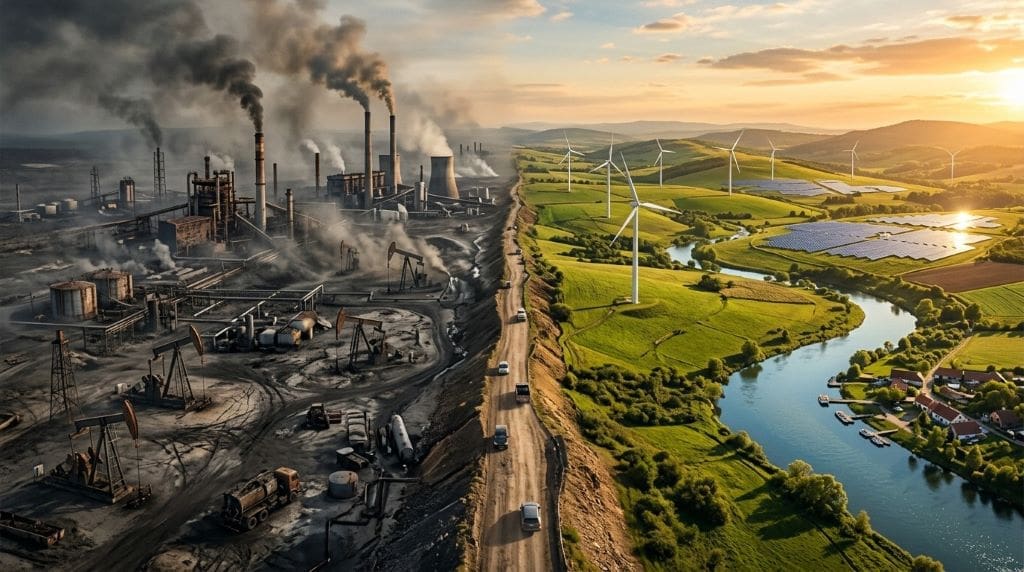
In late April 2026, the world witnessed a key moment on Fossil fuel phase-out. Generally, fifty-seven countries gathered in Santa Marta, Colombia to discuss moving away from coal, oil, and gas. In fact, leaders, scientists, Indigenous peoples, and young voices shared ideas in open discussions. In simple terms, they explored practical ways to reduce dependence on fossil fuels without delay or conflict. Especially, this became the first global summit focused on “transitioning away” from fossil fuels. In the end, it also showed how global energy change is becoming an important part of science learning for higher-class students..
TL;DR ‘Fossil fuel phase-out’
The Carbon Brief report explains that 57 countries met in Santa Marta, Colombia to plan a practical Fossil fuel phase-out. In general, they agreed to create national roadmaps for reducing coal, oil, and gas use while supporting clean energy systems. As a matter of fact, scientists, governments, Indigenous groups, and young people worked together on a shared energy transition. In simple terms, they focused on clear steps to move away from fossil fuels and build a cleaner future.
Key Takeaways at a Glance
Before we dig deeper, here are the highlights from Santa Marta:
- 57 countries joined the first conference on transitioning away from fossil fuels in Santa Marta, Colombia from April 24–29, 2026
- These countries represent about one-third of the world’s economy.
- Colombia and the Netherlands co-hosted the summit.
- Around 400 global academicians attended a science pre-conference.
- Tuvalu and Ireland will co-host the second summit in 2027 in the Pacific island nation.What is fossil fuel phase out its significance
What is Fossil Fuel Phase-Out ?
Fossil fuel phase-out means slowly reducing and finally stopping the use of coal, oil, and gas for energy. Consequently , we can cut harmful emissions that cause climate change. As a result, cleaner sources like solar and wind improve air quality and protect nature. In the long run, it supports a healthier life and a more sustainable future for all.
What Actually Happened in Santa Marta?
A New Kind of Climate Meeting
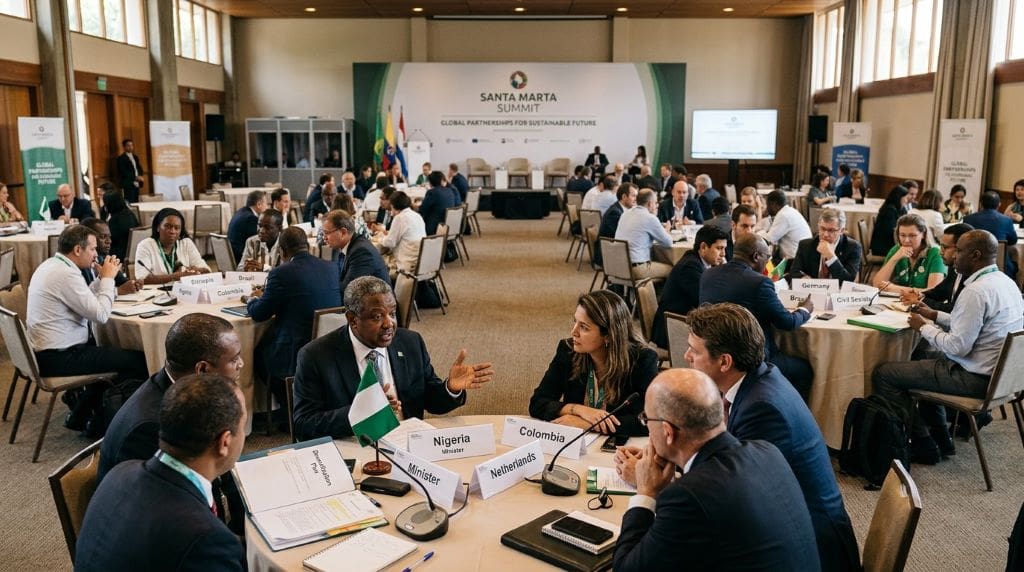
Before this summit, global climate talks often stalled around the Fossil fuel phase-out. In general, countries spent days arguing, and progress moved slowly. In contrast, Santa Marta used a different approach designed by co-hosts Colombia and the Netherlands. Actually, attending countries called the new format “refreshing,” “highly successful,” and “groundbreaking.” In simple terms, the summit improved dialogue and helped nations discuss climate action in a more direct and effective way.
The high-level segment was not a space for negotiations, but rather a forum for countries and other stakeholders to discuss practical steps to move away from fossil fuels. Ministers sat in small circles. They spoke from their hearts, not their scripts. That small shift changed everything.
Nigeria’s minister told the plenary that Nigeria is actively diversifying its economy away from extracting oil, which accounts for around 80% of its exports, and strongly believes the question is not whether extraction should decline, but how to organize it so it is manageable, fair and politically viable.
Three Big Workstreams Launched
Countries design national roadmaps for a Fossil fuel phase-out and connect them with their climate plans. In general, they set clear goals to reduce coal, oil, and gas use. In addition, governments reform financial systems to end fossil fuel subsidies. They also aim to reduce debt traps that harm poorer nations. In simple terms, countries support fossil-fuel-free trade systems with help from OECD nations, which include many wealthy economies. Countries are not obligated to produce a new fossil-fuel roadmap, and participation in all workstreams is voluntary. Still, the momentum is real.
Where Your Science Subjects Come In
Physics Powers the Clean Energy Future
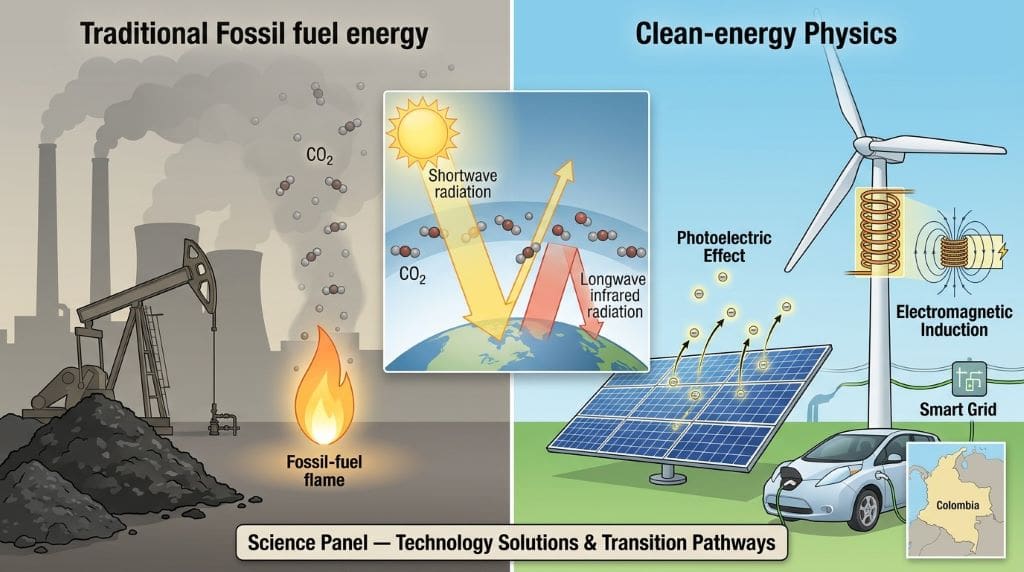
Most of the world still depends on burning coal, oil, and gas during the Fossil fuel phase-out debate. In general, burning releases energy, which matches basic thermodynamics from Grade 11 physics. Actually, this process also releases carbon dioxide into the air. In simple terms, CO₂ traps heat in the atmosphere. In essence, this leads to the greenhouse effect, a key physics concept that explains how Earth warms..
As a result, the world needs new energy sources that don’t burn carbon. Solar panels use the photoelectric effect to turn sunlight into electricity. Wind turbines use electromagnetic induction. Both are topics covered in your physics textbook. What’s more, the science panel launched at Santa Marta will specifically focus on “technology solutions” and “transition pathways” — and physicists are central to both.
To illustrate, consider this: Colombia’s national fossil fuel roadmap, led by Professor Piers Forster of the University of Leeds, found that Colombia could cut its energy-related emissions to 90% below 2015 levels by 2050 through ambitious policies to move away from fossil fuels and electrify its transport sector. That electrification needs engineers and physicists to design it. You could be one of them.
Chemistry Is at the Heart of the Transition

While it may be true that politics drives summits, science drives solutions. During the Fossil fuel phase-out discussion, Colombian environment minister Irene Vélez Torres highlighted a growing gap between science and government action. In general, she explained that economic and political lobbying often pushes science aside. Actually, she warned that this weakens decision-making on climate issues. In simple terms, she called for stronger science-based policies. In essence, she urged governments to rely more on scientific evidence when making environmental decisions.
That’s where chemistry students come in. Green hydrogen, biofuels, carbon capture — all of these are chemical engineering solutions. They reduce greenhouse gases in the atmosphere. They replace fossil fuels at a molecular level. The 400 scientists at the Santa Marta pre-conference debated exactly these topics, including the role of methane and the chemistry of cleaner energy sources.
The scientists at the pre-conference split into 11 different workstreams to debate topics ranging from fossil-fuel phase out policies and the role of methane to just transitions and economic diversity. Many of those workstreams relied heavily on chemistry and materials science.
To put it differently, the molecules you study in the lab today — CO₂, CH₄, H₂ — are the molecules at the centre of the world’s biggest challenge.
A New Science Panel That Needs Young Scientists
The Science Panel for Global Energy Transition
All things considered, one of the most exciting outcomes from Santa Marta about Fossil Fuel Phase-Out was the launch of a brand-new science body. The “science panel for global energy transition” was launched by Dr. Johan Rockström, director of the Potsdam Institute for Climate Impact Research, and Dr. Carlos Nobre from the University of São Paulo.
The panel will involve 50 to 100 scientists and will be split into four working groups focusing on transition pathways, technology solutions, policy design and evaluation, and finance instruments.
In contrast to the long-cycle IPCC reports, this panel aims to produce annual updates and provide analysis scaled down to the national level, giving governments faster, more actionable science. That’s a new kind of career path for young scientists — not just doing research in a lab, but advising governments on real energy decisions.
The Action Insights Report
After that, the summit also released a major scientific report on fossil fuel phase-out. A synthesis report offering 12 action insights for how countries can transition away from fossil fuels was produced by an ad-hoc group of 24 scientists at the request of the Colombian government, then further refined by the 400 academics gathered at the pre-conference.
The report contains explicit action recommendations for countries, such as halting all new fossil-fuel expansion and prohibiting fossil fuel advertising, recognising fossil fuels as health-harming products.
Sooner or later, someone has to put the science behind these recommendations. That someone could be a student reading this article right now.
Colombia’s Own Roadmap — A Model for All Nations
To illustrate further, Colombia didn’t just talk. It acted. The roadmap for Colombia, led by Professor Piers Forster, showed that by the 2040s, Colombia could see net economy-wide savings from transitioning away from fossil fuels, potentially reaching $23 billion annually by 2050.
Forster said that the biggest issues facing countries are economic and linked to the cost of living, so putting economic value on the transition was a key part of the work. This is where mathematics and data science also play a huge role — building economic models of the energy transition is a real STEM career.
Frequently Asked Questions
What is the Santa Marta summit?
It was the world’s first conference dedicated to transitioning away from fossil fuels. It was held in Colombia in April 2026 describing about fossil fuel phase-out. Fifty-seven countries attended and discussed roadmaps away from coal, oil, and gas.
What are NDCs?
NDC stands for Nationally Determined Contribution. It is a climate plan each country submits under the Paris Agreement. The Santa Marta roadmaps will be connected to these national plans.
What is the Santa Marta Action Repertoire?
It is a large list of over 400 policy ideas and research findings. This database acts as a guide for nations to help them change their energy systems and keep their economies strong.
Why did the meeting take place in Colombia?
Colombia is a major coal exporter, making it a symbolic place to talk about change. The country is trying to show how a nation can move from selling coal to using green power.
References:
- Forster, P., et al. (2026). Colombia’s fossil-fuel transition roadmap. University of Leeds, Priestley Centre for Climate Futures. https://eprints.whiterose.ac.uk/id/eprint/240400/
- Dunne, D. (2026, April 30). Santa Marta: Key outcomes from first summit on ‘transitioning away’ from fossil fuels. Carbon Brief. https://www.carbonbrief.org/santa-marta-key-outcomes-from-first-summit-on-transitioning-away-from-fossil-fuels/
- Author
- Latest Posts

I completed my Master of Science from the University of Allahabad in 2017 with a strong academic background in life sciences and chemistry. My specialization included Molecular Biology, Microbiology, Genetics, Plant Breeding, Phycology, Paleobotany, and Bioinformatics, along with Organic Chemistry, Inorganic Chemistry, and Physical Chemistry. This multidisciplinary training provided me with a comprehensive understanding of biological systems and analytical scientific approaches.
After completing my postgraduate studies, I gained valuable professional experience in both the education and social development sectors. I worked at A.M. Oxford Public School, where I was actively involved in guiding students toward academic excellence. In this role, I focused on creating an engaging learning environment, encouraging critical thinking, and nurturing students’ curiosity for scientific learning. My experience as an educator strengthened my communication, mentoring, and classroom management skills.
In addition to my teaching experience, I worked with Jeevan Jagriti Foundation, where I contributed to community-based initiatives aimed at improving educational access and awareness among underprivileged sections of society. Through this work, I participated in programs designed to support social development and promote the value of education in marginalized communities.
These professional experiences helped me develop strong interpersonal, leadership, and organizational skills while reinforcing my commitment to education and community service.