Diterpenoid Alkaloid Biosynthesis Breakthrough Enables Future Metabolic Engineering
Diterpenoid Alkaloid Biosynthesis Discovery Reveals Key Entry Enzymes

Estimated reading time: 6 minutes
Diterpenoid alkaloid biosynthesis is a complex process that produces complex natural chemicals found in plants. Scientists want to make them for medical use, but their structure is very difficult to build. A new study examined the initial steps in how plants make these chemicals. They discovered the key starting materials and the enzymes that build them. This work helps us understand how nature creates these complex molecules. It also gives scientists a way to make them in a lab for future drugs.
Key Takeaways
Scientists identified the first key steps in the biosynthesis of diterpenoid alkaloids in plants. They identified the exact starting molecules for this process. They also discovered the specific enzymes that build these molecules step by step. This work reveals how nature creates these complex compounds. It also gives researchers a clear path to produce these chemicals in a lab for future medicines.
Biological Importance of Alkaloids in Plants
Diterpenoid alkaloids help plants survive. These natural chemicals act as a strong defense system. They stop insects and animals from eating the plant. They also fight off harmful germs and fungi. By understanding the first steps of how plants make these alkaloids, scientists see how plants protect themselves. This knowledge helps us appreciate how plants stay healthy in the wild. It also shows why these compounds are valuable for future medical use.
Chemical Structure and Diversity
Diterpenoid alkaloids have a very complex chemical structure. They are formed from a basic building block called a diterpene. This starting molecule then changes through many small steps during diterpenoid alkaloid biosynthesis. Each step adds new atoms or changes the shape of the molecule. This process creates many different types of alkaloids. Some have one ring, while others have several rings fused. Some contain nitrogen, which makes them more potent. This wide variety of structures helps explain why these compounds have so many different functions in nature.
Comparative Transcriptomics for Diterpenoid Alkaloid Biosynthesis Gene Discovery
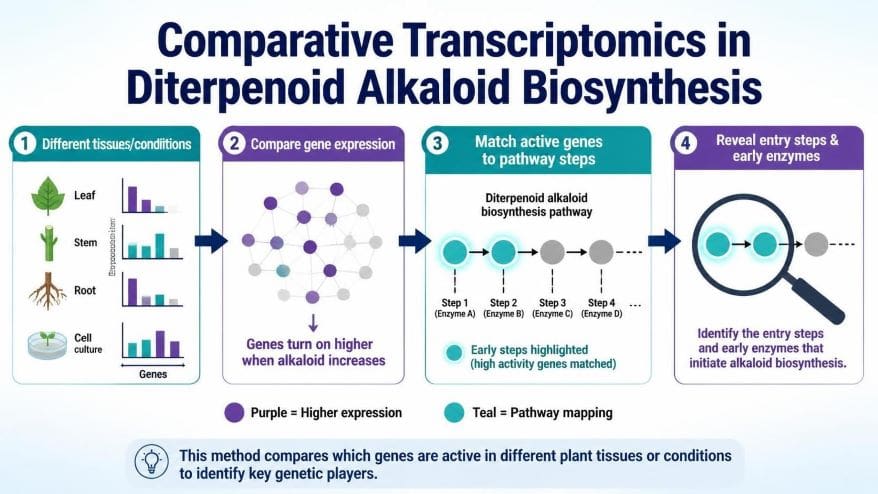
Scientists use comparative transcriptomics to identify genes involved in diterpenoid alkaloid biosynthesis. This method compares which genes are active in different plant tissues or conditions. When a plant makes more diterpenoid alkaloid, certain genes turn on at higher levels. Researchers then match those active genes to the steps in diterpenoid alkaloid biosynthesis. This approach revealed the entry steps in the pathway. It also helped scientists discover the early enzymes that build these complex molecules. By comparing gene activity across many plant samples, researchers can quickly identify the key genetic players involved in diterpenoid alkaloid biosynthesis.
Metabolomics Tools for Pathway Elucidation
Metabolomics tools help scientists map out diterpenoid alkaloid biosynthesis. These tools measure all the small molecules inside a plant at once. By examining these molecules, researchers can see which appear first in the pathway. They can also track how these molecules change over time. This reveals the steps of entry into diterpenoid alkaloid biosynthesis. Scientists then link each molecule to a specific enzyme. This method shows the exact order of chemical reactions. It also helps identify unknown intermediates in the pathway. Using metabolomics, researchers can quickly discover how plants stepwise build diterpenoid alkaloid compounds. This makes pathway elucidation faster and more accurate.
Engineering Heterologous Hosts for Diterpenoid Alkaloid Production
Scientists now engineer simple hosts to make diterpenoid alkaloid compounds. They take key genes from plants and insert them into microbes such as yeast or bacteria. These microbes then act as tiny factories. The entry steps in diterpenoid alkaloid biosynthesis are the most important part. Scientists first add the genes for these early steps to the host. This lets the host build the starting molecules. Then researchers add more genes to complete the pathway. This method avoids the hard work of growing whole plants. It also speeds up production. By using heterologous hosts, scientists can produce diterpenoid alkaloids more quickly and in greater amounts. This opens the door for future medicines.
Applications of Diterpenoid Alkaloid Biosynthesis
Understanding diterpenoid alkaloid biosynthesis could enable many real-world applications. With knowledge of the entry steps, scientists can now produce these compounds in the lab. This allows them to make medicines for pain, heart conditions, and inflammation. Researchers can also engineer plants to produce more diterpenoid alkaloids for natural pest control. This reduces the need for chemical pesticides. The same knowledge helps farmers breed stronger crops that resist insects and diseases. In drug discovery, scientists use the pathway to create new versions of diterpenoid alkaloid compounds with better effects. These steps, from the characterization of the entry steps in diterpenoid alkaloid biosynthesis, now drive innovations in medicine, agriculture, and biotechnology.
Challenges in Reconstructing Diterpenoid Alkaloid Biosynthetic Pathways
Reconstructing diterpenoid alkaloid biosynthetic pathways is not straightforward. Even after scientists characterize the entry steps, many problems remain. The pathway has many complex steps that work in a strict order. Some enzymes work only within specific plant cells and fail in simple hosts like yeast. Other steps produce unstable molecules that break down quickly. Scientists also struggle to identify all the genes involved. Many pathway genes are present at low levels or only turn on at specific times. These challenges arise from the difficulty of characterizing the entry steps in diterpenoid alkaloid biosynthesis. While the entry steps are now clear, fully rebuilding the whole diterpenoid alkaloid pathway still requires more work. Each new step brings new hurdles for researchers to solve.
Future Directions in Diterpenoid Alkaloid Biosynthesis Research
Future research on diterpenoid alkaloid biosynthesis will build on the entry steps. Scientists now plan to find all the remaining genes in the pathway. They will use advanced tools, such as machine learning, to predict new enzymes. Researchers also want to engineer custom pathways that make new diterpenoid alkaloid compounds not found in nature. Another goal is to increase production in microbial hosts for large-scale manufacturing. Scientists will also study how plants control when and where they make these compounds. This knowledge from characterizing the entry steps in diterpenoid alkaloid biosynthesis creates many new opportunities. The future of diterpenoid alkaloid research is promising. It promises new medicines, better crops, and more profound insights into how nature builds complex molecules.
Frequently Asked Questions
What are diterpenoid alkaloids, and why are they important?
Diterpenoid alkaloid compounds come from plants. They combine terpenoid and alkaloid features. You mainly observe these special molecules in Aconitum and Delphinium plants. These diterpenoid alkaloid substances have many uses. They show a wide range of biological and medicinal activities. This versatility makes them very valuable for science and medicine.
How were the biosynthetic enzymes identified?
This study employed several methods to identify the genes and enzymes involved in the entry steps of diterpenoid alkaloid biosynthesis. Scientists used comparative transcriptomics to compare gene activity in different plant tissues. They also used co-expression analysis to identify co-expressed genes. Isotope labeling experiments helped track how atoms move during the process. Metabolomics tools measured all the small molecules in the plant.
Why is ethanolamine significant in diterpenoid alkaloid biosynthesis?
The researchers found that ethanolamine, rather than ethylamine, is the preferred nitrogen source incorporated into the diterpenoid scaffold by a key reductase enzyme, challenging previous assumptions about alkaloid formation.
Reference
Miller, G. P., Mutabdžija-Nedelcheva, L., Andersen, T. B., Pascoe, I., Van Winkle, K., Sabbaghan, M., Bouillé, A., Iliaš, T., Tekel, A., Pluskal, T., & Hamberger, B. (2026). Characterization of the entry steps in diterpenoid alkaloid biosynthesis. Molecular Plant. Advance online publication. https://doi.org/10.1016/j.molp.2026.05.022
This article was written by Rakshanda Jabbar and reviewed for editorial accuracy by our editorial team. It has not yet undergone independent review by a professional.
- Author
- Latest Posts

I completed my Master of Science from the University of Allahabad in 2017 with a strong academic background in life sciences and chemistry. My specialization included Molecular Biology, Microbiology, Genetics, Plant Breeding, Phycology, Paleobotany, and Bioinformatics, along with Organic Chemistry, Inorganic Chemistry, and Physical Chemistry. This multidisciplinary training provided me with a comprehensive understanding of biological systems and analytical scientific approaches.
After completing my postgraduate studies, I gained valuable professional experience in both the education and social development sectors. I worked at A.M. Oxford Public School, where I was actively involved in guiding students toward academic excellence. In this role, I focused on creating an engaging learning environment, encouraging critical thinking, and nurturing students’ curiosity for scientific learning. My experience as an educator strengthened my communication, mentoring, and classroom management skills.
In addition to my teaching experience, I worked with Jeevan Jagriti Foundation, where I contributed to community-based initiatives aimed at improving educational access and awareness among underprivileged sections of society. Through this work, I participated in programs designed to support social development and promote the value of education in marginalized communities.
These professional experiences helped me develop strong interpersonal, leadership, and organizational skills while reinforcing my commitment to education and community service.