Researchers estimated a 90% probability of breaking records. This calculation covered July 2023 to June 2024.
El Niño 2024: Why Scientists Say 90% Chance of Record-Breaking Heat Could Change Everything!
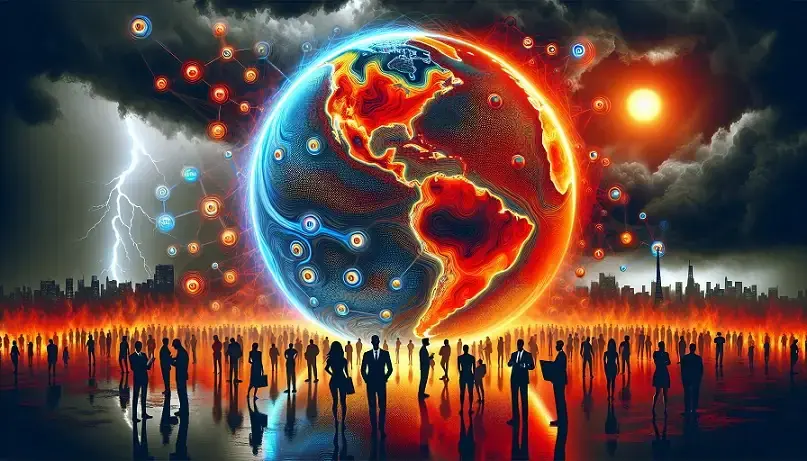
The El Niño 2024 event posed a 90% chance of breaking global temperature records. Researchers found that ENSO (El Niño-Southern Oscillation) drives nearly 44% of year-to-year temperature variability. Vulnerable regions included the Bay of Bengal, South China Sea, Caribbean, Alaska, and Amazon basin. These areas faced heightened risks of marine heatwaves, wildfires, and permafrost melting. The study used a simple four-factor model incorporating CO₂ levels, El Niño strength, volcanic aerosols, and climate persistence. Scientists emphasized that understanding El Niño patterns is crucial for predicting extreme weather and implementing mitigation strategies worldwide.
Key Takeaways
- Physics, math, and geography are essential subjects for this field.
- El Niño 2023-24 had a 90% chance of breaking global temperature records.
- Regions like Alaska, Amazon, and Asian seas faced extreme heat risks.
- Marine heatwaves increased dramatically during this El Niño event.
- Climate science careers are growing rapidly worldwide
What is El Niño and Why Does it Matter?
El Niño is a climate pattern in the Pacific Ocean. It occurs when ocean surface temperatures rise significantly. This warming affects weather patterns globally. As a result, many regions experience unusual heat.
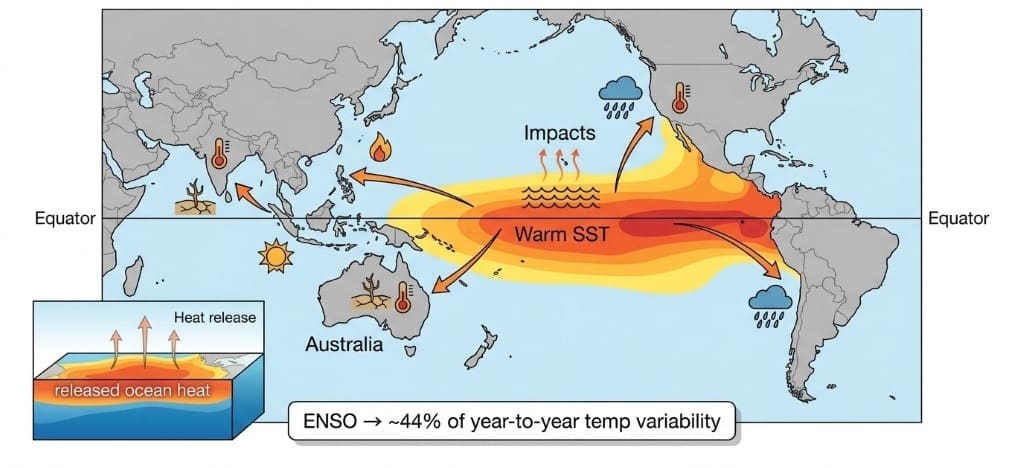
According to Jiang et al. (2024), ENSO (El Niño-Southern Oscillation) drives 43.7% of year-to-year temperature changes. This makes it the strongest natural climate influencer. All things considered, understanding El Niño helps us predict extreme weather.
Record-Breaking Temperatures: The Numbers
The 2023-24 El Niño pushed global temperatures higher. Researchers estimated a 90% probability of breaking records. This calculation covered July 2023 to June 2024.
Temperature Projections by El Niño Strength
| El Niño Scenario | Temperature Anomaly Range (°C) |
|---|---|
| Moderate | 1.028 to 1.097 |
| Strong | 1.064 to 1.195 |
Source: Jiang et al., 2024
At this point, the data shows clear trends. Stronger El Niño events cause higher temperature spikes. With this in mind, climate monitoring becomes crucial.
Regions at High Risk During El Niño 2024
Certain areas faced greater dangers than others. To enumerate, here are the most affected regions:
Most Vulnerable Areas
- Bay of Bengal and South China Sea – Year-round marine heatwaves threatened marine ecosystems
- Alaska – Permafrost melting accelerated due to rising temperatures
- Amazon Basin – Wildfire risks increased dramatically
- Caribbean Sea – Coral reefs faced severe heat stress
In like manner, these regions share coastal characteristics. Ocean persistence keeps temperatures elevated longer. For the most part, maritime areas warm more than inland regions.
Marine Heatwave Impact
Marine heatwaves are periods of extremely warm ocean water. They last at least five consecutive days. These events damage coral reefs and fish populations. In effect, entire ecosystems can collapse.
Why Climate Science Matters for Your Future
Climate change is the defining challenge of our time. At the same time, it creates exciting career opportunities. Scientists, engineers, and data analysts are needed worldwide.
Career Paths in Climate Science
- Climate Scientist – Studies weather patterns and predictions
- Environmental Engineer – Designs solutions for climate challenges
- Data Analyst – Processes climate model outputs
- Oceanographer – Studies ocean temperature changes
- Meteorologist – Forecasts weather and climate events
By and large, these careers offer meaningful work. You can help solve real global problems. In this case, your education directly impacts humanity’s future.
Core Subjects to Study in High School
To pursue climate science careers, focus on these subjects:
| Subject | Why It Matters |
|---|---|
| Physics | Understanding energy transfer and thermodynamics |
| Mathematics | Building and solving climate models |
| Chemistry | Studying greenhouse gases and reactions |
| Geography | Learning about regional climate patterns |
| Computer Science | Programming climate simulations |
| Biology | Understanding ecosystem impacts |
In similar fashion, statistics skills are highly valuable. Climate scientists use probability calculations constantly. The research paper itself used regression models extensively.
The Science Behind Temperature Predictions
Scientists use mathematical models to predict temperatures. The model in this study was elegantly simple. It used only four main factors:
- Carbon dioxide levels (greenhouse gases)
- ENSO index (El Niño strength)
- Volcanic aerosols (cooling effect)
- Climate damping rate (system memory)
To put it differently, these factors explain most temperature changes. The model achieved 68.4% explained variance. In short, simple physics can predict complex outcomes.
How Climate Memory Works
Climate persistence means current conditions affect future weather. Oceans have stronger memory than land areas. This happens because water holds heat longer.
So that students understand: imagine a hot bath. It stays warm for hours after filling. The ocean works similarly but on massive scales.
What El Niño 2024 Means for You
El Niño 2024 demonstrated climate science’s importance. Above all, we need more trained professionals. Young people today can become tomorrow’s climate heroes.
The research by Jiang et al. (2024) shows prediction is possible. With attention to good data, scientists can warn communities. To that end, education in STEM fields becomes essential.
This article was first published on March 2, 2024. Revised on April 22, 2026.
References
Jiang, N., Zhu, C., Hu, Z., McPhaden, M. J., Chen, D., Liu, B., Ma, S., Yan, Y., Zhou, T., Qian, W., Luo, J., Yang, X., Liu, F., & Zhu, Y. (2024). Enhanced risk of record-breaking regional temperatures during the 2023–24 El Niño. Scientific Reports, 14, 2521. https://doi.org/10.1038/s41598-024-52846-2
- Author
- Latest Posts

Charudatta Pathak was a student at St. Aloysius High School in Bhusawal, established in 1874, making it one of India’s oldest convent institutions. He earned his bachelor’s degree in mechanical engineering from SSVPS College of Engineering, Dhule in 1995, demonstrating exceptional academic achievement. Thereafter, he launched his career as a CNC programmer in a toolroom. He has utilized FANUC, Deckel, Maho, and Mikron controllers to operate 2-axis and 3-axis machines for the fabrication of jigs, fixtures, dies, and molds. He commenced his career as an academic in 1996, when he assumed the role of lecturer at SSVPS College of Engineering, Dhule. Additionally, he earned his post-graduate degree in CAD/CAM from L. D. College of Engineering, Ahmedabad, in 2000, and then acquired a Ph.D. from COEP in 2011 while concurrently engaged in teaching. Until 2023, he occupied many academic roles, including lecturer, assistant professor, professor, dean, principal, director, and vice chancellor at both public and private universities throughout India. From 2008 to 2010, he served as the project lead in the CAE department of a European multinational firm. During his 28-year professional tenure, he identified a need for dependable books targeted at students in grades 8 to 12, particularly for nascent career planning. He founded ENTECH Digital Magazine, a free monthly publication available on entechonline.com and magzter.com. Teens with a strong interest in Science, Technology, Engineering, and Mathematics (STEM) who aspire to pursue careers in these fields may find ENTECH Digital Magazine beneficial.


